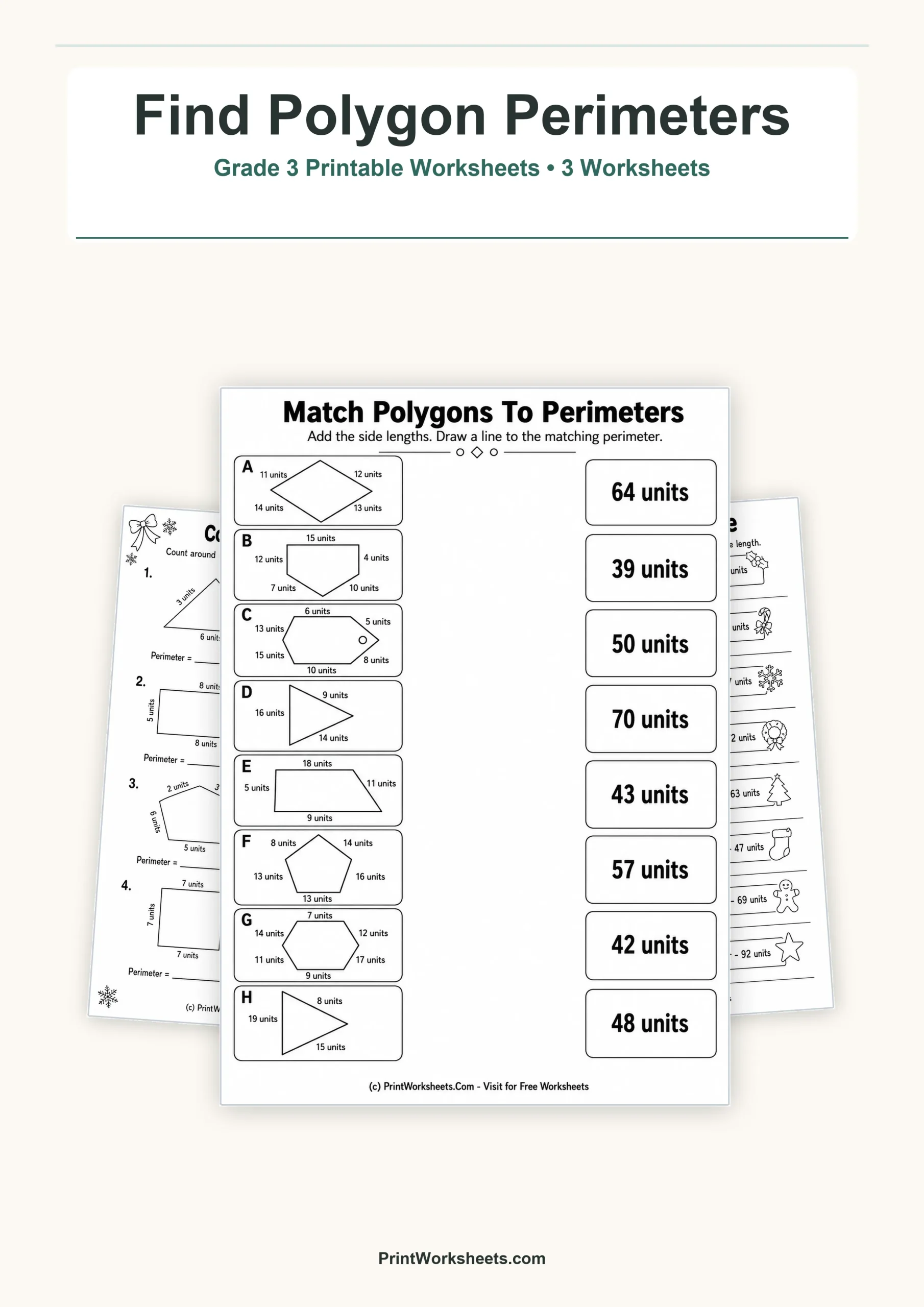
Perimeter of polygons worksheets give Grade 3 students a focused way to practice finding the distance around a shape by adding side lengths. This printable set uses three different task formats so students do more than repeat the same calculation. They first find complete perimeters from labeled polygons, then match polygons to perimeter values, and finally work backward from a known perimeter to determine a missing side. The progression keeps the skill consistent while changing the thinking students must use.
Perimeter of polygons worksheets: add every side
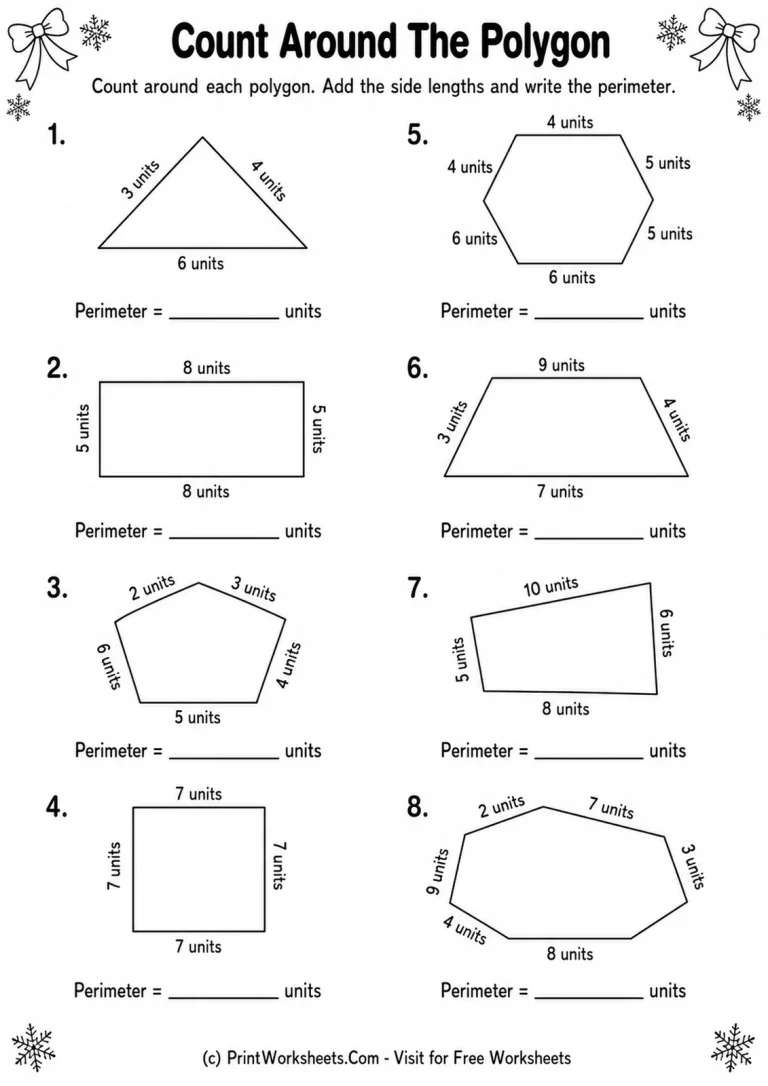
The first worksheet, Count Around The Polygon, asks students to add the labeled side lengths of eight different polygons and write each perimeter in units. The page includes familiar shapes such as a triangle, rectangle, square, trapezoid, pentagon, and multi-sided polygons. The side lengths are printed directly beside each edge, so the mathematical job is clear: count all the way around without skipping a side. Examples include a triangle with sides of 3, 4, and 6 units, a rectangle with side lengths of 8 and 5 units, and a six-sided figure with different values around its boundary. This page works well for direct perimeter practice because students can concentrate on addition and on recognizing that every outer side contributes to the total.
Match polygons to their perimeter totals
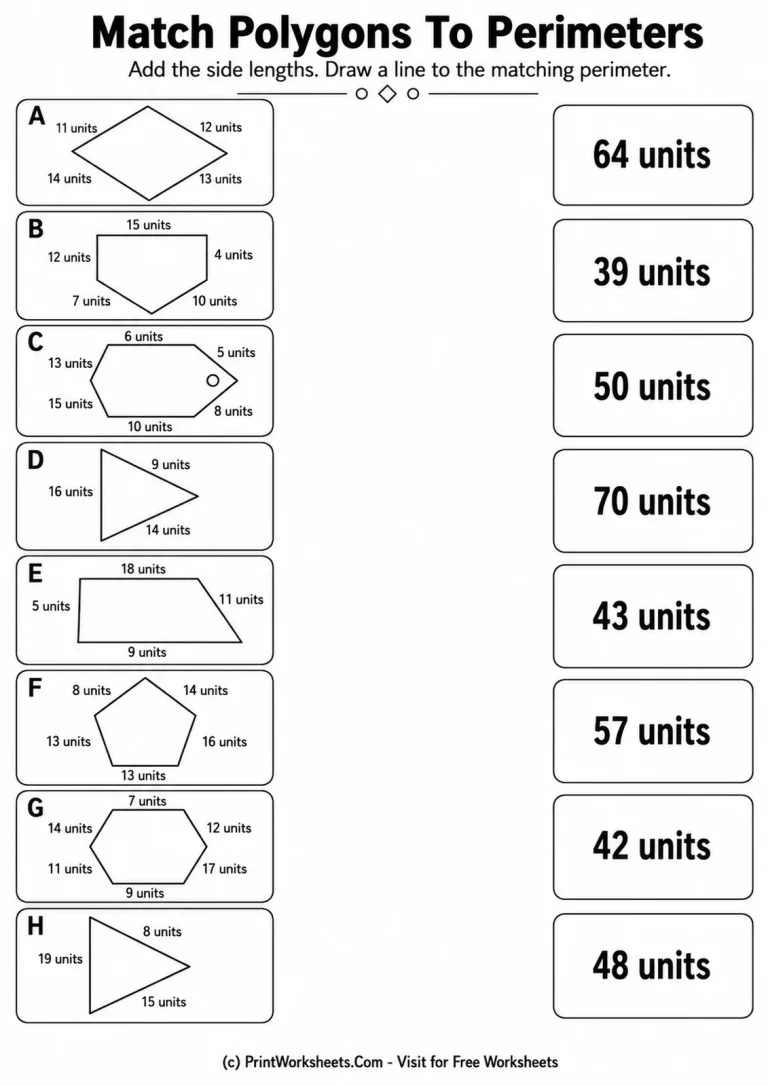
The second worksheet changes the response format. Instead of writing one answer under each figure, students add the sides of polygons labeled A through H and draw a line to the matching perimeter on the right. The answer choices include values such as 39, 42, 43, 48, 50, 57, 64, and 70 units. Students must calculate accurately and then locate the matching total, which adds a checking step to the activity. The figures vary in the number of sides and use larger whole-number lengths than the first page. That makes this worksheet useful after students understand the basic rule for perimeter and are ready to manage longer addition chains.
Use perimeter to find a missing side
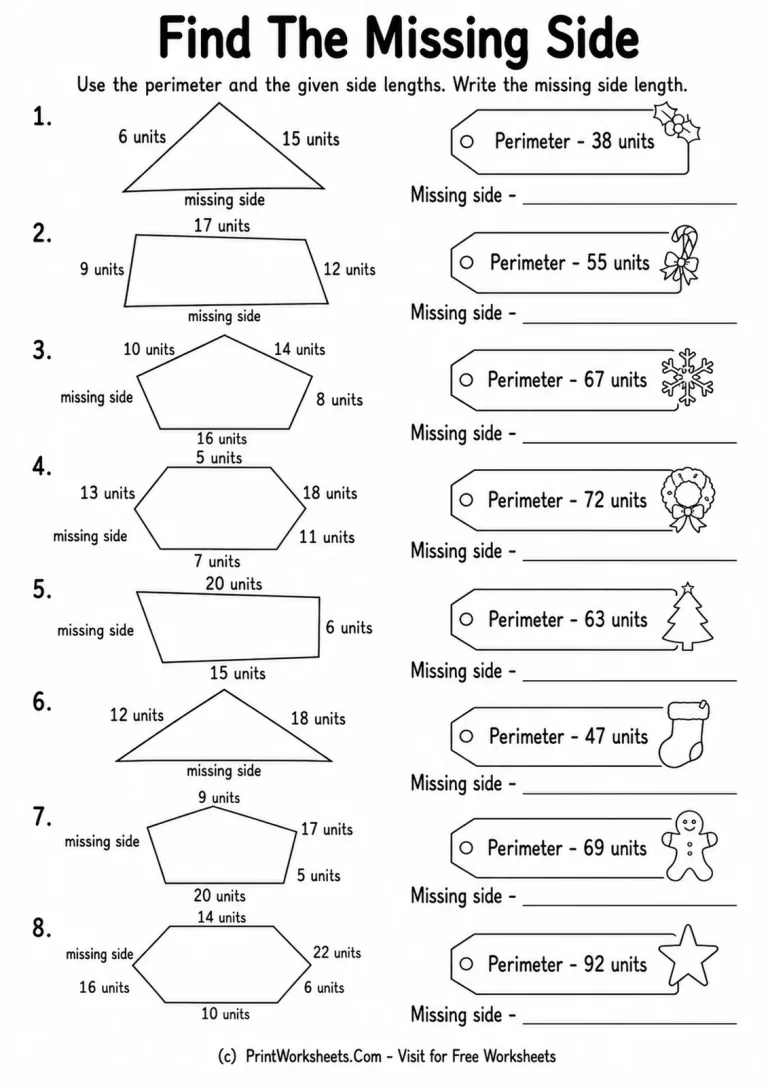
The third worksheet, Find The Missing Side, reverses the process. Each problem provides the total perimeter and all but one side length. Students add the known sides and subtract that sum from the perimeter to find the unknown side. For example, one triangle has a perimeter of 38 units with two known sides of 6 and 15 units. Other problems use quadrilaterals, pentagons, and six-sided figures with perimeters ranging from 47 to 92 units. This format helps students see perimeter as a relationship among all side lengths rather than only as an add-everything routine. It also provides useful practice with multi-step reasoning and subtraction.
How the three worksheets build Grade 3 geometry practice
Together, the pages form a simple skill ladder. Students begin by calculating a perimeter directly from visible side lengths. They then repeat that calculation while matching each polygon to a set of possible totals. Finally, they apply the perimeter equation in reverse to solve for an unknown side. Because all measurements use whole-number units, the arithmetic stays appropriate for Grade 3 while the geometry reasoning becomes gradually more demanding.
These worksheets can be used for a perimeter lesson, independent practice, math centers, homework, or a short review before assessment. Teachers can assign the first page when introducing the procedure, use the matching page for extra fluency, and save the missing-side page for students who are ready to explain or apply the relationship between a total perimeter and its individual sides. Parents can also use the sequence for structured practice at home without needing a different set of directions for every problem.
If your students are also working on area, pair this perimeter practice with our area with unit squares worksheets for Grade 3. Using both resources can help learners distinguish two related geometry ideas: perimeter measures the distance around a figure, while area measures the space inside it.
Printable perimeter practice for third grade
Use the set as a complete progression or choose the page that best matches the current lesson. Students practice adding side lengths, checking totals through matching, and finding an unknown side from a given perimeter. The variety of polygons and response formats makes the resource useful for repeated practice without simply duplicating the same worksheet structure.