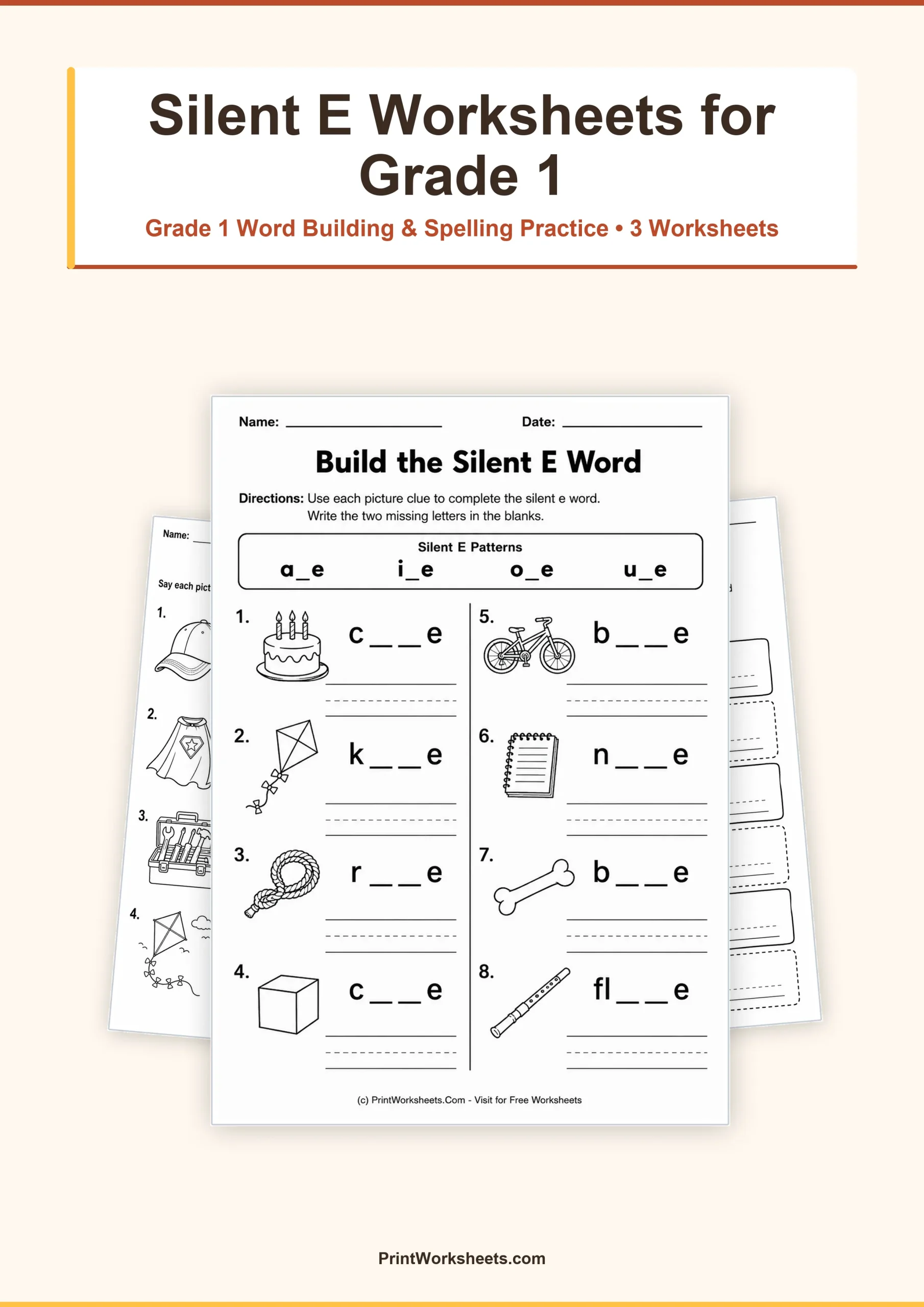
These silent e worksheets give first graders focused practice with one of the most important early spelling patterns: adding a final e to change a short-vowel word into a long-vowel word. Across three printable activities, children compare short-vowel and silent-e words, complete long-vowel words from picture clues, and correct misspelled words inside simple sentences. The sequence moves from visual recognition to word construction and then to spelling in context, making the set useful for classroom practice, home review, or a short phonics check.
Practice Long-Vowel Silent E Spelling Step by Step
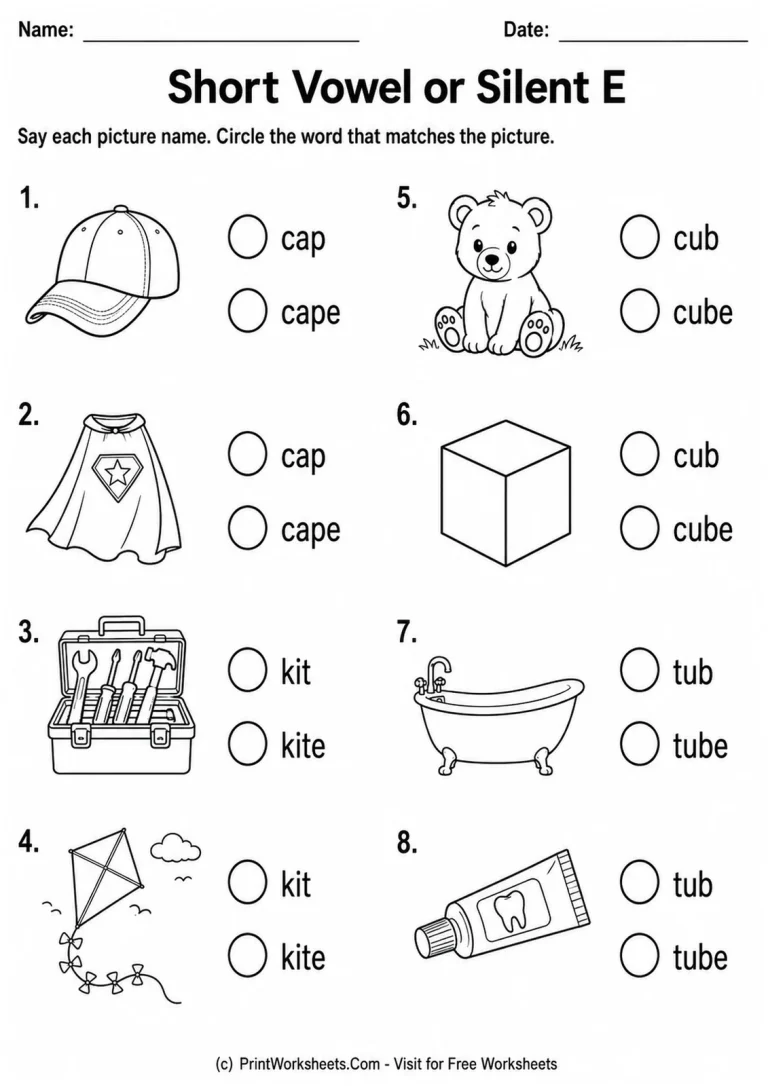
The first worksheet, Short Vowel or Silent E, helps children notice how one final letter can change both spelling and vowel sound. Students look at pictures and choose the word that matches each image. Word pairs such as cap and cape, kit and kite, cub and cube, and tub and tube make the contrast concrete. Instead of asking children to memorize a rule in isolation, the page connects the spelling change to a visible object and a familiar word. This makes it easier for early readers to compare the CVC pattern with its CVCe counterpart.
This type of side-by-side discrimination is especially helpful before students are expected to spell silent-e words independently. They must pay attention to every letter, not just the beginning sound. The activity also gives teachers and parents an easy way to discuss how the final e changes the vowel from a short sound to a long sound while the word itself changes meaning.
Build Silent E Words from Picture Clues
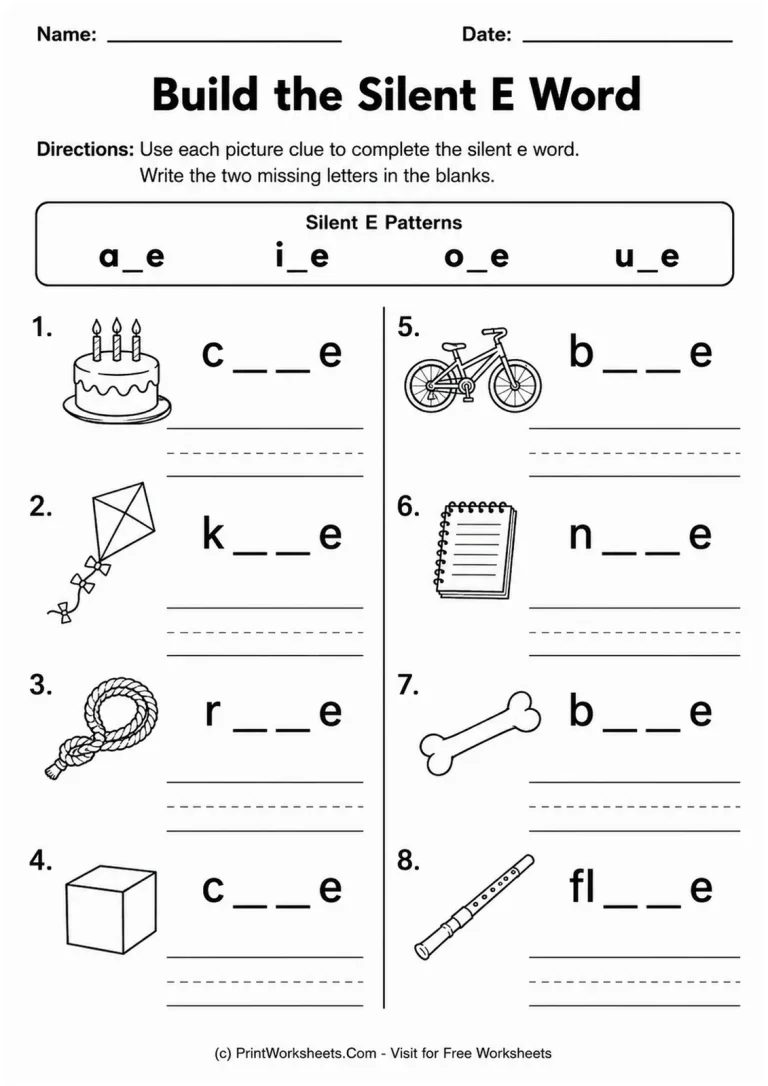
The second worksheet, Build the Silent E Word, shifts from choosing between complete words to constructing them. Visible models show the a_e, i_e, o_e, and u_e patterns, giving students a clear reminder of the spelling structure they are using. Each item includes a picture and a partially completed word. Children write the two missing letters needed to finish the correct silent-e spelling.
The picture set includes cake, kite, rope, cube, bike, note, bone, and flute. Because the words represent several long-vowel patterns, students practice applying the same final-e idea across different vowels rather than repeating only one word family. The picture support keeps the task accessible for Grade 1 learners while still requiring active spelling. Students have to identify the word, connect its long-vowel sound to the correct pattern, and supply the missing letters.
From Word Patterns to Sentence-Level Spelling
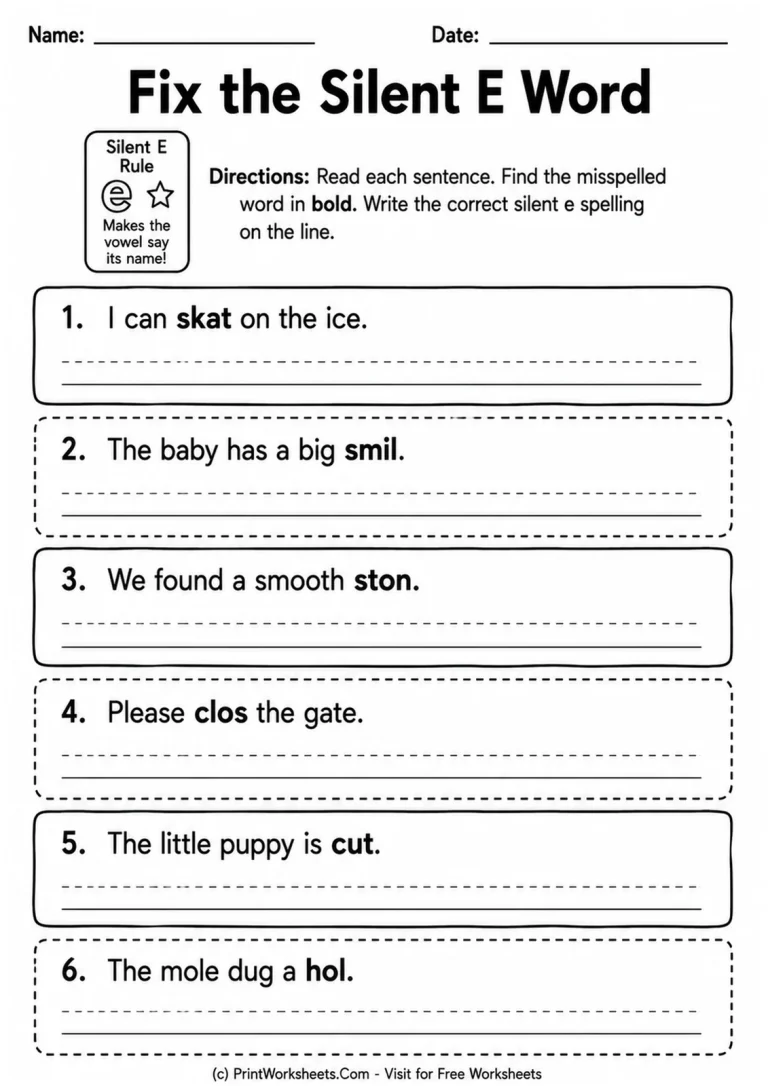
The third worksheet, Fix the Silent E Word, asks students to use what they know in short sentences. Each sentence contains a bold misspelled word that is missing its final e. Children identify the error and write the corrected form on the line. Examples move from spellings such as skat, smil, ston, clos, cut, and hol to skate, smile, stone, close, cute, and hole.
This sentence-based task adds an important layer to silent-e practice. Students are no longer relying only on a picture. They use the meaning of the whole sentence along with the spelling pattern to decide what the word should be. Correcting skate, smile, stone, and close also reinforces the idea that final e is part of the written word even though it is not pronounced as a separate sound.
Ways to Use These Grade 1 Silent E Worksheets
The three pages work well as a short instructional sequence. Begin with the picture-based short-vowel versus silent-e comparisons so students can hear and see the contrast. Next, use the word-building page to practice a_e, i_e, o_e, and u_e spellings with structured support. Finish with the sentence correction page after students are ready to apply the pattern with less visual help.
Teachers can also use the worksheets separately. The comparison page fits a phonics mini-lesson or small-group warm-up. The word-building page can be used for independent seatwork or a literacy center because the pictures provide clear clues. The sentence correction page works well as a quick review, morning work activity, or informal assessment of whether students can recognize missing final e in context.
What First Graders Practice
By working through this set, students practice distinguishing short-vowel words from long-vowel silent-e words, recognizing common CVCe patterns, completing partially written words, and correcting spelling inside sentences. The activities repeatedly connect sound, spelling, pictures, and meaning, which helps children see silent e as a usable spelling pattern rather than a list of unrelated words.
Use these printable pages when your Grade 1 learners are ready to move beyond simply identifying long vowels and begin spelling silent-e words with greater independence. The progression from cap versus cape to building words like kite and rope and finally correcting words like stone and cute provides varied practice while keeping the skill focus clear.