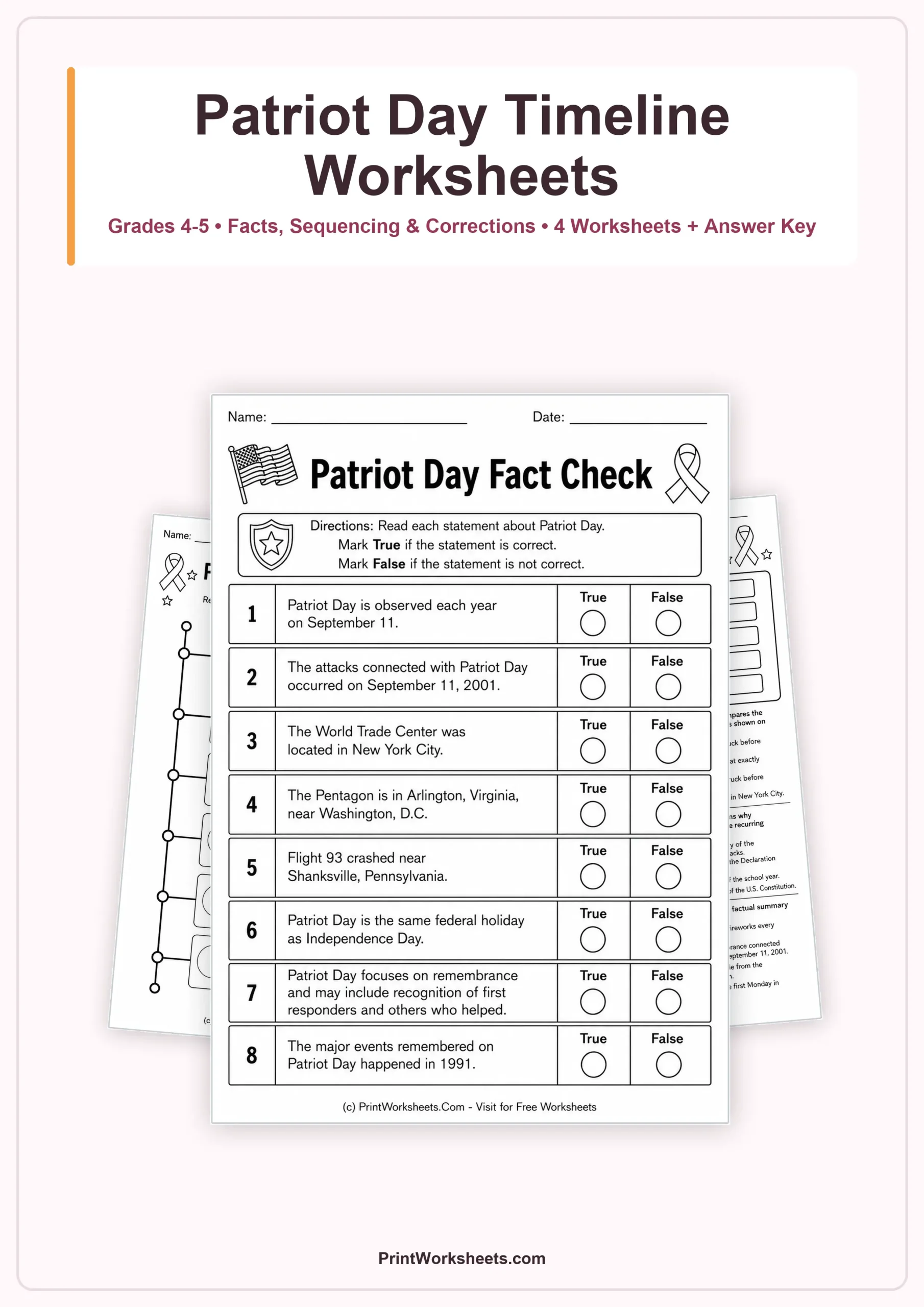
These Patriot Day timeline worksheets give students in Grades 4-5 structured practice with chronology, historical facts, times, and locations connected with September 11. Rather than presenting one long passage followed by similar questions, the printable set changes the thinking task from page to page. Students put timed events in order, evaluate True or False statements, read a reference timeline to answer questions, and correct inaccurate timeline details. The result is a compact social studies resource that emphasizes careful reading of factual information while keeping the historical content direct and age-appropriate.
Patriot Day timeline worksheets for chronology and fact checking
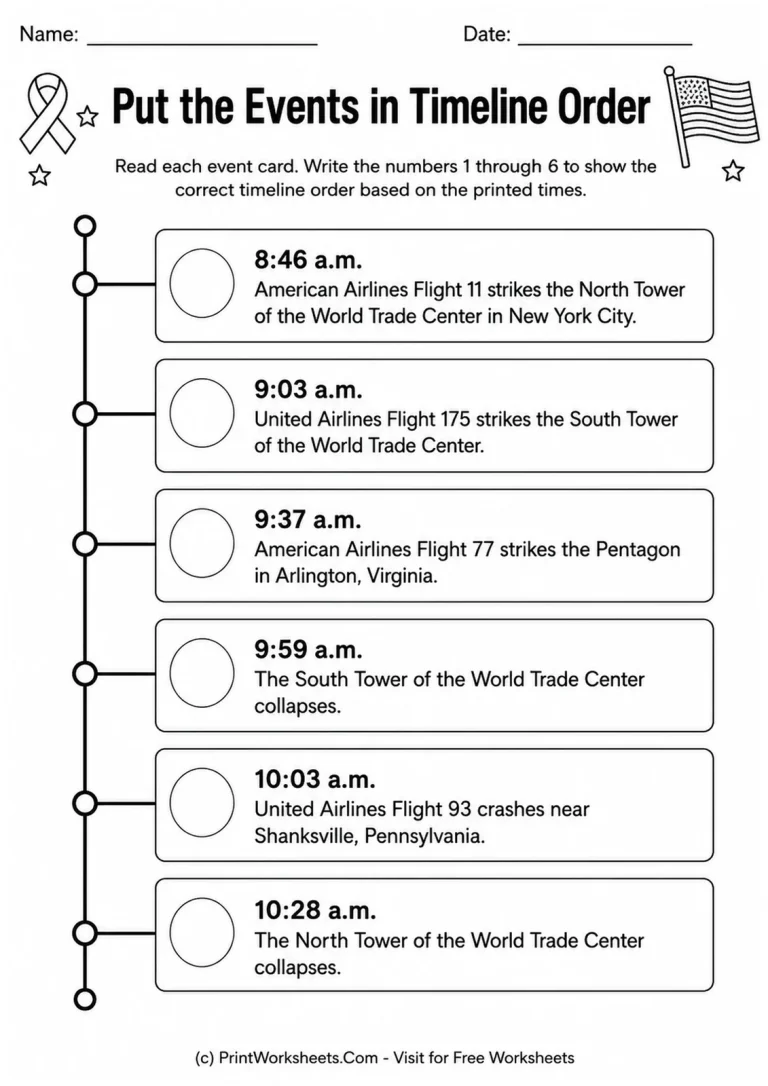
The first worksheet, Put the Events in Timeline Order, presents six major events with printed times ranging from 8:46 a.m. to 10:28 a.m. Students write the numbers 1 through 6 to show the correct timeline sequence. The event cards include Flight 11 striking the North Tower, Flight 175 striking the South Tower, Flight 77 striking the Pentagon in Arlington, Virginia, the collapse of the South Tower, Flight 93 crashing near Shanksville, Pennsylvania, and the collapse of the North Tower. Because each card includes a precise time, students can use explicit chronological evidence rather than relying only on memory.
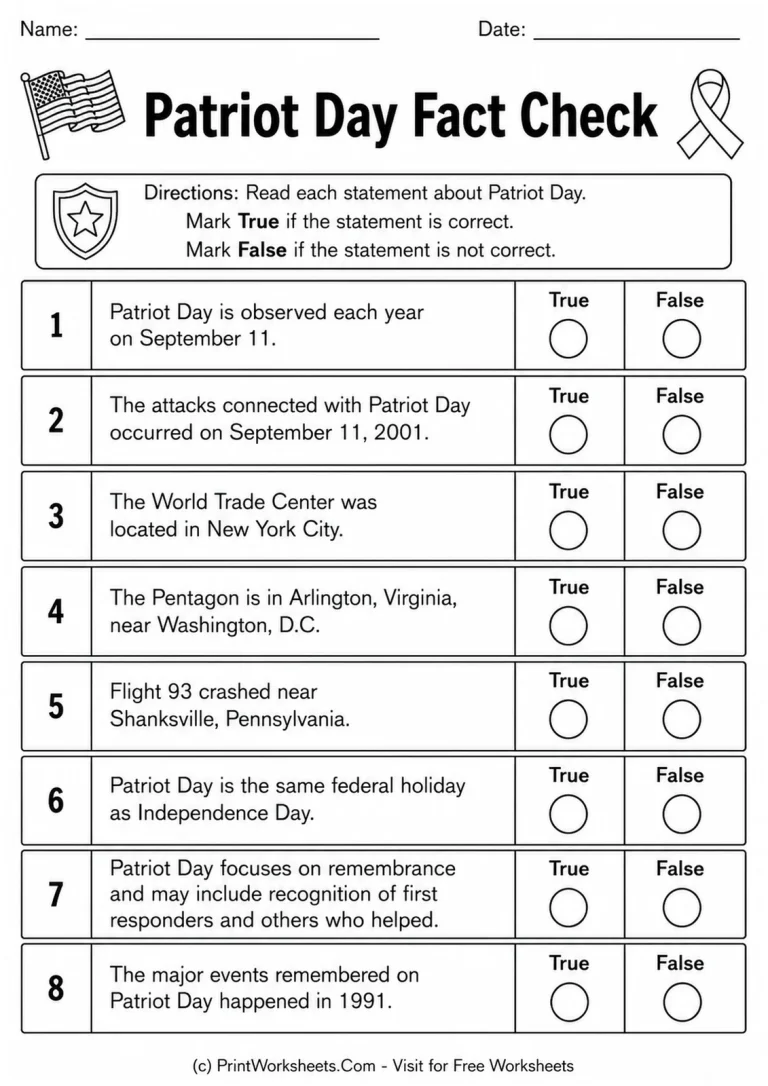
The second worksheet changes the format to a Patriot Day fact check. Eight statements ask students to decide whether each detail is True or False. The questions cover the annual September 11 observance, the year 2001, the location of the World Trade Center, the Pentagon’s location near Washington, D.C., Flight 93 near Shanksville, and the remembrance focus of Patriot Day. Two deliberately incorrect statements check whether students can reject the idea that Patriot Day is the same as Independence Day or that the remembered events happened in 1991. This makes the page useful as a quick knowledge check after instruction.
Reading evidence from a Patriot Day timeline
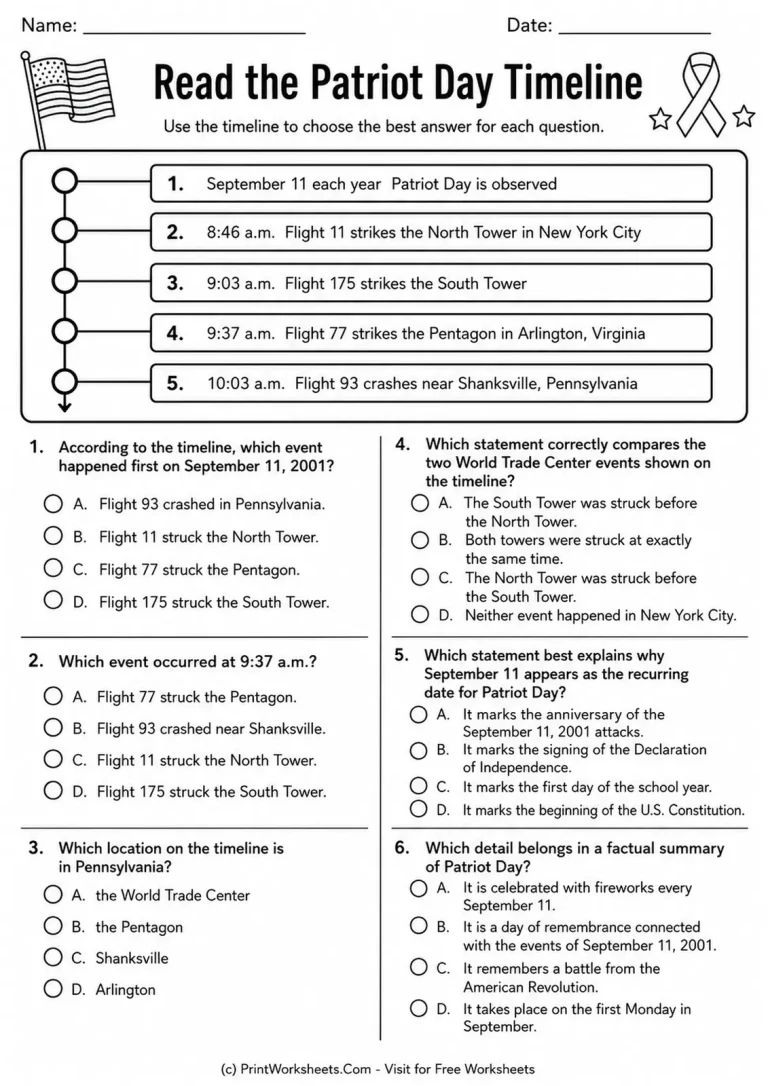
The third page, Read the Patriot Day Timeline, provides a reference timeline followed by six multiple-choice questions. Students identify which event happened first, connect 9:37 a.m. with Flight 77 and the Pentagon, locate Shanksville in Pennsylvania, and compare the order of the two World Trade Center strikes. Later questions move beyond simple retrieval by asking why September 11 appears as the recurring Patriot Day date and which statement belongs in a factual summary. Students therefore practice both locating details and interpreting what those details mean within the timeline.
This page can pair naturally with the Patriot Day reading comprehension passages when students need additional background reading before answering timeline questions. Teachers who want students to strengthen topic language first can also use the Patriot Day vocabulary worksheets as a separate vocabulary-focused companion.
Correcting errors instead of only recognizing answers
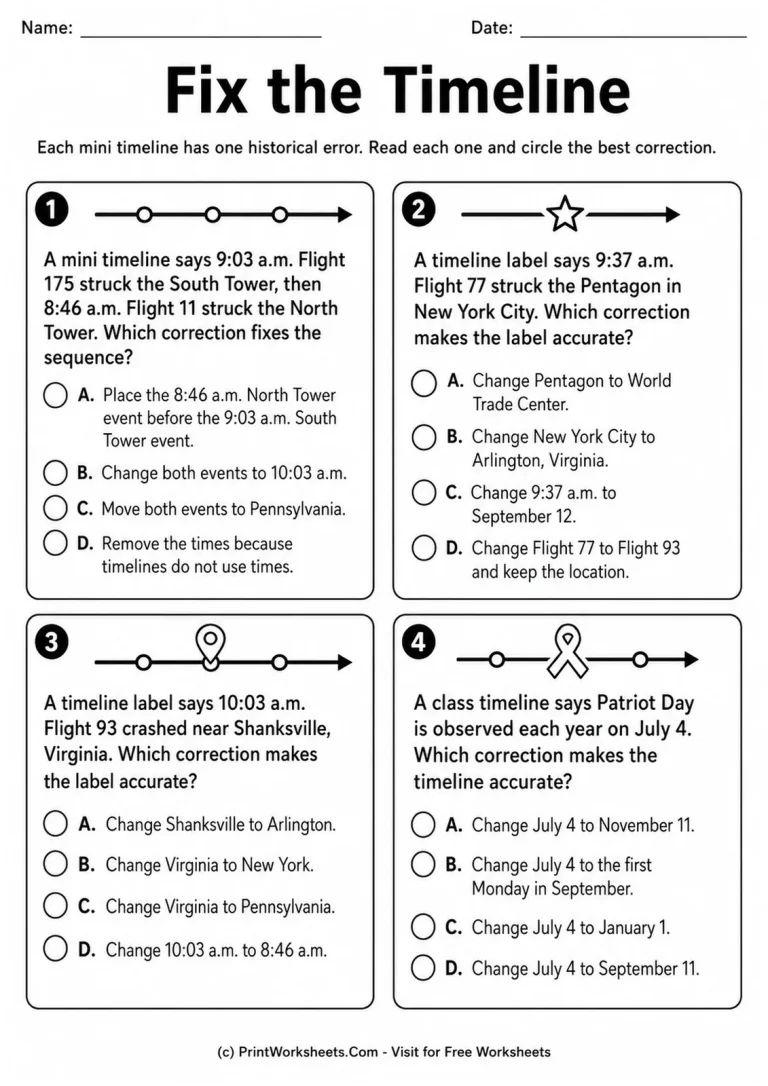
The final student worksheet, Fix the Timeline, asks learners to inspect four mini timelines that each contain one historical error. Students choose the correction that restores accuracy. One item reverses the 8:46 a.m. and 9:03 a.m. sequence, another places the Pentagon in New York City instead of Arlington, Virginia, a third puts Shanksville in Virginia instead of Pennsylvania, and the final item gives July 4 instead of September 11 as the Patriot Day observance date. This error-analysis format requires students to notice what is wrong and identify the specific detail that must change.
A focused Grades 4-5 social studies sequence
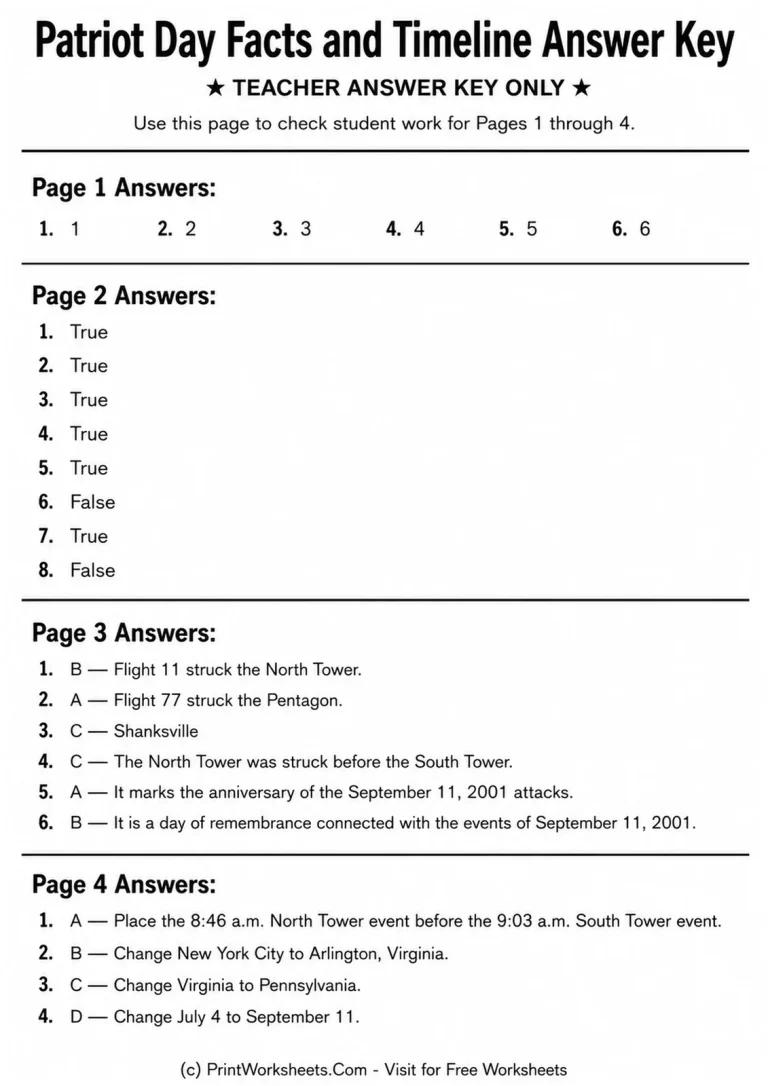
The four pages create a clear progression without depending on a single activity type. Page 1 emphasizes chronological ordering, Page 2 checks factual knowledge, Page 3 develops timeline reading and comparison, and Page 4 applies those facts through correction tasks. A teacher answer key supplies responses for every student item, including the six sequencing numbers, eight True or False responses, six timeline multiple-choice questions, and four correction questions. Teachers can use the pages together as a short Patriot Day lesson sequence or select individual worksheets for review, independent practice, centers, or follow-up work. Across the set, the central habit remains consistent: read the evidence carefully, distinguish accurate details from errors, and connect historical events with the correct time and place.