A square does not stop being a rectangle just because it has four equal sides. That overlapping relationship is the central idea in these quadrilateral hierarchy worksheets for Grade 5. Across three printable activities, students use right angles, equal sides, and parallel sides to decide not only what a shape is called, but also which larger quadrilateral groups contain it. The holiday-themed examples keep the pages visually approachable while the mathematics stays focused on classification and hierarchy.
Quadrilateral Hierarchy Worksheets for Grade 5
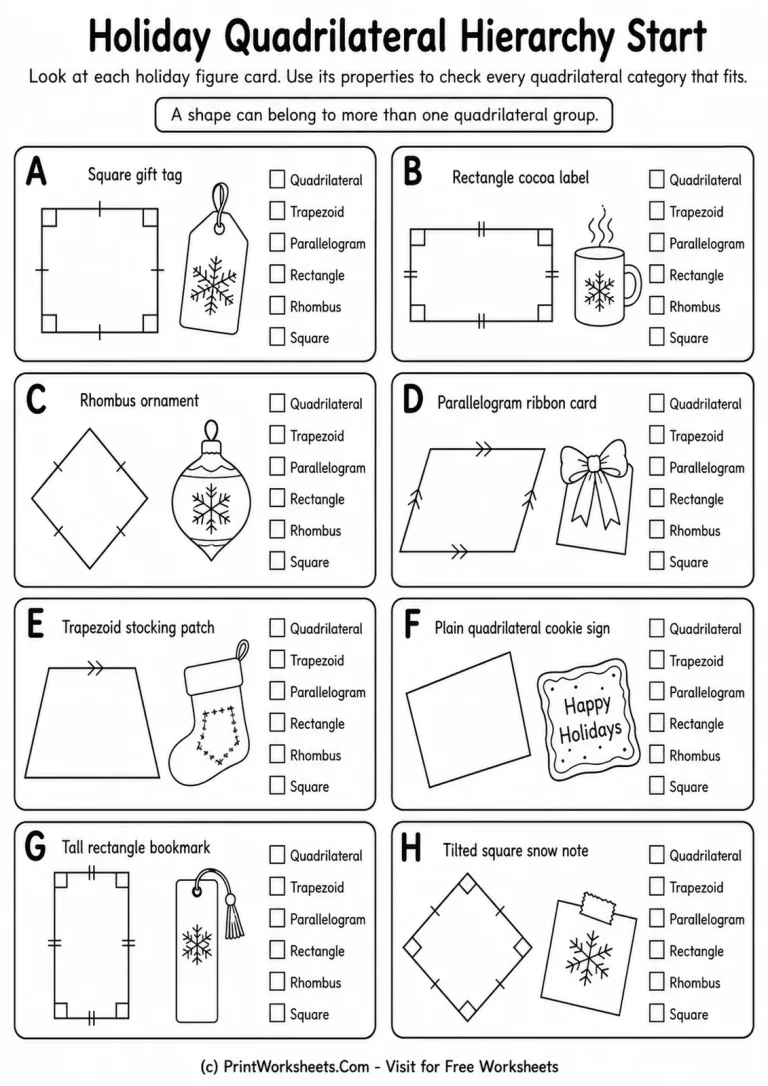
The first activity makes the hierarchy visible through eight figure cards labeled A through H. Students examine a square gift tag, rectangle cocoa label, rhombus ornament, parallelogram ribbon card, trapezoid stocking patch, plain quadrilateral cookie sign, tall rectangle bookmark, and tilted square snow note. Beside every figure is the same set of categories: Quadrilateral, Trapezoid, Parallelogram, Rectangle, Rhombus, and Square.
Instead of choosing only one label, students are told to check every category that fits. That detail is important. A square, for example, belongs to the square, rhombus, rectangle, parallelogram, and quadrilateral groups. A non-square rectangle still belongs to the rectangle, parallelogram, and quadrilateral groups. A plain four-sided figure with no marked special properties remains a quadrilateral. This format helps students see classification as a system of nested relationships rather than a collection of unrelated vocabulary words.
Match Property Clues to Quadrilateral Families
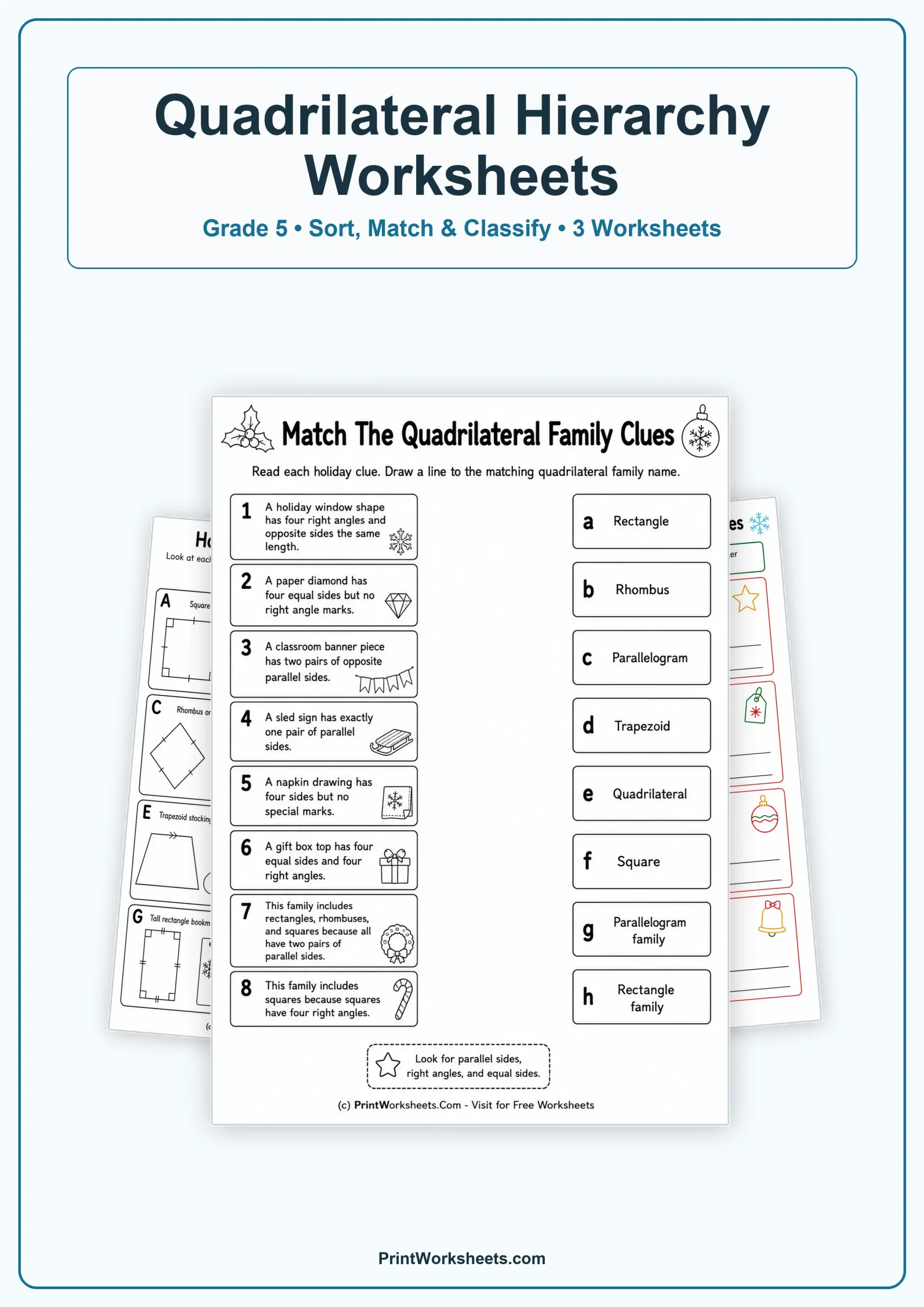
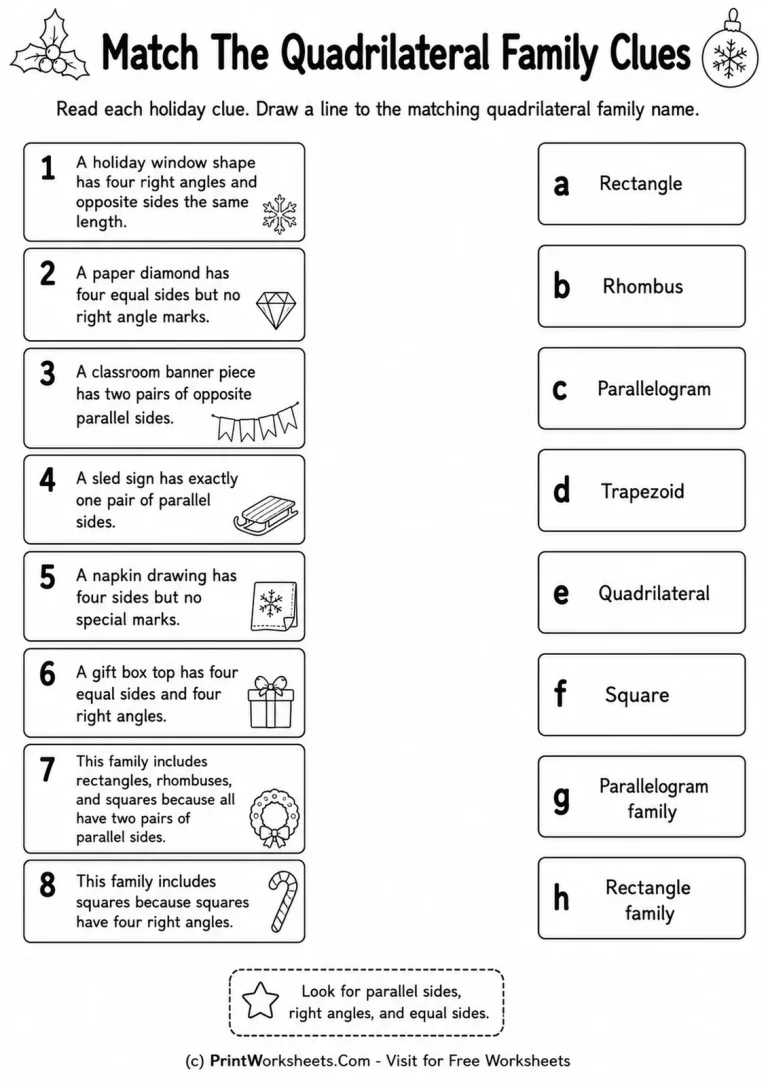
The matching worksheet shifts the focus from visible diagrams to written geometric evidence. Eight holiday clues describe figures using properties such as four right angles, four equal sides, two pairs of opposite parallel sides, exactly one pair of parallel sides, or simply four sides with no special markings. Students draw lines from each clue to a quadrilateral name or family label.
The choices include Rectangle, Rhombus, Parallelogram, Trapezoid, Quadrilateral, Square, Parallelogram family, and Rectangle family. Two clues specifically ask students to reason about families: rectangles, rhombuses, and squares all belong to the parallelogram family because they have two pairs of parallel sides, while squares belong to the rectangle family because they have four right angles. These prompts make the worksheet especially useful after students already know the basic shape names and are ready to explain how the categories connect.
Find the Most Specific Name and Its Larger Groups
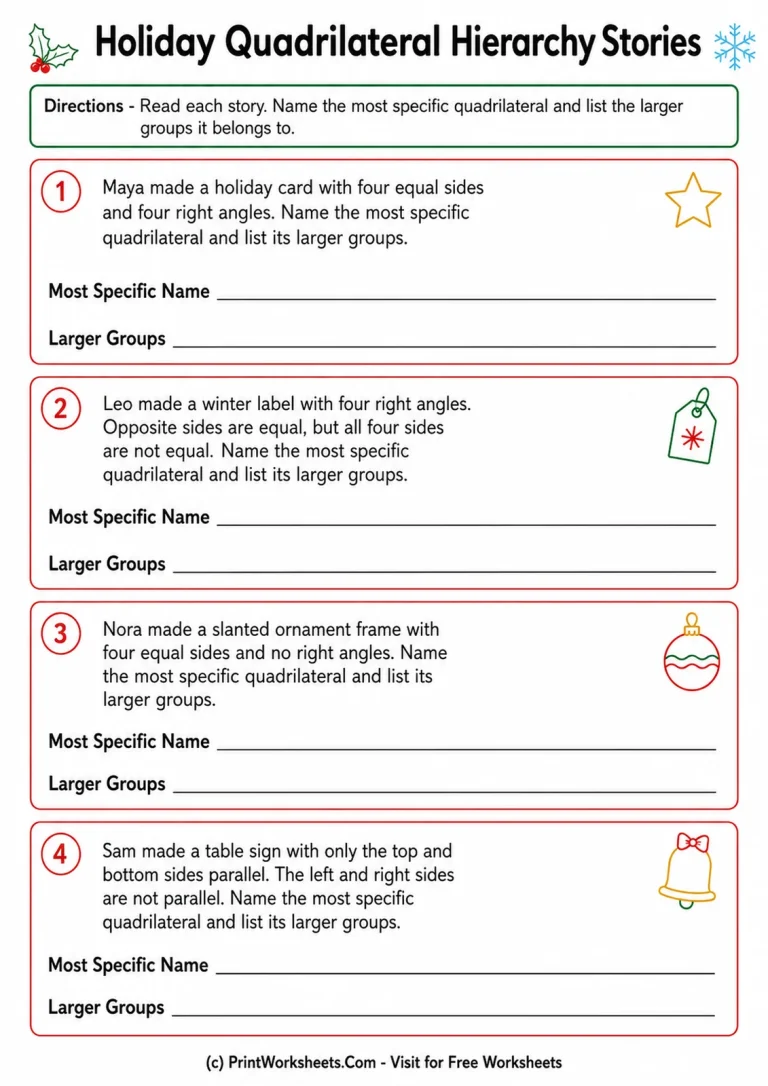
The story activity asks students to apply the hierarchy without relying on a pre-drawn geometric model. Four short situations describe holiday objects using defining properties. One card has four equal sides and four right angles, one label has four right angles but not four equal sides, one ornament frame has four equal sides and no right angles, and one table sign has only its top and bottom sides parallel.
For each story, students write the most specific quadrilateral name and then list the larger groups to which it belongs. A square therefore expands upward through rectangle, rhombus, parallelogram, and quadrilateral. A rectangle belongs to the parallelogram and quadrilateral groups. A rhombus also belongs to the parallelogram and quadrilateral groups. The trapezoid example reinforces the set’s use of the definition with exactly one pair of parallel sides.
Teaching the Difference Between a Shape Name and a Shape Family
A helpful way to use these pages is to ask two questions repeatedly: “What is the most specific name?” and “What else must also be true?” The first question encourages precise naming. The second encourages hierarchical reasoning. Students who call every four-right-angle figure only a rectangle can be pushed to notice when equal-side information makes square the more specific name. Students who treat squares and rhombuses as completely separate can compare their equal-side property and then trace both back to the parallelogram family.
If students need an earlier review of basic shape recognition before working with nested categories, the identify quadrilaterals worksheets provide a simpler starting point. The Grade 5 hierarchy set can then be used to extend that recognition into property-based reasoning and family relationships.
Useful Ways to Check Student Reasoning
These worksheets work well for independent practice, small-group review, math centers, or a short geometry assessment. When checking responses, look beyond whether a student selected the correct shape name. Ask students to point to the evidence: parallel-side marks, right-angle marks, equal-side marks, or a sentence describing those properties. On the hierarchy sort, a student who identifies a square but checks only “Square” has recognized the figure but has not yet demonstrated the full hierarchy. On the story problems, the larger-group line provides a quick way to see whether students understand inclusion relationships.
By the end of the set, students should be able to move in both directions: from properties to a precise quadrilateral name and from that name outward to the broader families that contain it. That makes these pages a focused practice set for Grade 5 geometry lessons on classifying two-dimensional figures by their defining attributes.