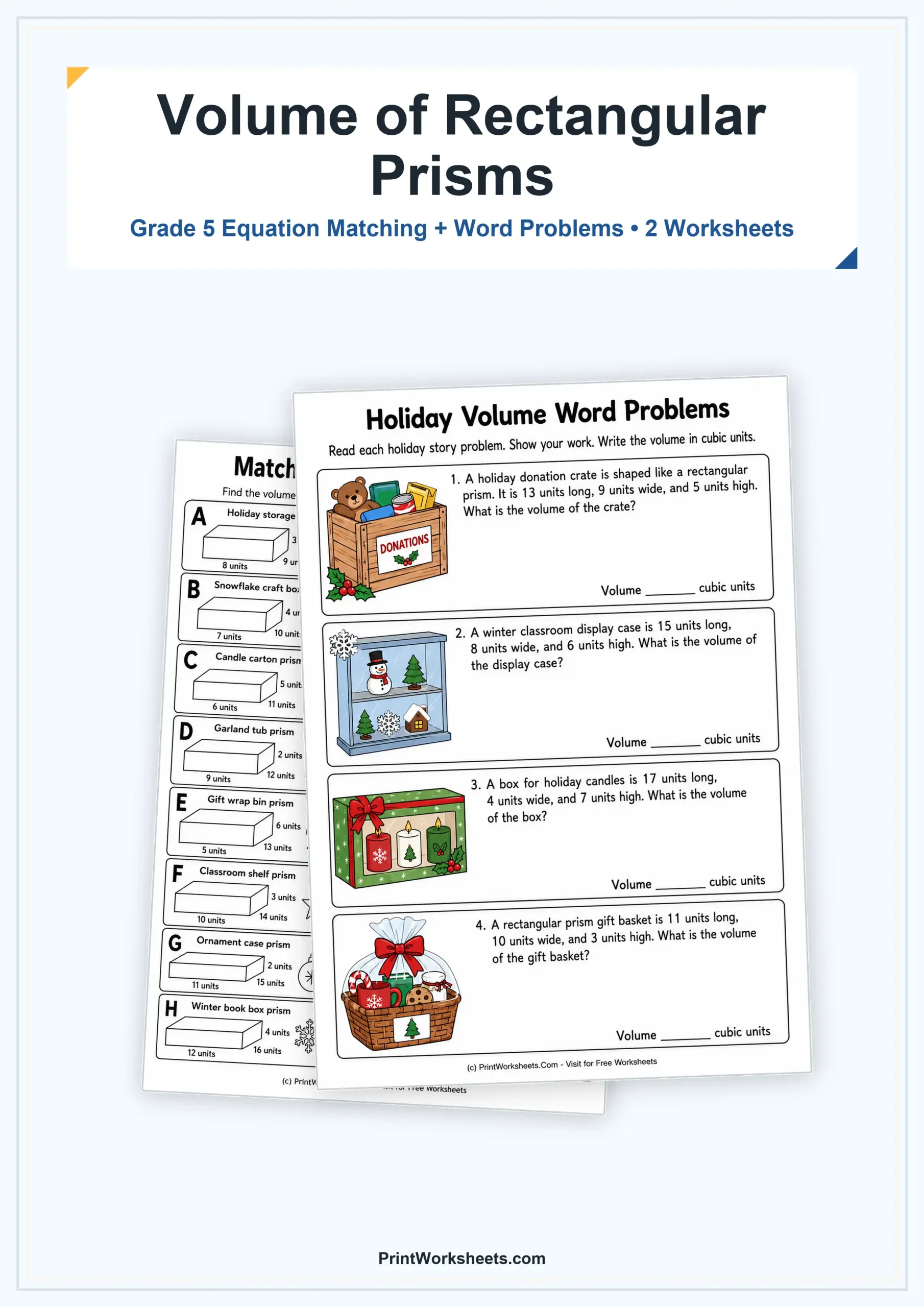
These volume of rectangular prisms worksheets give Grade 5 students two different ways to practice the same core skill: using length × width × height to find volume in cubic units. One worksheet is an equation-matching activity with eight labeled prisms, while the second uses four holiday-themed word problems. Together, the pages move from reading dimensions and recognizing equivalent multiplication equations to deciding which dimensions matter in a written situation and calculating the final volume.
Volume of Rectangular Prisms Worksheets with Equation Matching
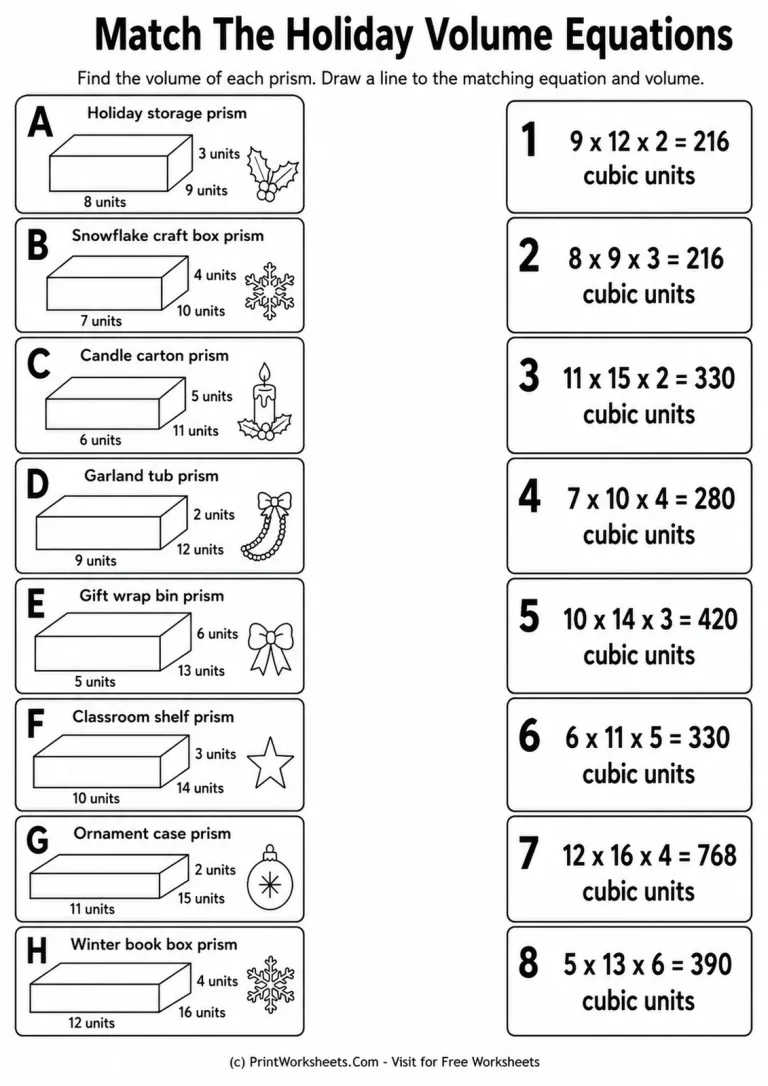
The matching page, Match The Holiday Volume Equations, presents eight rectangular prisms labeled A through H. Each prism has three visible dimensions, and students calculate its volume before drawing a line to the matching equation and cubic-unit result on the right side of the page. The numbers are large enough to require real multiplication practice without turning the activity into a long computation drill.
The examples include prisms measuring 8 × 9 × 3, 7 × 10 × 4, 6 × 11 × 5, 9 × 12 × 2, 5 × 13 × 6, 10 × 14 × 3, 11 × 15 × 2, and 12 × 16 × 4 units. Their volumes range from 216 to 768 cubic units. Because students must connect each model to a complete equation rather than simply write a number, the page reinforces the relationship between the three dimensions, multiplication, and the meaning of cubic units.
Why the Matching Format Is Useful
This activity also includes a useful reasoning feature: more than one prism can have the same numerical volume even when its dimensions are different. For example, 8 × 9 × 3 and 9 × 12 × 2 both equal 216 cubic units. Likewise, 6 × 11 × 5 and 11 × 15 × 2 both equal 330 cubic units. Students therefore cannot rely only on the final volume. They need to compare the full multiplication expression to make the correct match. That makes the page helpful for checking whether students understand volume as a product of three dimensions rather than as an isolated answer.
Apply the Volume Formula in Holiday Word Problems
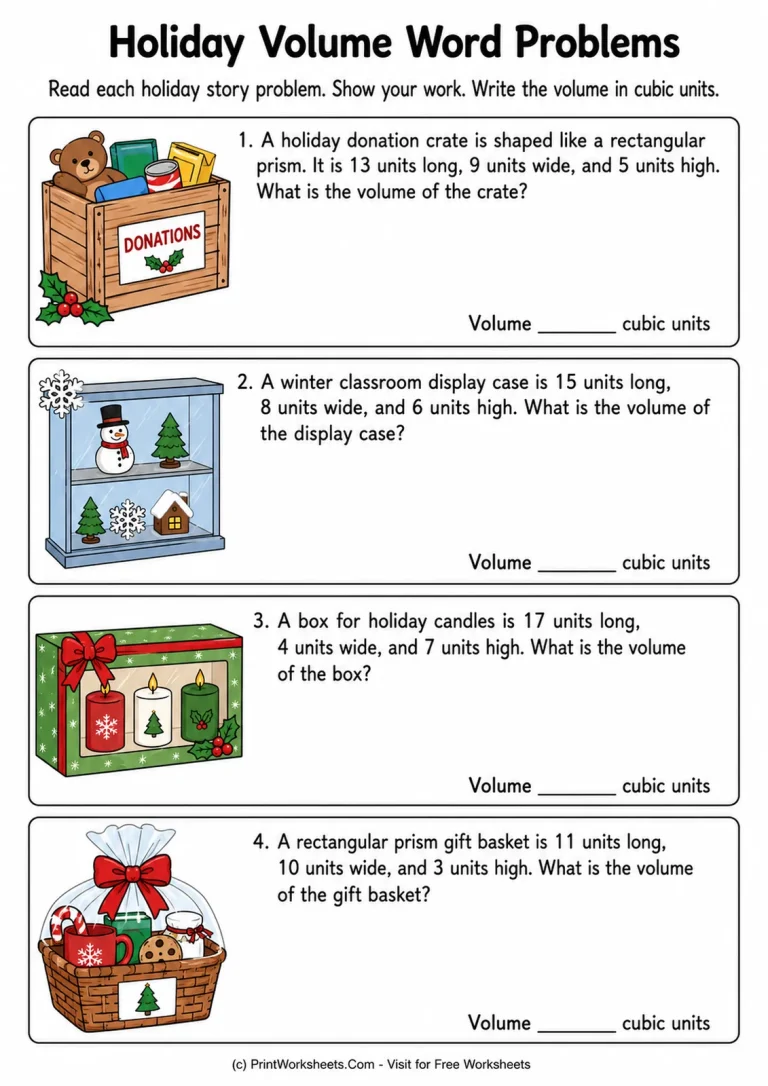
The second printable, Holiday Volume Word Problems, asks students to apply the rectangular-prism formula in four short contexts. The situations feature a holiday donation crate, a winter classroom display case, a box for holiday candles, and a rectangular-prism gift basket. Each problem states the length, width, and height in units and asks for the volume in cubic units.
The donation crate measures 13 × 9 × 5 units, giving students a volume calculation of 585 cubic units. The classroom display case measures 15 × 8 × 6 units for a volume of 720 cubic units. The candle box uses 17 × 4 × 7 units, which produces 476 cubic units, and the gift basket measures 11 × 10 × 3 units for 330 cubic units. These problems require students to pull the three measurements out of complete sentences, organize them into a multiplication expression, and label the answer correctly.
Ways to Use These Grade 5 Volume Worksheets
The two-page set works well when students already know the basic formula and need varied practice. The equation-matching page can be used first because every dimension is displayed directly beside a prism. Students can calculate each product and then use the matching choices as a built-in way to check whether their equation appears among the options. The word-problem page can follow as a more independent application task because students must identify the relevant measurements from text before multiplying.
For classroom instruction, teachers can have students write the multiplication equation beside each prism before drawing any matching lines. That small step makes student reasoning visible and helps catch cases where a learner multiplies only two dimensions. On the word-problem page, students can underline the length, width, and height in each story, then write the formula V = l × w × h before solving. Parents using the worksheets at home can use the same routine to keep the focus on the structure of the problem instead of guessing from the pictures.
Build Connections with Other Geometry Skills
Volume is part of a broader measurement and geometry progression. Students who need additional work interpreting dimensions and boundaries can also practice with perimeter of polygons worksheets. For shape classification and geometric vocabulary, the identify quadrilaterals worksheets provide another way to review properties of figures. The lines, rays and line segments worksheets can support students who are still strengthening foundational geometry language.
Use these printables for independent practice, a short review after teaching the volume formula, math centers, homework, or a quick check before moving into more complex volume problems. The combination of equation matching and written application gives students repeated practice with the same Grade 5 volume concept while requiring two noticeably different types of thinking.