These Grade 5 surface area worksheets introduce rectangular-prism surface area through four different kinds of practice instead of repeating the same formula question. Students begin by adding six visible face areas, move to matching labeled prism nets with total surface areas, check whether stated answers are true or false, and finish with contextual box problems. The sequence gives students several ways to see that surface area means the total area covering every outside face of a rectangular prism.
Surface Area Worksheets That Build the Idea Step by Step
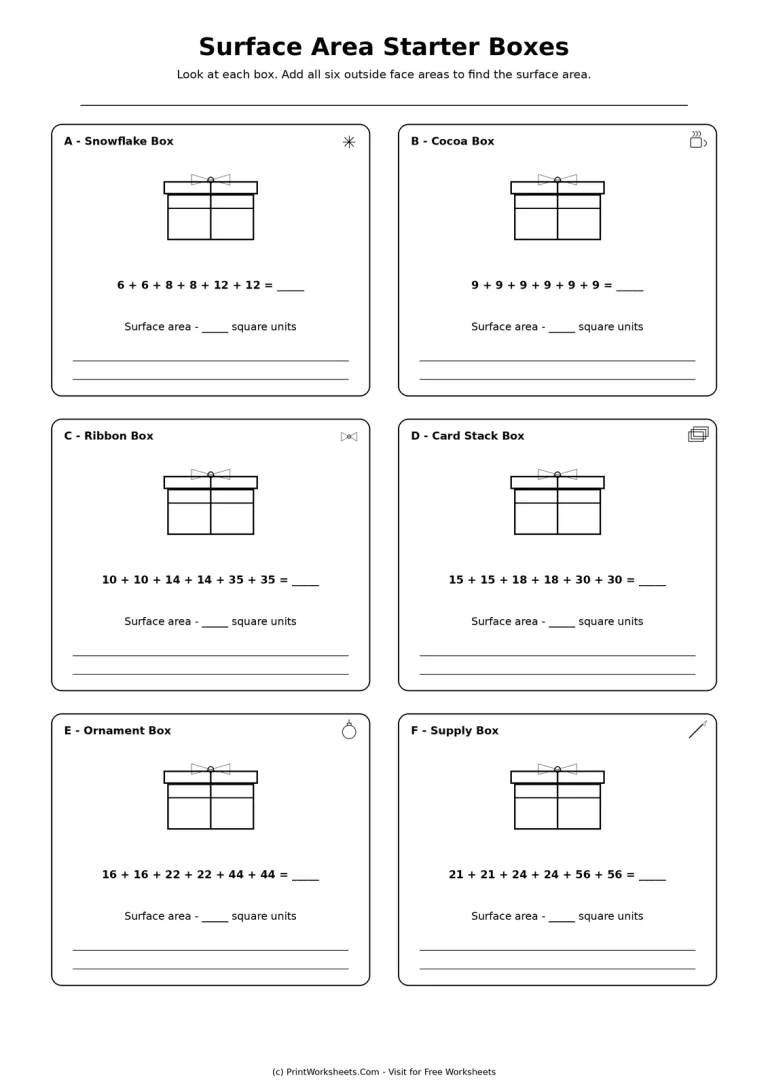
The first worksheet, “Surface Area Starter Boxes,” makes the structure of surface area especially clear. Each of six themed boxes shows an addition expression made from six face areas, such as 6 + 6 + 8 + 8 + 12 + 12. Students add all six values and then record the surface area in square units. Because opposite faces appear as equal pairs, this page helps students notice the repeated-face pattern before they are expected to work only from dimensions. The six problems increase in numerical size, with totals ranging from 52 to 202 square units.
This is a useful bridge from earlier area work. Students who need a refresher on finding the area of individual rectangles can revisit area with unit squares worksheets before combining multiple faces. For students ready to connect rectangular dimensions with perimeter and area relationships, the area and perimeter worksheets provide another useful foundation.
Match Rectangular-Prism Nets to Total Surface Area
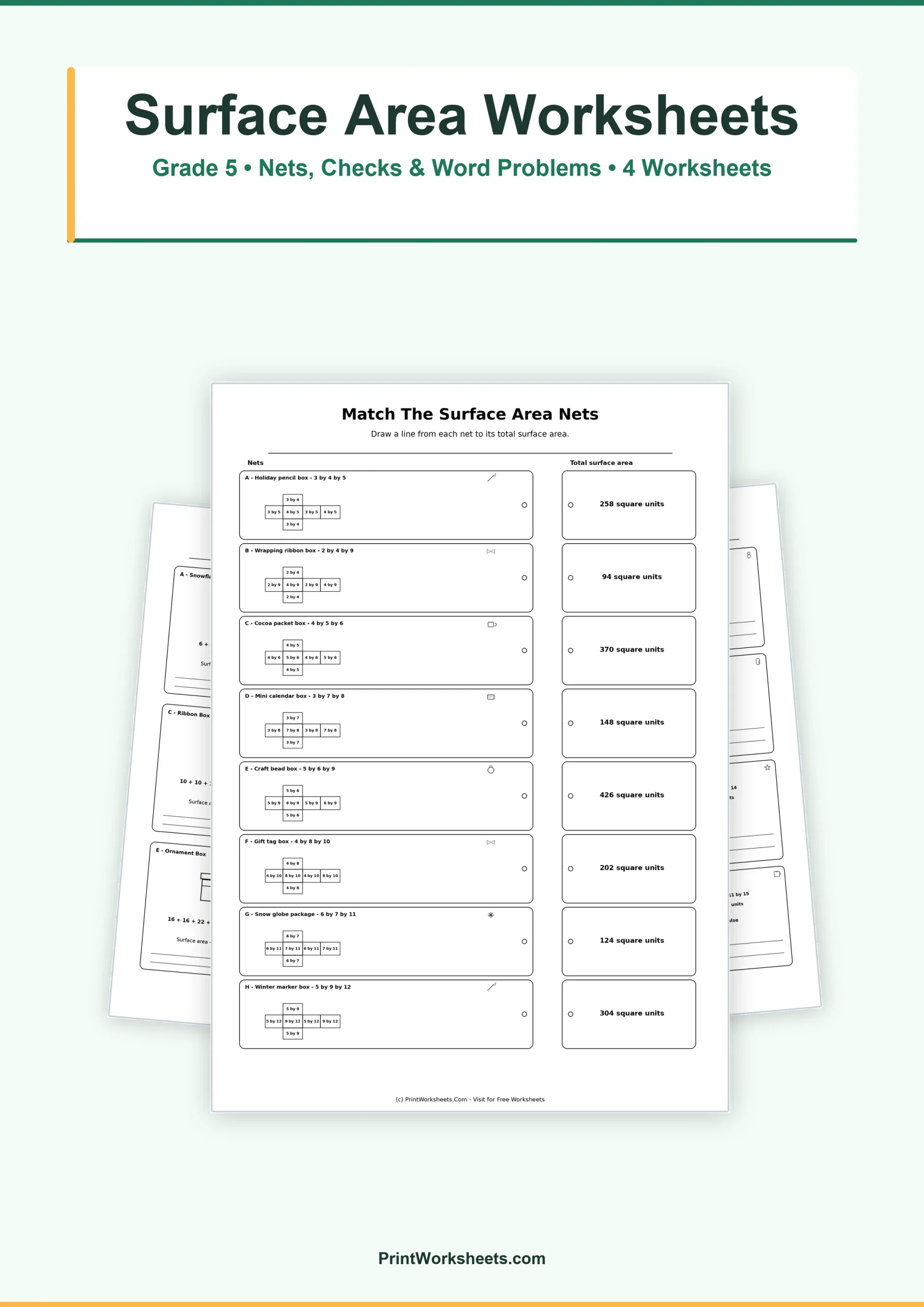
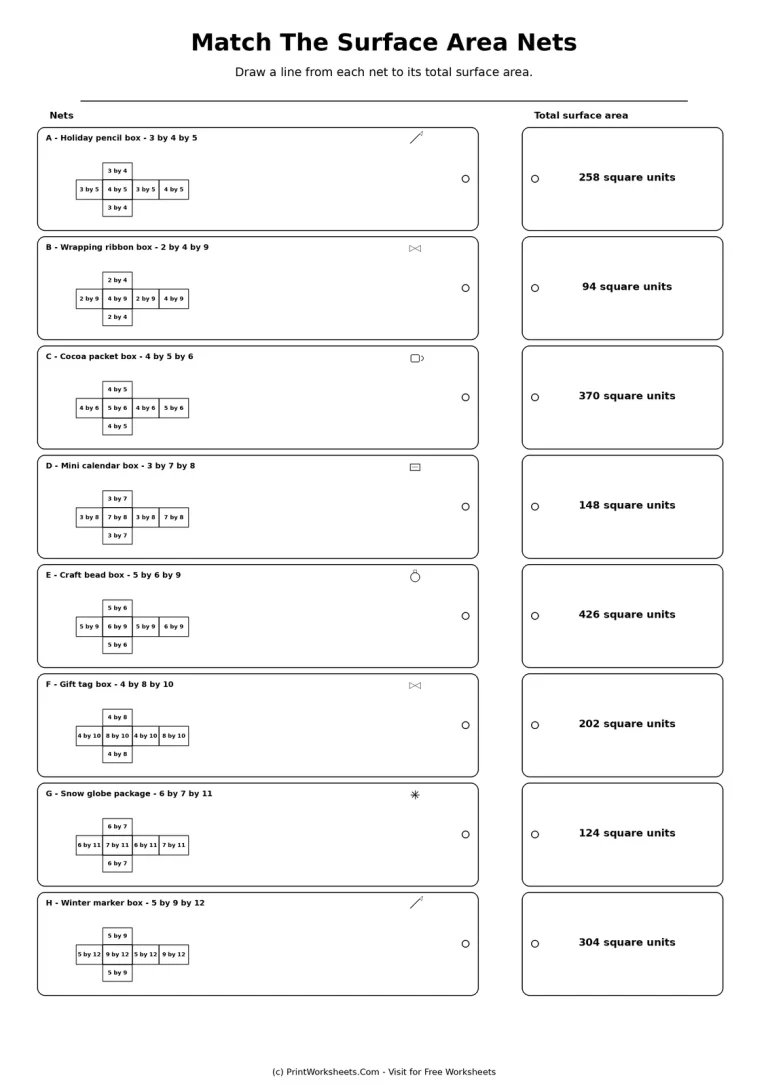
The second page shifts from prepared sums to rectangular-prism nets. Eight nets labeled A through H show the dimensions of each face, along with overall prism dimensions such as 3 by 4 by 5, 4 by 5 by 6, and 5 by 9 by 12. Students calculate the combined area of the six rectangles and draw a line to the correct total surface-area choice. The answer choices are all distinct, so each net has one clear match.
This matching format requires more than arithmetic. Students must read the net, recognize pairs of congruent faces, keep track of all six rectangles, and compare their result with the available totals. It gives a visual connection between a three-dimensional rectangular prism and the two-dimensional rectangles that make up its exterior.
Check Surface Area Claims with True or False Reasoning
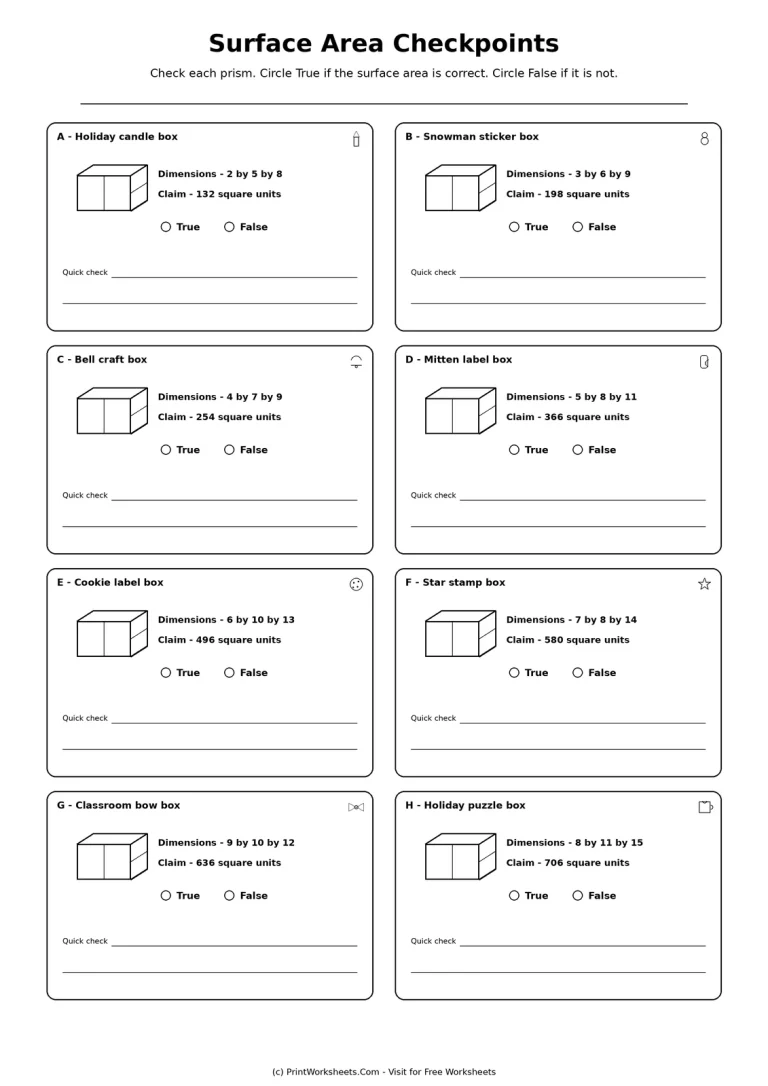
On “Surface Area Checkpoints,” students receive eight rectangular prisms with three dimensions and a claimed surface area. They circle True when the claim is correct and False when it is not, then use the “Quick check” lines to show enough work to justify the decision. Some claims are correct and others are deliberately incorrect, so students cannot succeed by following a predictable answer pattern.
The dimensions become progressively larger, from 2 by 5 by 8 through 8 by 11 by 15. This page is well suited to independent practice because students must verify a result rather than simply produce one. It can also support a short classroom discussion about common errors, such as forgetting a pair of faces or combining the three face areas without doubling them.
Apply Surface Area in Grade 5 Word Problems
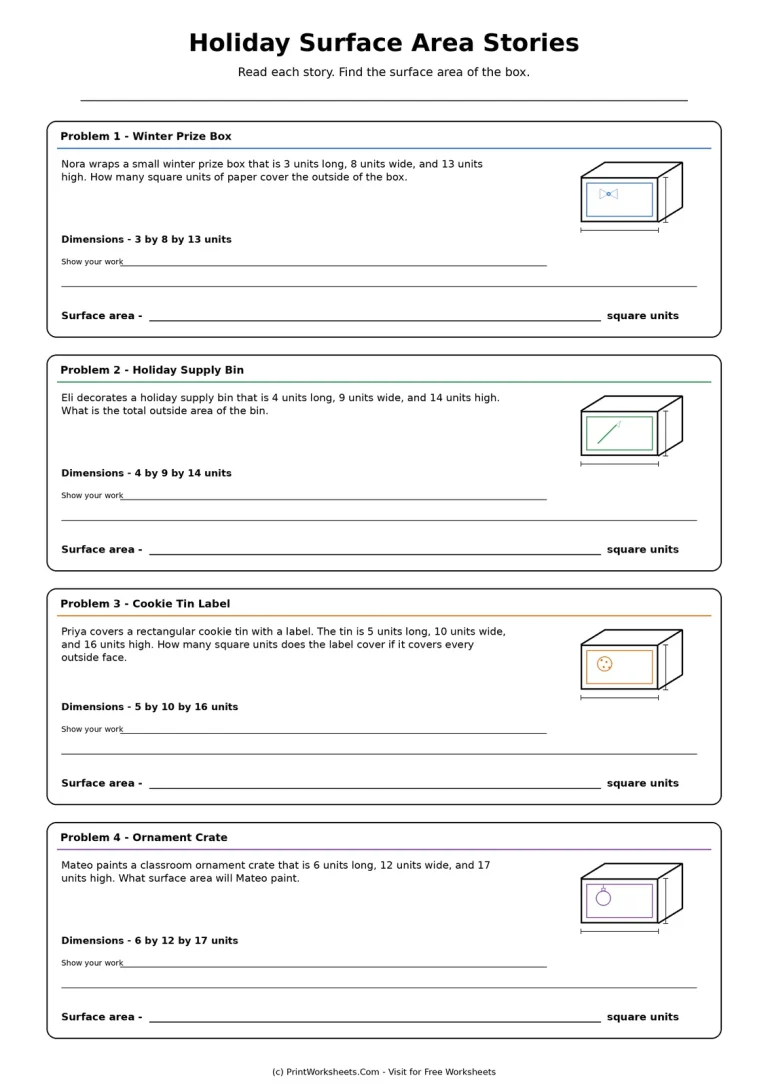
The final student worksheet, “Holiday Surface Area Stories,” moves the skill into four short real-world contexts. Students find the outside area of a winter prize box measuring 3 by 8 by 13 units, a holiday supply bin measuring 4 by 9 by 14, a cookie tin measuring 5 by 10 by 16, and an ornament crate measuring 6 by 12 by 17. Each problem includes a simple rectangular-prism illustration, the dimensions written again below the story, work space, and a final answer line labeled in square units.
These problems ask students to interpret phrases such as “paper cover the outside,” “total outside area,” and “covers every outside face” as surface-area situations. That language practice matters because students need to recognize when a problem is asking for total exterior area rather than volume or the area of just one face.
Ways to Use This Four-Page Set
The pages can be used in sequence for a short surface-area unit, or selected individually for warm-ups, centers, homework, or review. Page 1 works well for students first learning why six faces are included. Page 2 emphasizes nets and visual structure. Page 3 is useful for error analysis and checking calculations. Page 4 is the strongest choice for assessing whether students can transfer the skill to written situations. Together, the four activities provide a varied introduction to rectangular-prism surface area while keeping the focus on clear Grade 5 computation and reasoning.