These compare unit fractions worksheets for grade 3 include two printable pages with comparison, ordering, missing-number, and reasoning activities. Students compare fractions with a numerator of one by examining their denominators, writing greater than, less than, or equal symbols, and explaining why a smaller denominator represents a larger piece of the same whole.
The worksheets move from direct symbolic comparisons to more advanced fraction reasoning. Students compare pairs such as 1/2 and 1/4, order three unit fractions from greatest to least, complete missing denominators, evaluate true or false statements, and create their own correct comparisons.
Compare Unit Fractions Worksheets for Grade 3
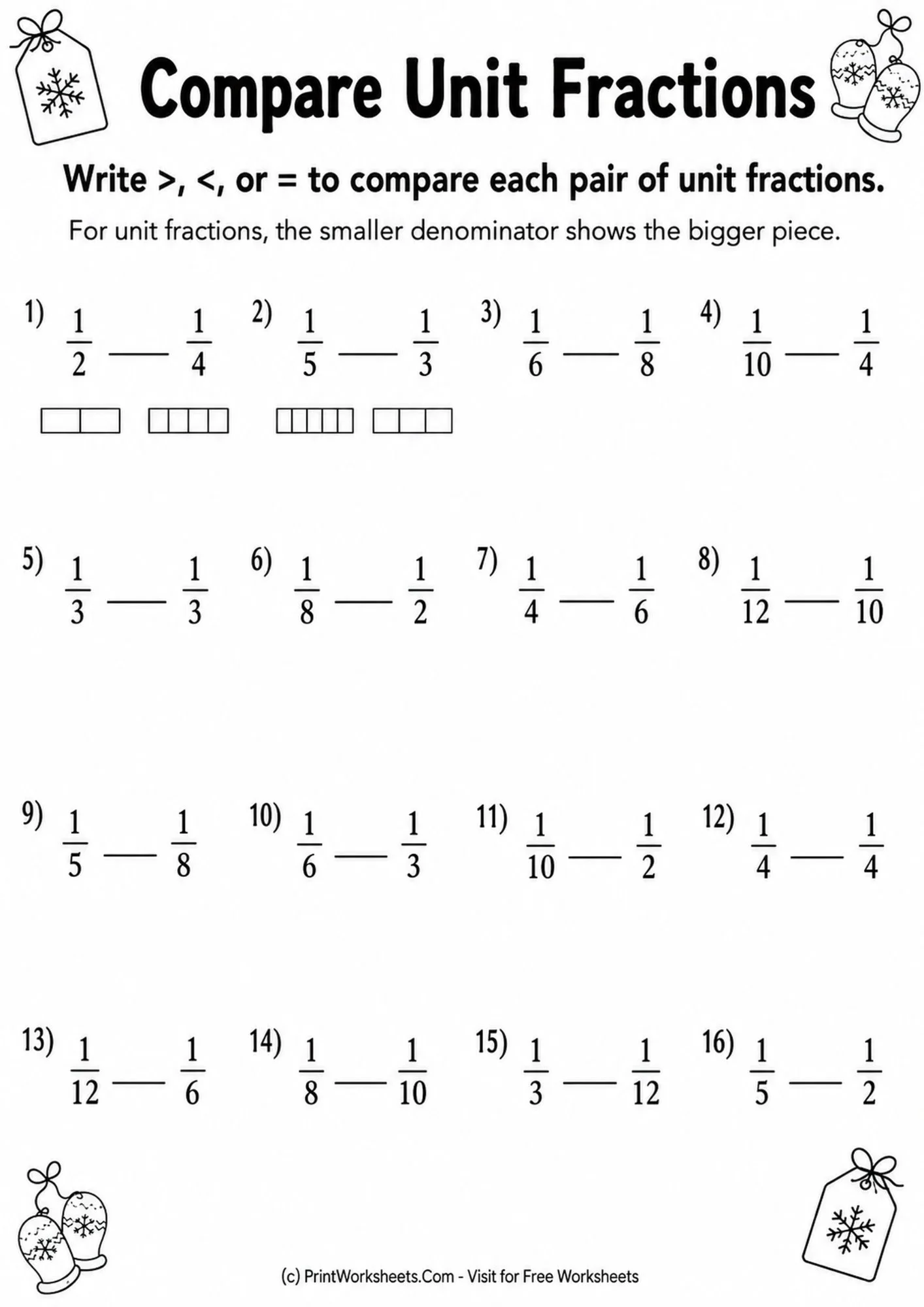
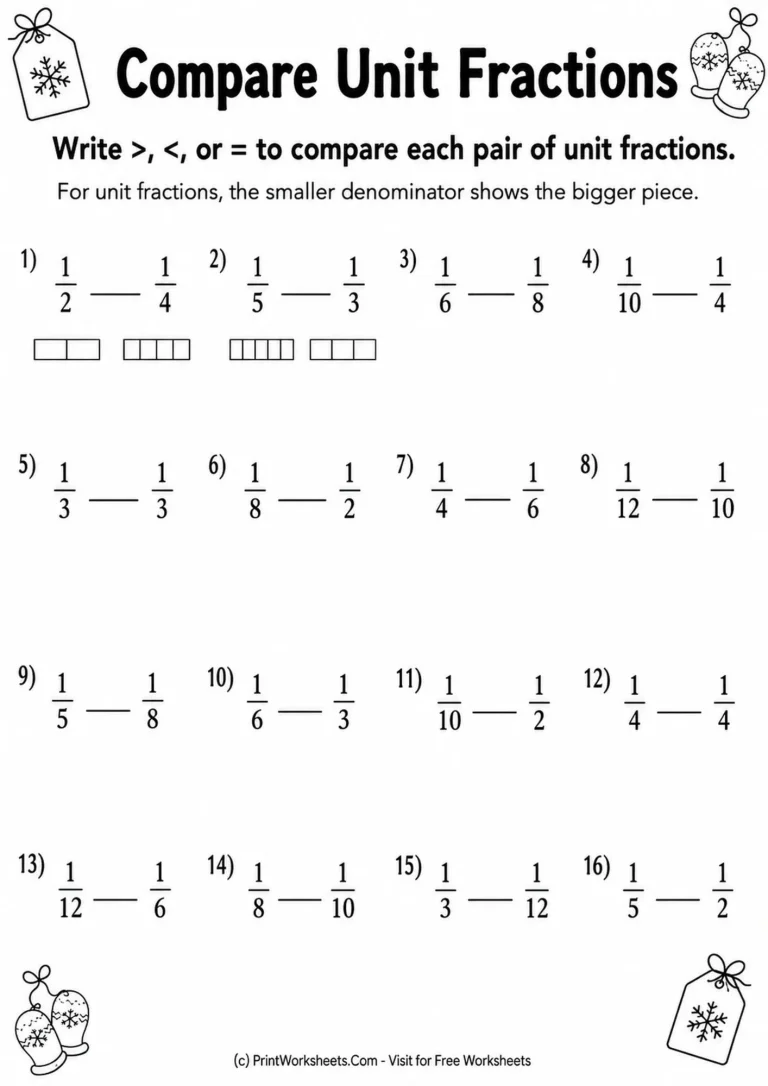
The first worksheet, Compare Unit Fractions, contains 16 comparison problems. Students write >, <, or = between each pair of fractions.
The page begins with a reminder that, for unit fractions, a smaller denominator represents a bigger piece. When the same whole is divided into fewer equal parts, each individual part is larger. For example, 1/2 is greater than 1/4 because a whole divided into two pieces produces larger pieces than a whole divided into four pieces.
The comparison pairs use denominators including 2, 3, 4, 5, 6, 8, 10, and 12. Several problems also include equal fractions such as 1/3 and 1/3 or 1/4 and 1/4. These examples help students remember that identical numerators and denominators represent equal values.
Review the basic model first: Use the unit fractions on number lines worksheets for grade 3 to help students see how equal intervals represent unit-fraction values.
Use Denominators to Compare Fraction Size
A unit fraction always has a numerator of one. Because the numerator stays the same, students can compare the denominators directly. The fraction with the smaller denominator represents the larger piece.
- 1/2 is greater than 1/5 because halves are larger than fifths.
- 1/8 is less than 1/3 because eighths are smaller than thirds.
- 1/4 equals 1/4 because both fractions name the same part of an equal whole.
The first four problems also provide small fraction-strip models. These visual supports connect the symbolic comparisons with equal parts of the same-length whole.
Complete the Unit Fraction Thinking Challenge
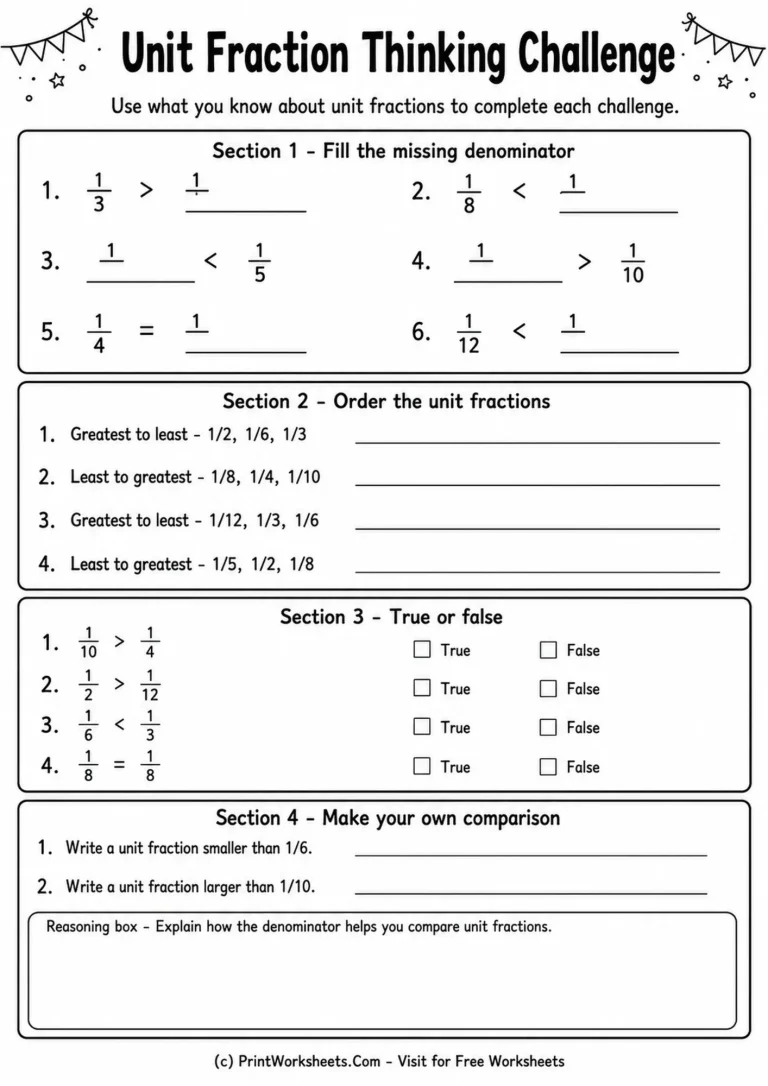
The second worksheet, Unit Fraction Thinking Challenge, provides four different activity sections. This makes the page suitable for independent review, small-group instruction, or a more advanced fraction center.
Fill in Missing Denominators
Students complete comparison statements containing a missing denominator. Some questions may allow several correct answers. For example, to make 1/3 greater than another unit fraction, the missing denominator must be greater than 3.
This activity requires students to reason about the relationship between denominator size and unit-fraction value instead of solving by memorized rules alone.
Order Unit Fractions
Students arrange sets of three fractions from greatest to least or least to greatest. The sets include fractions such as 1/2, 1/6, 1/3, 1/8, 1/4, and 1/10.
Students can first locate the smallest denominator to find the greatest unit fraction. They can then continue ordering the remaining denominators in the opposite direction.
Evaluate True or False Comparisons
The true-or-false section asks students to check four completed fraction statements. Examples include 1/10 > 1/4, 1/2 > 1/12, and 1/8 = 1/8.
This format helps reveal whether students are incorrectly assuming that a larger denominator always creates a larger fraction.
Create and Explain Comparisons
The final section asks students to write a unit fraction smaller than 1/6 and another unit fraction larger than 1/10. A large reasoning box then asks them to explain how the denominator helps them compare unit fractions.
Continue with same-numerator practice: Try the compare fractions with the same numerators worksheets for additional denominator-based comparison activities.
Ways to Use These Unit Fraction Worksheets
- Whole-class instruction: Model several comparisons and discuss why fewer equal parts create larger pieces.
- Math centers: Let students complete the 16 direct comparison problems independently.
- Small-group support: Use fraction strips or paper pieces to demonstrate difficult comparisons.
- Independent assessment: Use the thinking challenge to check ordering and written reasoning.
Download the free printable PDF to practice comparing unit fractions, ordering fraction values, using comparison symbols, and explaining denominator relationships in Grade 3.