These fraction models with halves thirds fourths worksheets for grade 3 include three printable activities for reading, drawing, and applying visual fractions. Students count shaded parts, identify the total number of equal parts, complete fraction models, and solve short fraction stories. The worksheets use clear rectangles, circles, squares, and equal-part bars to represent fractions such as 1/2, 1/3, 2/3, 1/4, 2/4, and 3/4.
The three-page sequence begins with completed shaded models, continues with models students must finish themselves, and ends with short real-world situations. This progression allows students to connect the numerator and denominator with the visible parts of a whole.
Read Shaded Halves, Thirds, and Fourths
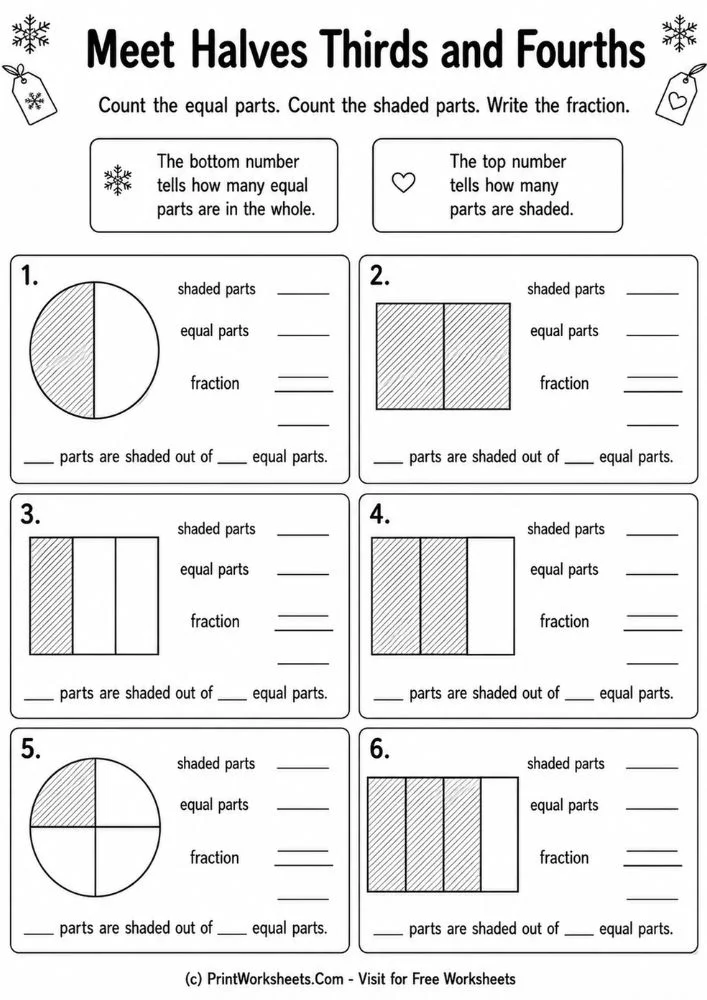
The first worksheet, Meet Halves Thirds and Fourths, contains six visual fraction models. For every model, students record the number of shaded parts, count all equal parts, and write the matching fraction.
The examples include a circle divided into halves, rectangles divided into thirds, and models divided into fourths. Students complete sentences such as “___ parts are shaded out of ___ equal parts,” reinforcing the relationship between the numerator and denominator.
One model shows one shaded half, while another shows both halves shaded. The thirds models represent 1/3 and 2/3, and the fourths models represent 1/4 and 3/4. These examples help students compare how the same whole can be divided into different numbers of equal parts.
Build Equal-Part Fraction Models
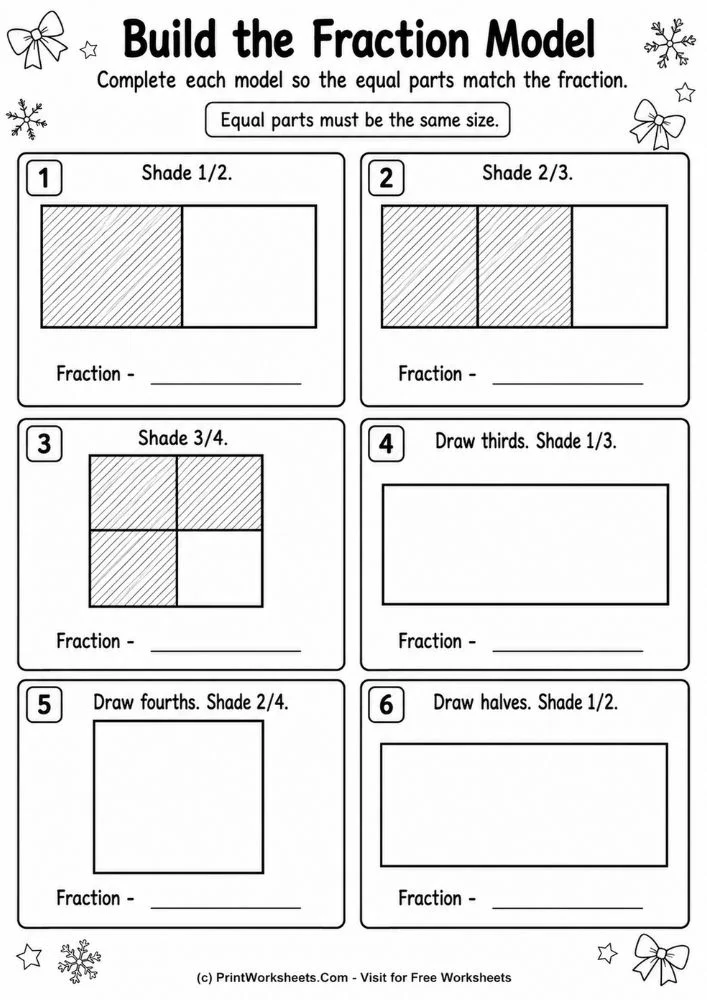
The Build the Fraction Model worksheet combines completed examples with drawing tasks. Students first read models showing 1/2, 2/3, and 3/4. They then create their own equal partitions and shade the requested amount.
Students draw thirds and shade 1/3, divide a square into fourths and shade 2/4, and draw halves before shading 1/2. A reminder at the top states that equal parts must be the same size. This keeps the focus on fair partitioning rather than simply drawing the correct number of sections.
The open models allow more than one correct partitioning method. For example, a rectangle may be divided vertically or horizontally as long as the resulting parts have equal area.
Fraction Model Story Problems for Grade 3
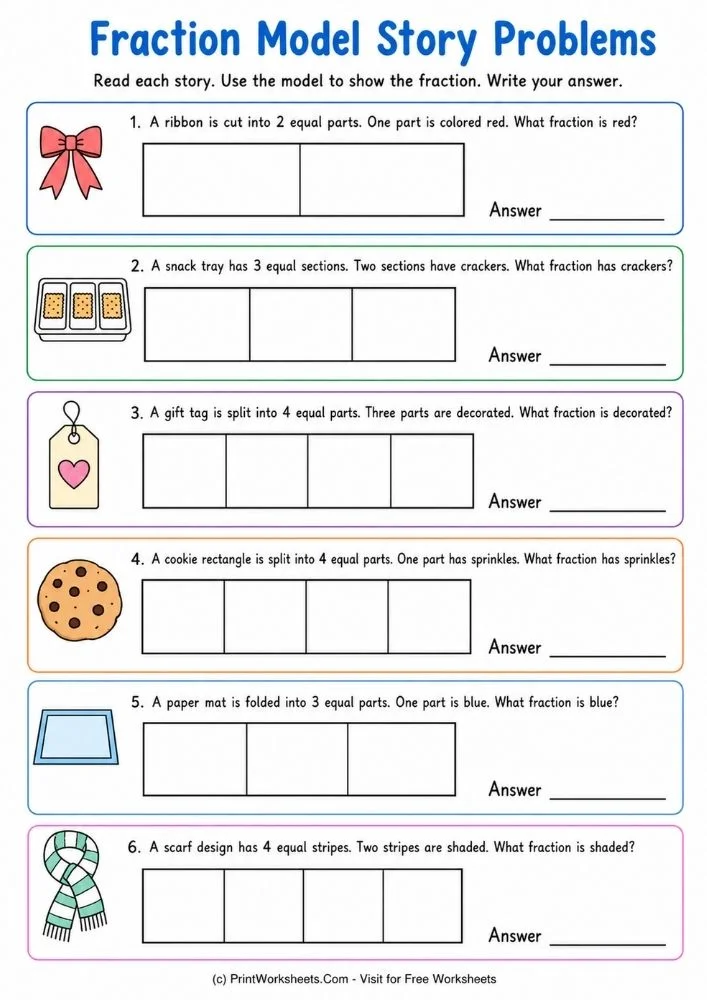
The third worksheet applies fraction models to six short situations. Students use blank equal-part bars to show the fraction described in each story and then write the answer.
The problems include a ribbon divided into two equal parts with one part colored, a snack tray with two of three sections filled, and a gift tag with three of four parts decorated. Other prompts use a cookie rectangle, a paper mat, and a scarf design.
Each story tells students both the number of equal parts and the number selected or shaded. Students transfer that information to the visual model before writing fractions such as 1/2, 2/3, 3/4, 1/4, 1/3, and 2/4.
Ways to Use These Fraction Model Worksheets
- Visual introduction: Begin with the completed shaded models and discuss the numerator and denominator.
- Guided drawing: Complete one open model together before students draw the remaining partitions independently.
- Small-group practice: Ask students to explain why their partitions are equal.
- Independent review: Use the story page after students understand halves, thirds, and fourths.
These printable fraction activities can be used during a Grade 3 fractions lesson, math-center practice, homeschool instruction, or independent review. Download the free PDF and use the three worksheets to practice reading, building, and explaining visual fraction models.