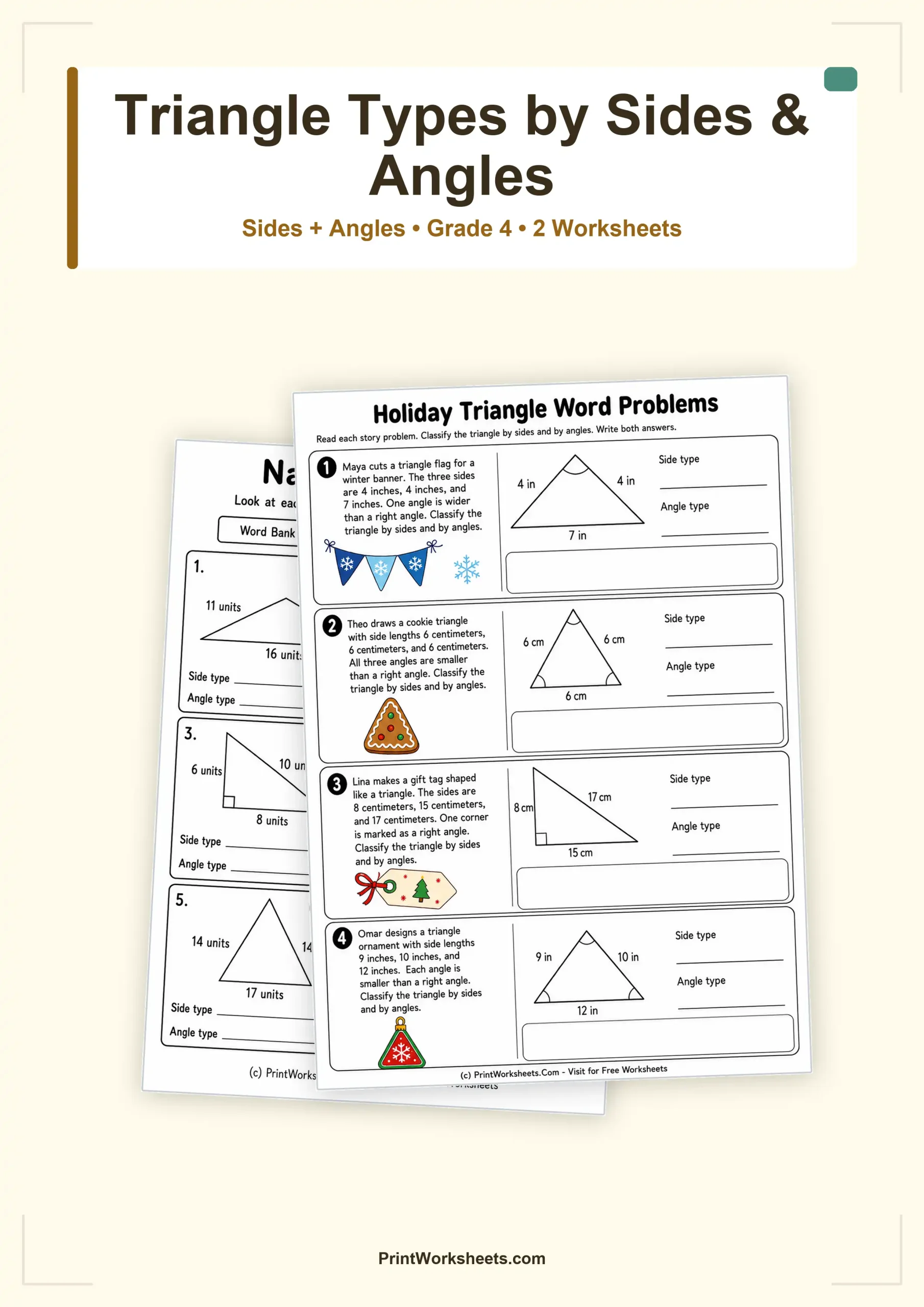
These classify triangles worksheets give fourth graders two different ways to practice the same geometry skill: identifying triangles by side lengths and by angle type. One page uses a compact word bank and six labeled figures, while the second places the classifications inside winter-themed story problems. Students work with equilateral, isosceles, and scalene triangles as well as acute, right, and obtuse triangles, so each problem asks them to consider two attributes instead of stopping after a single label.
Classify triangles worksheets with side and angle clues
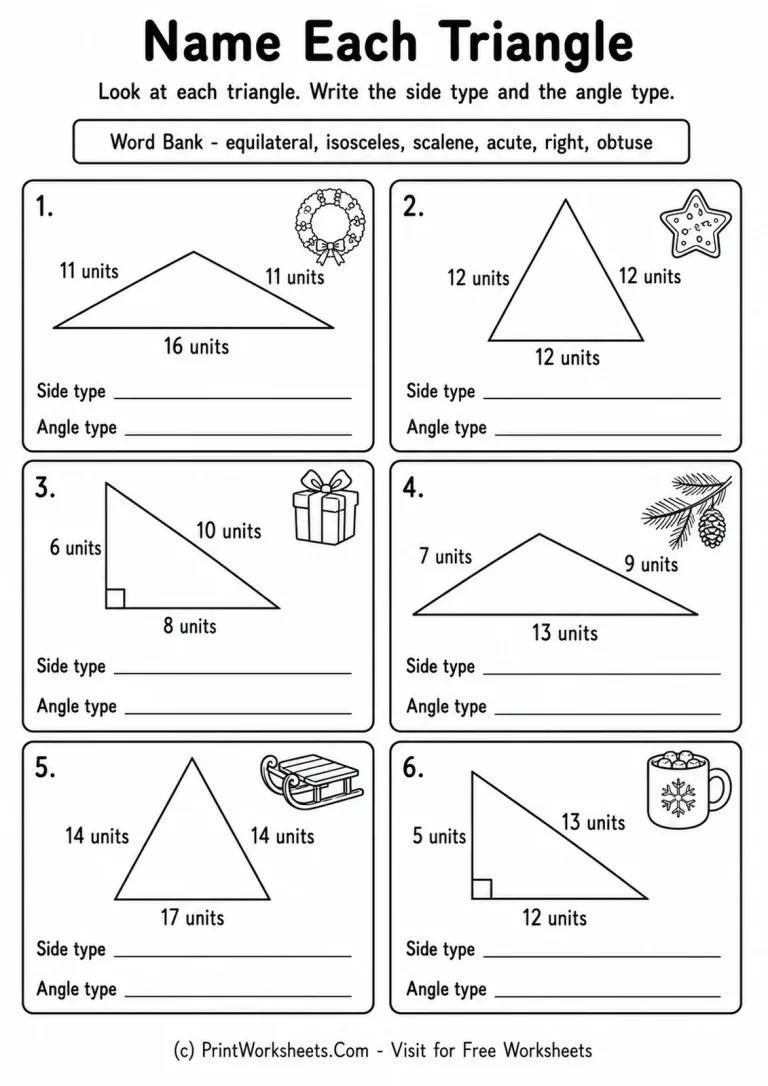
The first worksheet, “Name Each Triangle,” keeps the task focused. A word bank lists equilateral, isosceles, scalene, acute, right, and obtuse, and students write both a side type and an angle type for each of six triangles. Because the figures include side-length labels, students can reason from numerical information rather than relying only on how a triangle looks.
The examples provide a useful range of cases. An 11-11-16 triangle is isosceles and obtuse, while the 12-12-12 figure is equilateral and acute. A 6-8-10 triangle and a 5-12-13 triangle are both scalene right triangles. Students also see a 7-9-13 scalene obtuse triangle and a 14-14-17 isosceles acute triangle. This mix helps prevent the common misconception that a side classification automatically determines the angle classification.
Move from direct classification to holiday word problems
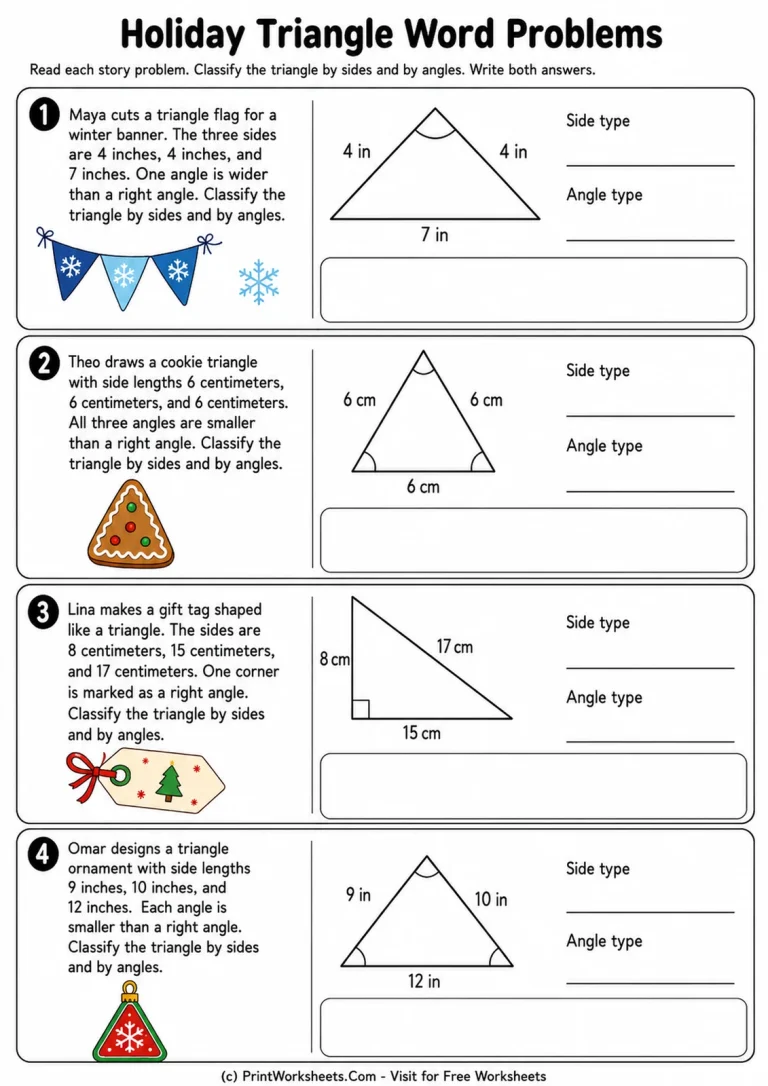
The second worksheet changes the format without changing the target skill. Four short holiday-themed situations describe triangles used for a winter banner, a cookie, a gift tag, and an ornament. Students read the side lengths and angle information, then record both the side type and angle type. The page pairs each story with a labeled triangle diagram, giving learners a chance to connect written information, measurements, and geometric vocabulary.
The problems are intentionally varied. The 4-4-7 banner triangle is isosceles and obtuse. The 6-6-6 cookie triangle is equilateral and acute. The 8-15-17 gift-tag triangle is scalene and right, and the 9-10-12 ornament triangle is scalene and acute. That progression gives students repeated practice with the complete classification language while changing the numerical evidence they must interpret.
What students practice on these Grade 4 triangle worksheets
Students practice comparing side lengths, recognizing when all three sides are equal, spotting pairs of equal sides, and identifying when all three side lengths differ. They also distinguish acute, right, and obtuse triangles using angle markings, stated angle information, and the structure of the diagrams. For students who are ready to explain their thinking, the labeled measurements create natural opportunities to ask why a triangle fits one category and not another.
This set also works well as a follow-up to broader polygon work. Students who have practiced recognizing and constructing shapes by attributes can continue with draw polygons by attributes worksheets. For additional measurement practice with labeled shapes, perimeter of polygons worksheets provide another way to use side-length information in geometry.
Ways to use the two-page set
The direct-classification page is a good choice for guided practice, a math center, or a quick check after introducing the six vocabulary terms. The holiday word-problem page can follow once students are comfortable naming triangle types from diagrams. Teachers can also split the pages across two lessons: first classify from visible measurements, then classify from short written scenarios. At home, the same sequence gives parents an easy way to see whether a child can use the vocabulary in more than one format.
For extra discussion, ask students to justify both parts of each answer separately. A student might explain that a triangle is isosceles because two sides match, then give a different piece of evidence for why it is obtuse or acute. This two-step explanation reinforces that side type and angle type describe different properties of the same triangle.
A focused Grade 4 geometry practice set
These worksheets are especially useful when students need more than simple triangle naming. The labeled side lengths, right-angle markers, word bank, and contextual problems require learners to combine evidence and choose two accurate classifications for each figure. Use the set for independent practice, review before a geometry assessment, or a short seasonal math activity that still keeps the mathematical objective clear.