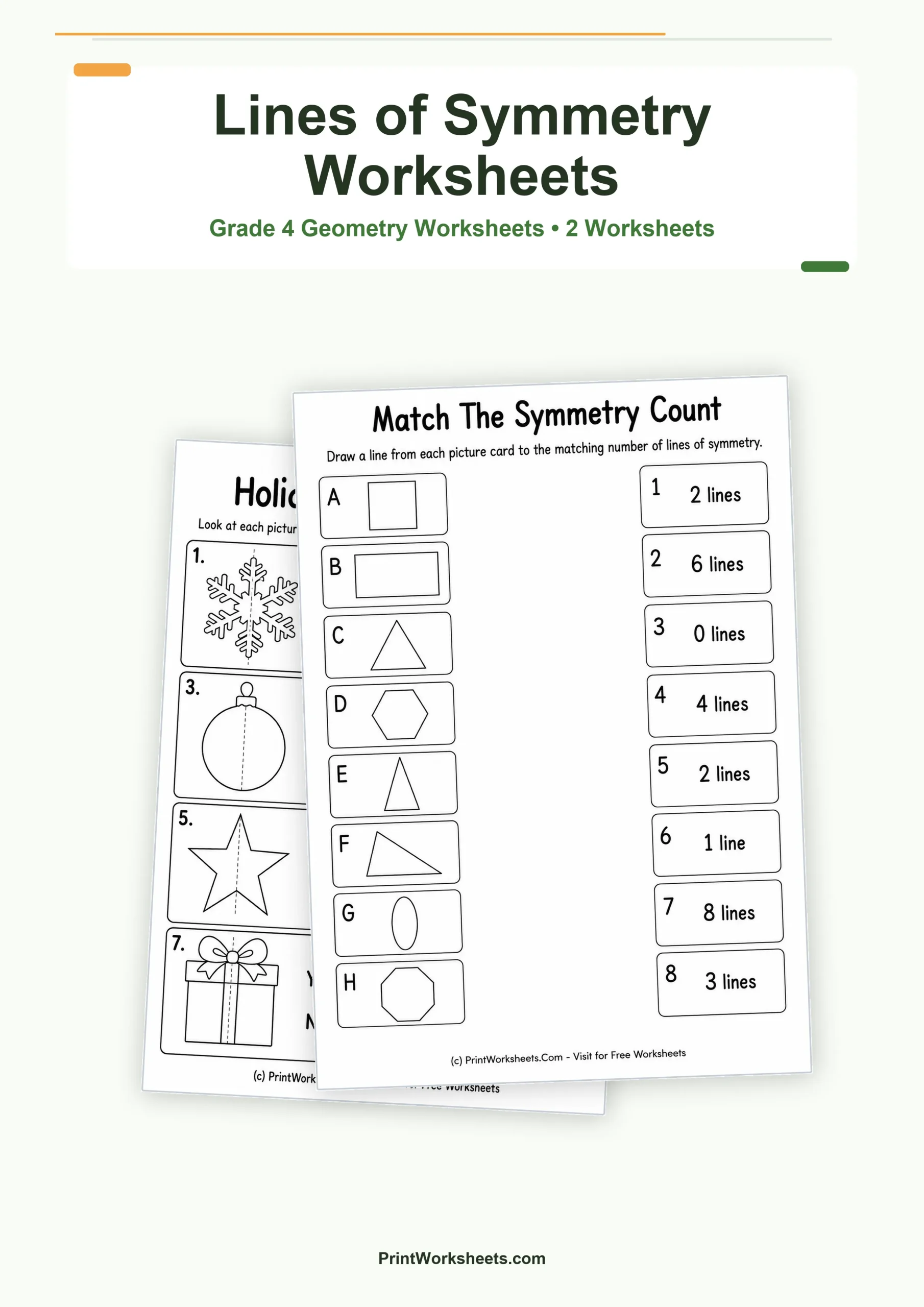
These lines of symmetry worksheets give Grade 4 students two different ways to reason about reflection. One page starts with familiar holiday pictures and asks students to decide whether each image has a line of symmetry. The second moves into geometric figures and asks students to match each shape with the correct number of symmetry lines. Together, the pages help students move from a quick visual judgment to more exact mathematical counting.
Lines of Symmetry Worksheets for Visual Recognition
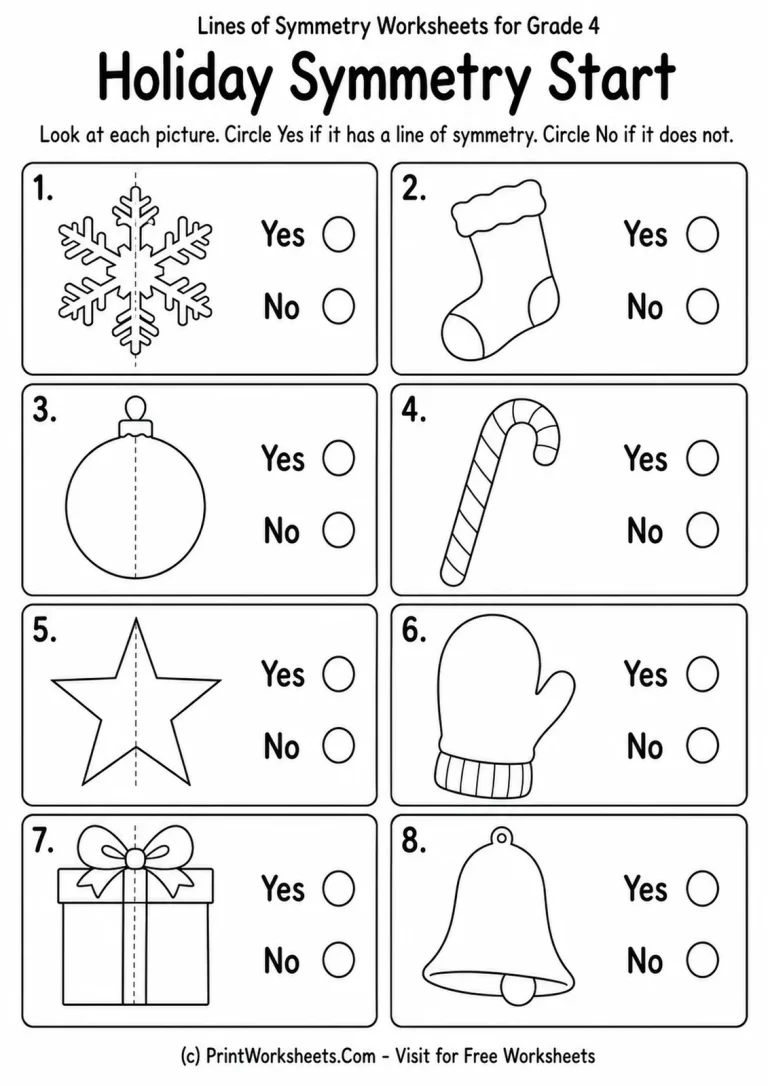
The first printable is built around eight holiday-themed objects. Students look at a snowflake, stocking, ornament, candy cane, star, mitten, gift, and bell, then circle Yes or No to show whether each picture has a line of symmetry. The mix matters because students are not simply identifying nice-looking or balanced pictures. They must compare the left and right sides of each drawing and decide whether a fold or mirror line would create matching halves.
Several pictures provide clear positive examples, including the snowflake, ornament, star, gift, and bell. Others, such as the stocking, candy cane, and mitten, give students useful non-examples. This contrast encourages careful observation and gives teachers an easy way to ask follow-up questions such as, “Where would you place the mirror line?” or “What part of this picture prevents the two sides from matching?”
Count Symmetry Lines in Geometric Shapes
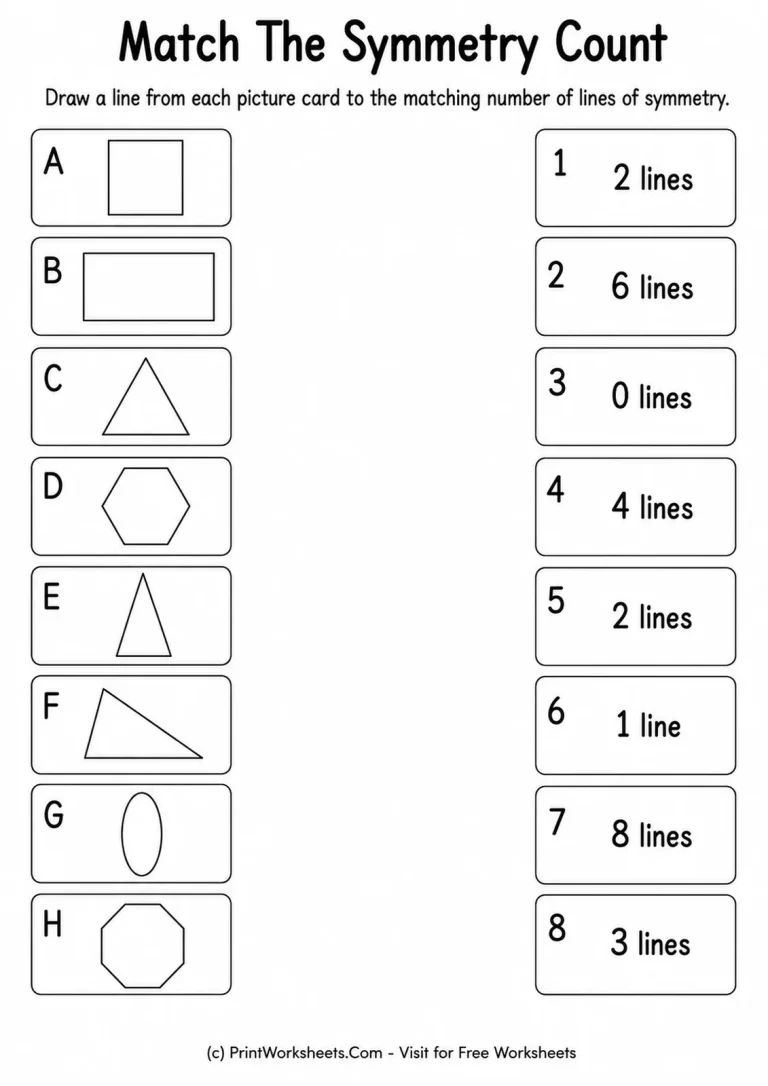
The second worksheet shifts from everyday pictures to standard geometric figures. Eight labeled cards show a square, rectangle, equilateral triangle, regular hexagon, isosceles triangle, scalene triangle, ellipse, and regular octagon. Students draw matching lines from each shape to a card showing the number of lines of symmetry.
This activity expands the skill beyond a simple yes-or-no decision. Students must distinguish between shapes with no line of symmetry, one line, two lines, and shapes with several lines. For example, the scalene triangle has 0 lines, the isosceles triangle has 1, the rectangle and ellipse each have 2, the equilateral triangle has 3, the square has 4, the regular hexagon has 6, and the regular octagon has 8. That range makes the page useful for checking whether students understand that symmetry is not limited to a single vertical line.
A Natural Grade 4 Geometry Progression
These two pages work well in sequence. Start with the picture-based page when students are first reviewing the idea of a mirror line. Because the objects are familiar, students can focus on the symmetry concept without needing to identify unfamiliar shapes. Then use the matching page to require more precise reasoning with geometric figures and exact counts.
The set can also support a short small-group lesson. Ask students to explain how they know a shape is symmetric before they mark an answer. For shapes with more than one symmetry line, students can point to possible vertical, horizontal, or diagonal mirror lines. This verbal explanation is especially helpful when students recognize symmetry visually but are not yet confident counting all possible lines.
Ways to Use These Printables
Teachers can use the pages for independent practice, a geometry center, morning work, homework, or a quick formative check. The first page is especially convenient for a fast warm-up because each item requires only a Yes or No response. The second page works well after instruction because students must compare several different shapes and symmetry counts.
If students need related geometry practice, the lines, rays and line segments worksheets offer another visual way to work with geometric features. For additional polygon practice, the perimeter of polygons worksheets can help students connect shape recognition with measurement.
What Students Practice
Across the two worksheets, students practice recognizing mirror symmetry, identifying non-symmetric examples, counting exact lines of symmetry, and comparing different classes of shapes. The combination of holiday illustrations and clean geometric figures keeps the practice varied while staying focused on one clear Grade 4 geometry skill.
Use the first page to build confidence with visual examples, then follow with the matching activity when students are ready to count symmetry lines more precisely. The two formats make this a compact printable set for reviewing an important geometry concept without repeating the same task twice.