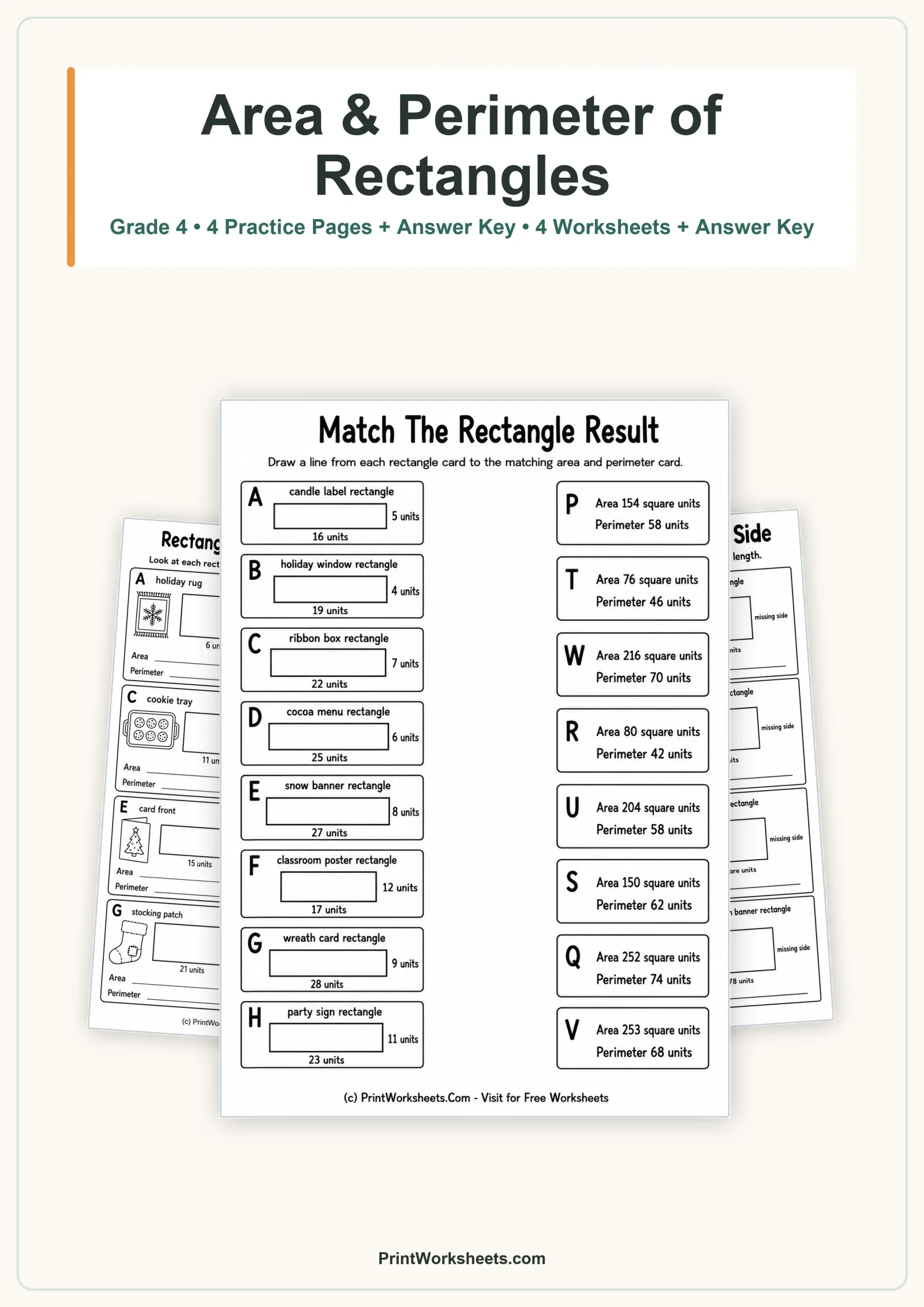
These area and perimeter worksheets give fourth-grade students a focused sequence of rectangle practice that moves beyond a single formula drill. Students begin by using given side lengths to calculate both measurements, then match rectangles to paired results, work backward to find missing side lengths, and finish with short story problems. Across the four student pages, the numbers stay whole and the diagrams keep the rectangle structure visible, so learners can concentrate on choosing and applying the correct relationship between length, width, area, and perimeter.
Area and Perimeter Worksheets for Rectangle Practice
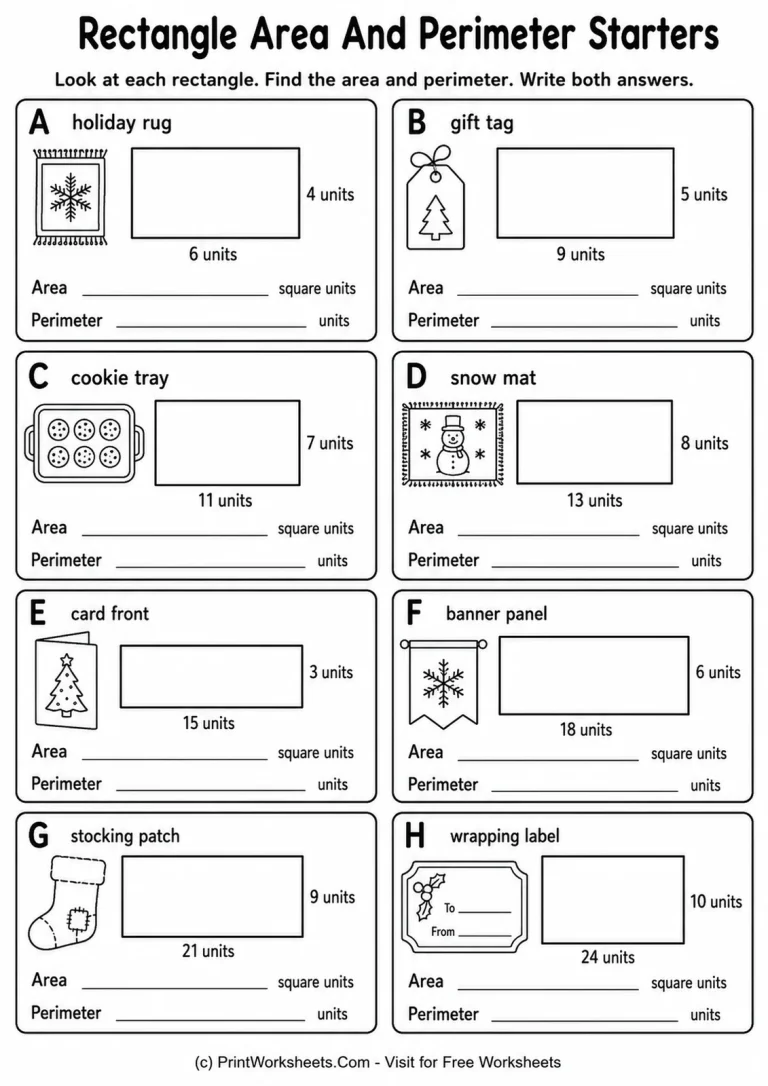
The first page works well as a warm-up or independent review because every item asks for two connected answers. Eight rectangles are labeled with side lengths such as 6 by 4, 11 by 7, 18 by 6, and 24 by 10 units. Students record area in square units and perimeter in units, reinforcing an important distinction in both the calculation and the label. The progression also gives repeated practice with multiplication for area and addition or the formula 2(l + w) for perimeter.
Match Dimensions to Both Results
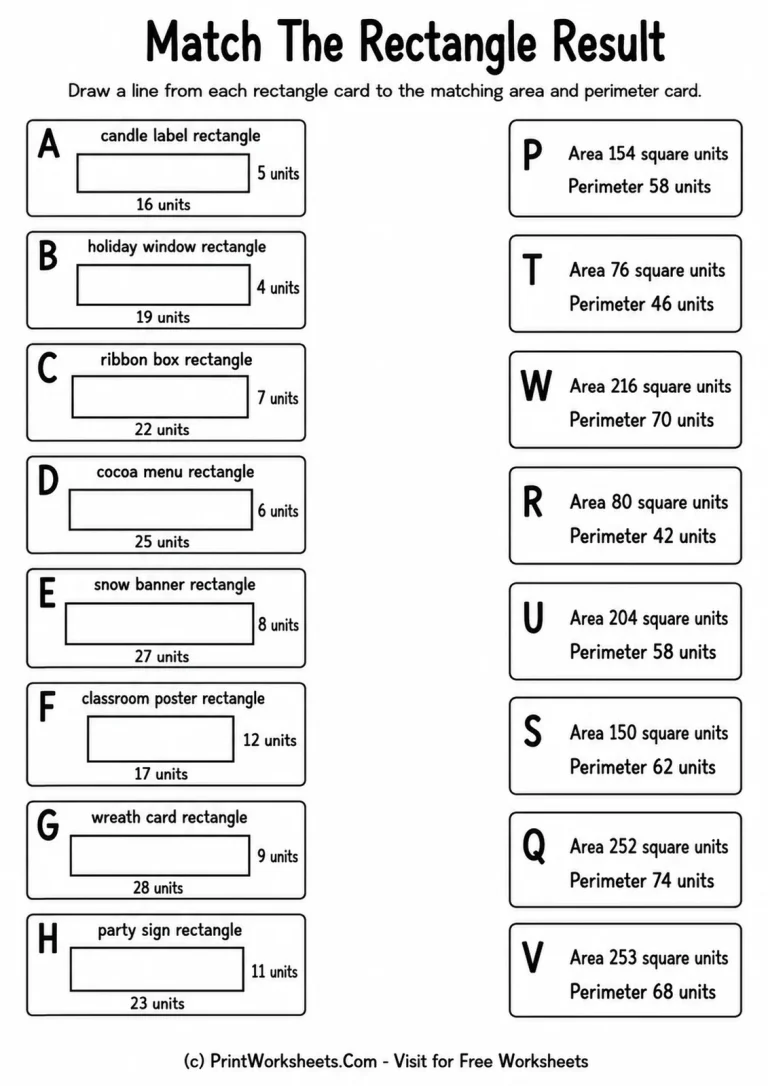
The second worksheet changes the task without changing the core skill. Students see eight rectangle cards and eight result cards, then draw a line to connect each rectangle with the correct area-and-perimeter pair. Because each right-side card includes both measurements, students cannot rely on only one quick calculation. For example, a 16-by-5 rectangle must match 80 square units and 42 units, while a 17-by-12 rectangle matches 204 square units and 58 units. This format is useful for checking whether students can verify two properties of the same rectangle before choosing an answer.
Work Backward to Find a Missing Side
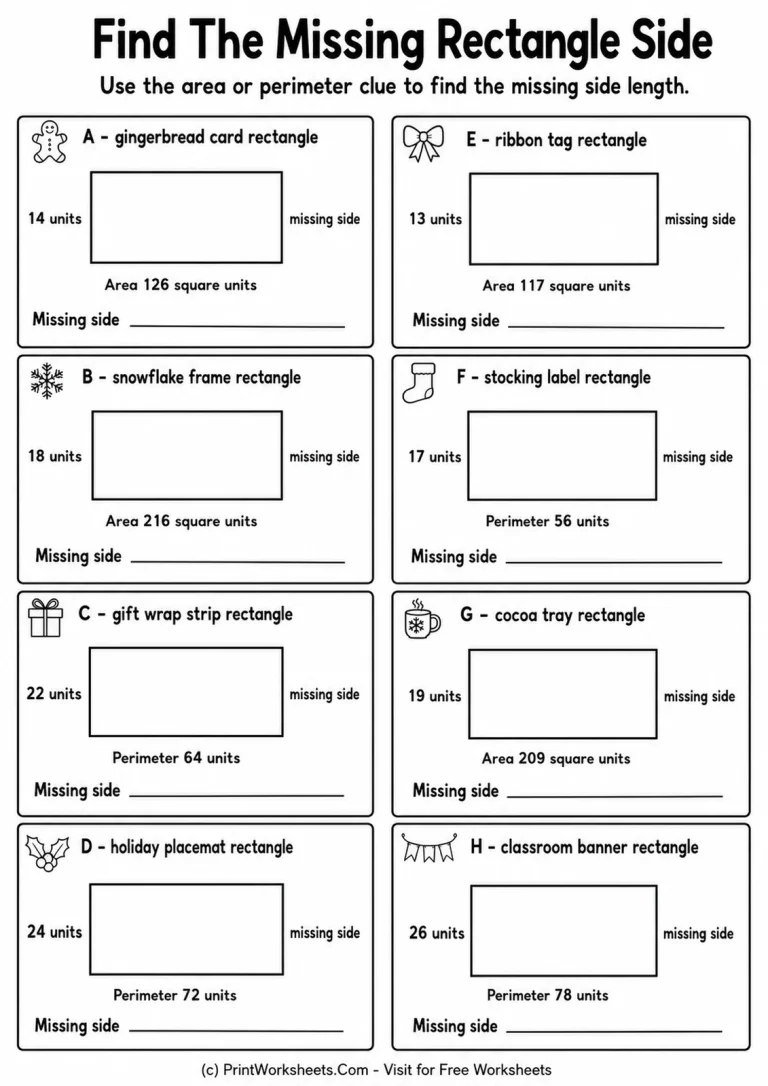
The third page adds a stronger reasoning step. Instead of receiving both dimensions, students use one known side together with either an area clue or a perimeter clue to determine the missing side length. The set mixes division problems, such as finding the unknown side when the area is 126 square units and the known side is 14 units, with perimeter equations such as 2(22 + x) = 64. Eight problems alternate these structures, helping students recognize when to divide an area by a known side and when to undo the perimeter formula.
Apply the Skill in Rectangle Story Problems
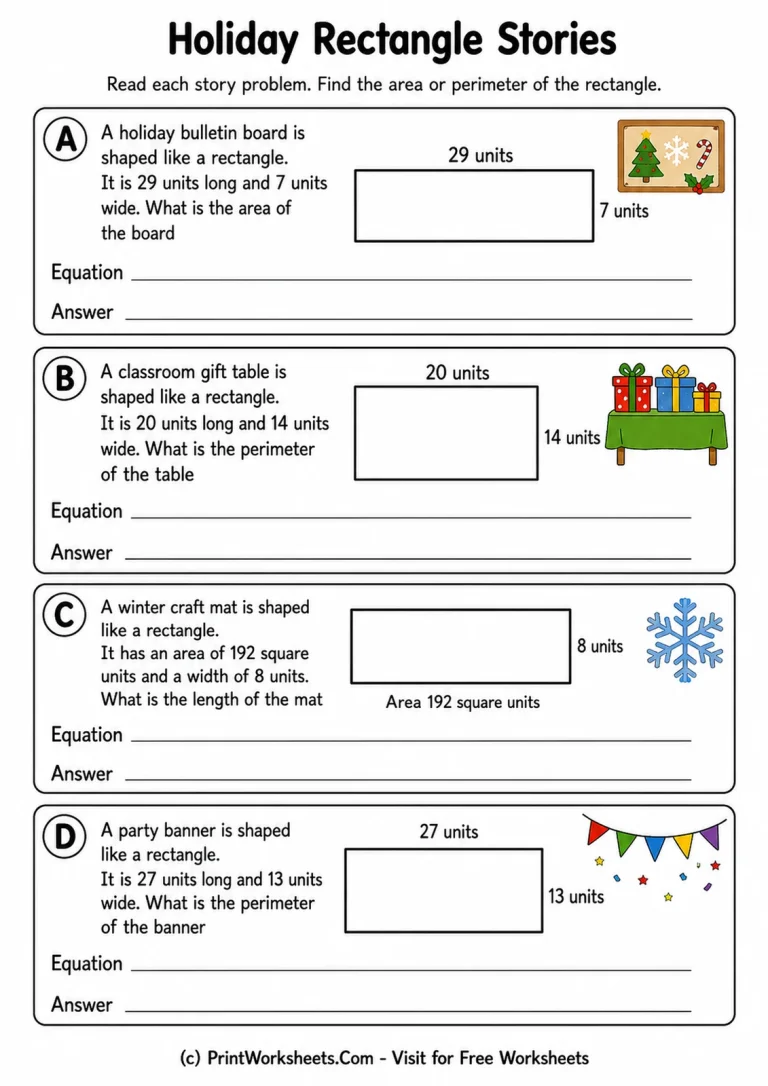
The fourth worksheet places the same mathematics into four short contexts. Students find the area of a 29-by-7 holiday bulletin board, the perimeter of a 20-by-14 classroom gift table, the missing length of a craft mat with area 192 square units and width 8 units, and the perimeter of a 27-by-13 party banner. Each problem includes a rectangle diagram plus separate spaces for an equation and an answer, encouraging students to show the operation they chose rather than write only a final number.
A Practical Grade 4 Geometry Sequence
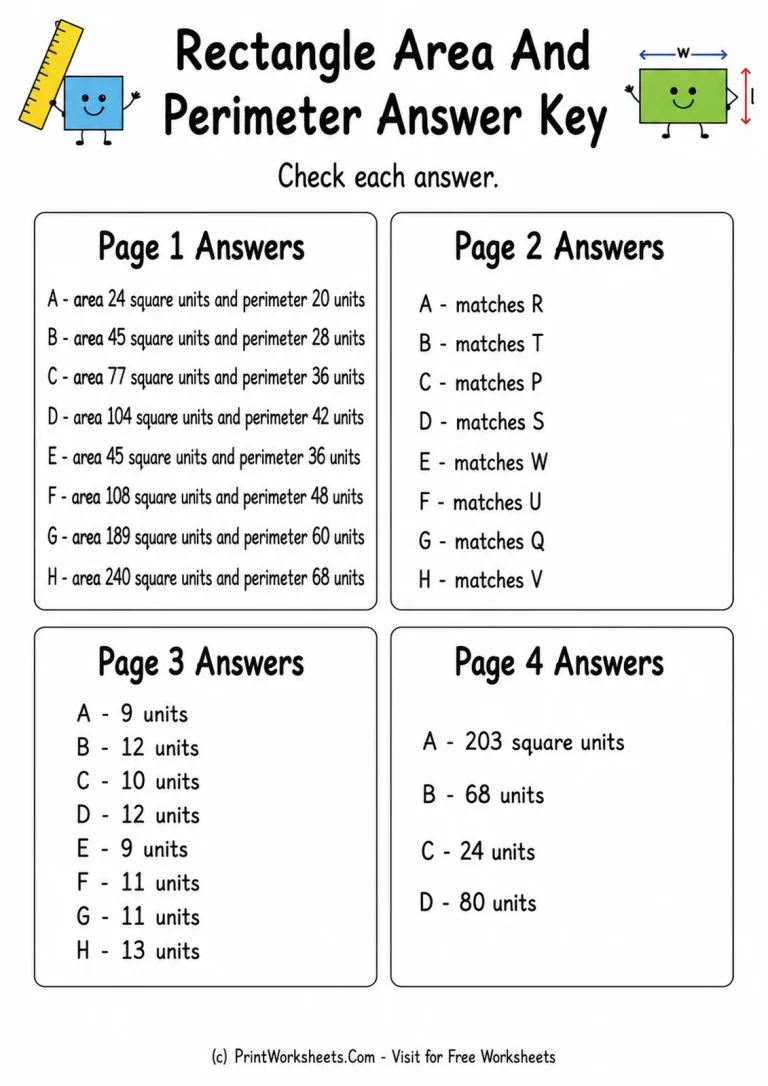
This set can be used in order when students are moving from direct computation toward multi-step reasoning. Page 1 establishes the two formulas side by side. Page 2 asks students to identify complete result pairs. Page 3 reverses the process by making one side unknown. Page 4 then requires students to decide from the wording whether the situation calls for area, perimeter, or an inverse operation. A complete answer key covers all four pages, making the packet practical for classwork, homework, math centers, intervention, or quick checking after independent practice.
For students who still need a more visual foundation for area, the area of rectangles with unit squares worksheets provide earlier practice connecting rectangular arrays to square-unit area. Learners who need extra work on boundary length can also use the perimeter of polygons worksheets before returning to the combined rectangle tasks here.
What Students Practice Across the Four Pages
Students repeatedly distinguish square units from linear units, calculate with whole-number dimensions, connect dimensions to paired results, solve for an unknown side, and translate short real-world descriptions into equations. The variety matters because it reveals whether a student understands the structure of a rectangle or is only memorizing a formula. A learner who succeeds on the matching and missing-side pages is showing that area and perimeter can be used flexibly in both forward and reverse directions.
Use the pages separately for targeted practice or as a short progression over several lessons. Starting with direct calculations and ending with the story problems creates a natural path from fluency to application, while the answer key keeps review efficient for teachers and families.