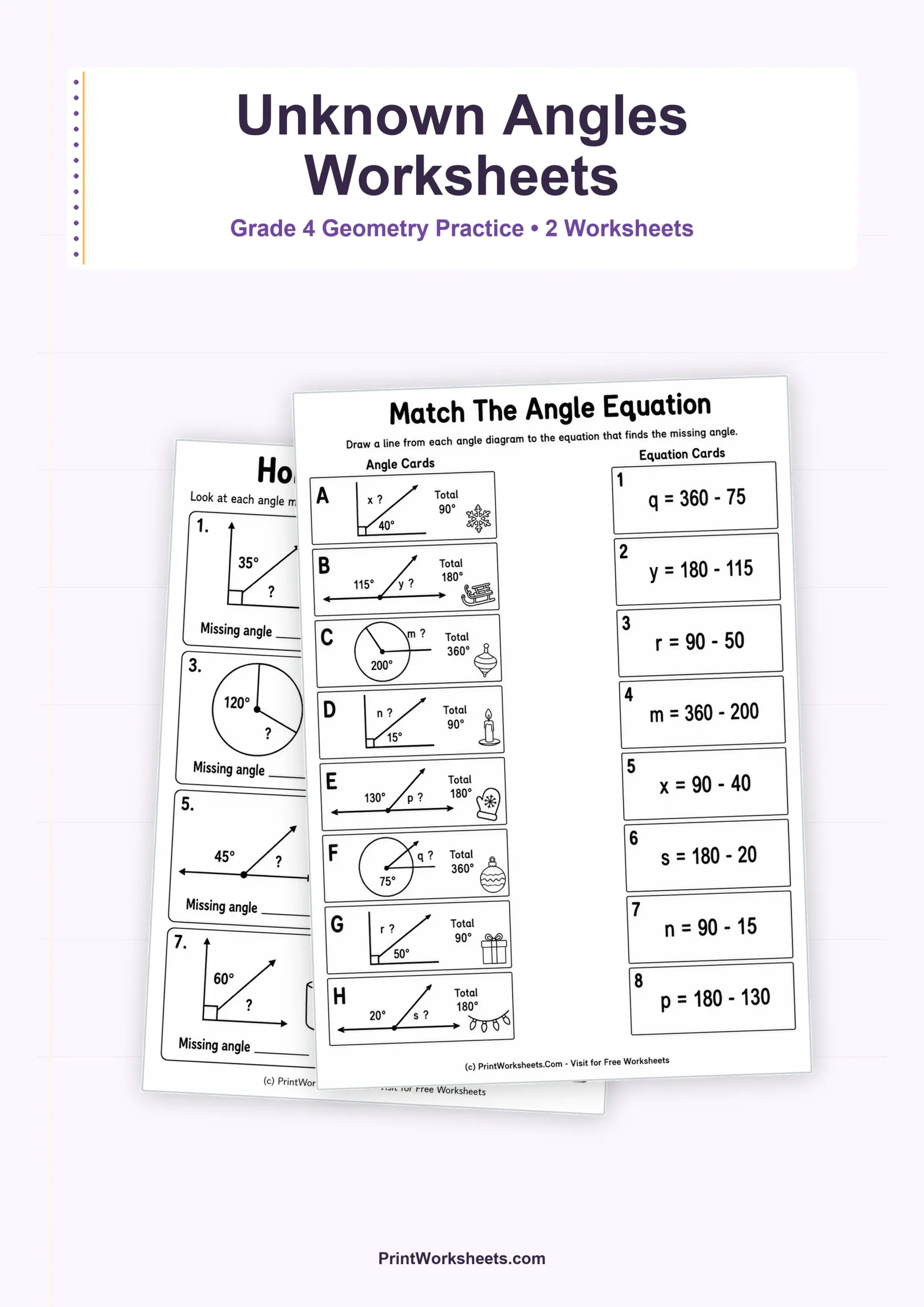
Angle relationships become more concrete when students can see the total measure and work backward to the missing part. These unknown angles worksheets for Grade 4 focus on that exact reasoning with right angles, straight angles, and full turns. Students use totals of 90°, 180°, and 360° rather than estimating from appearance, so every problem reinforces the idea that an unknown angle can be found by subtracting a known part from the complete angle measure.
Unknown Angles Worksheets with 90°, 180°, and 360° Totals
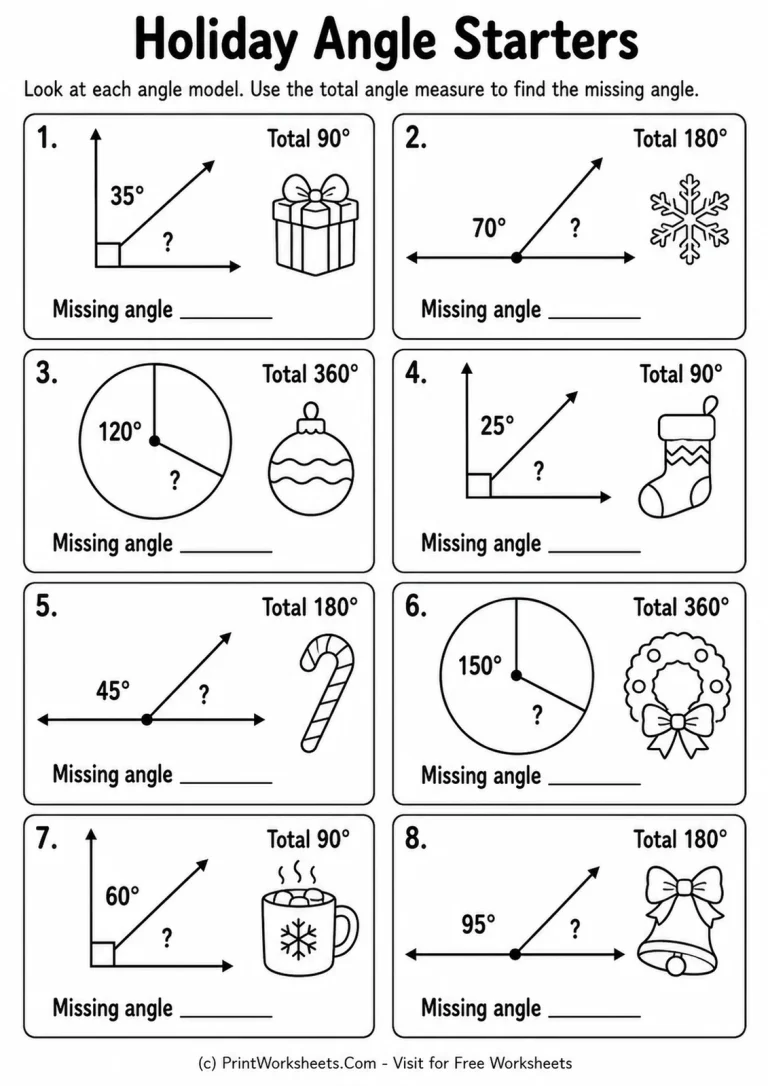
The first printable, Holiday Angle Starters, gives students eight direct missing-angle problems. Each model clearly identifies a total angle and one known measure. For example, students may see a 90° total with a 35° part, a 180° straight angle with a 70° part, or a 360° full-turn model with 120° already identified. To solve the problems, students determine how much of the total remains and record the missing angle on the answer line. Across the page, the correct missing measures include examples such as 55°, 110°, 240°, 65°, 135°, 210°, 30°, and 85°.
Build the subtraction relationship before introducing variables
This first activity works well when students are learning to connect geometric models with arithmetic. A teacher can ask, “What is the whole angle?” and “What part do we already know?” before students subtract. The visual mix is useful because the same reasoning is repeated across three common structures: a right angle totals 90°, a straight angle totals 180°, and a complete turn totals 360°. The seasonal line drawings add visual interest without changing the mathematical task, making the page suitable for independent practice, a short review station, or homework.
Match angle diagrams to the equation that solves them
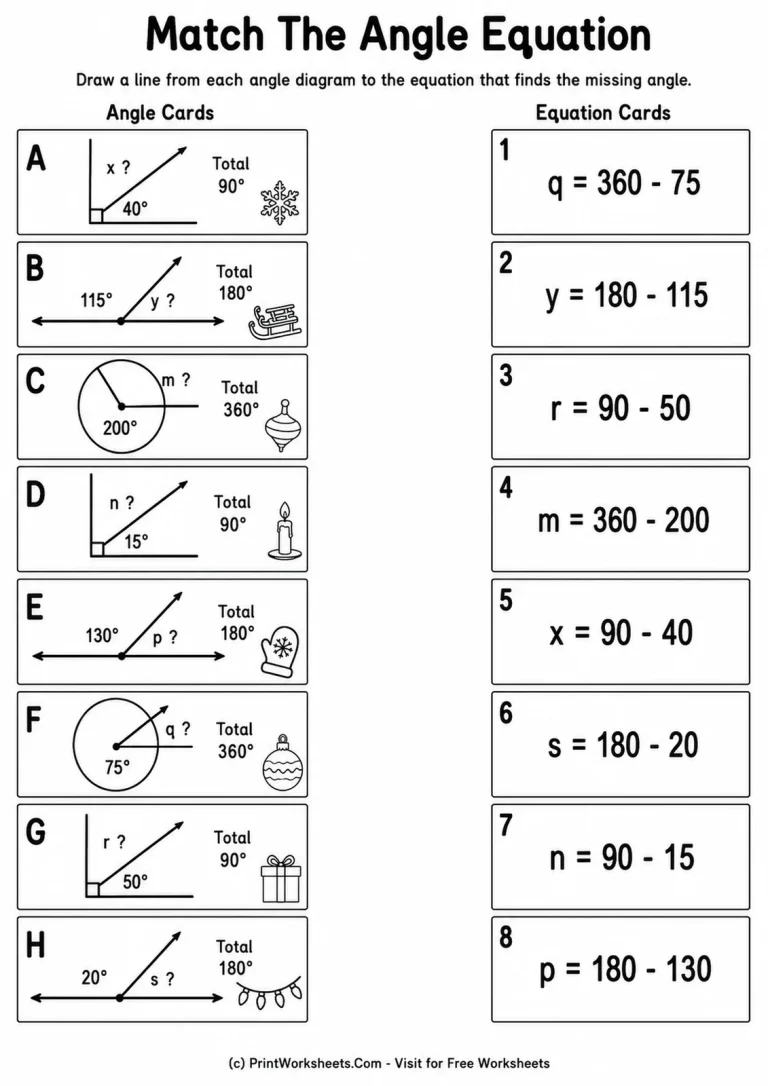
The second printable, Match The Angle Equation, shifts from calculating answers directly to recognizing the correct equation. Eight angle cards labeled A through H are paired with eight equation cards numbered 1 through 8. Students draw a line from each diagram to the subtraction equation that represents its missing angle. The cards include variables x, y, m, n, p, q, r, and s and again use totals of 90°, 180°, and 360°. Examples include x = 90 – 40, y = 180 – 115, m = 360 – 200, and q = 360 – 75.
Why the two activities work well together
The two-page sequence moves from computation to representation. On the first page, students see the known part and total, then calculate what is missing. On the second, they must identify which equation matches the structure of a diagram before solving it. That extra step encourages students to think about why the subtraction equation works instead of relying only on a memorized procedure. It also gives teachers a quick way to see whether a student understands the relationship among the whole angle, the known angle, and the unknown angle.
Ideas for Grade 4 instruction
Before assigning the pages, review the three benchmark totals students will encounter: 90° for a right angle, 180° for a straight angle, and 360° for one complete turn. Students can first state the total aloud, identify the given measure, and then write a subtraction equation. For additional discussion, ask them to predict whether the missing angle should be greater or less than the known angle before calculating. This simple check can help students notice unreasonable answers and strengthen angle-measure sense.
Continue with related Grade 4 geometry skills
After students are comfortable finding missing measures, they can connect angle knowledge to shape classification with classify triangles by angles and sides worksheets. For broader geometry review, perimeter of polygons worksheets provide measurement practice with polygon boundaries, while identify quadrilaterals worksheets reinforce recognition of common four-sided shapes and their properties. Together, these topics help students move between angle measure, shape attributes, and geometric reasoning.