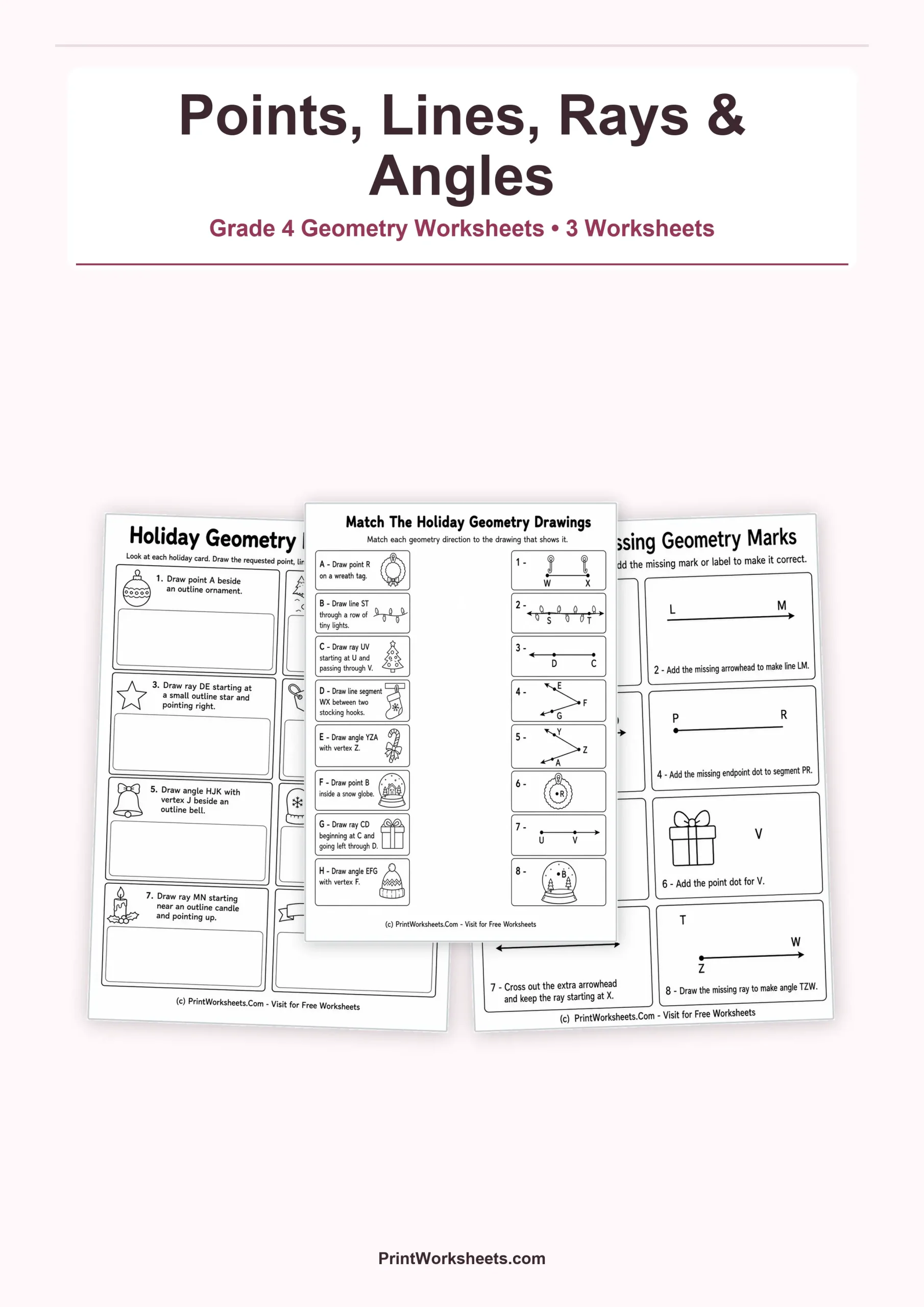
These points lines rays and angles worksheets give Grade 4 students a hands-on way to work with basic geometry notation instead of only naming figures from a textbook diagram. Across three printable pages, students draw labeled geometric objects in holiday-themed spaces, match written directions to finished representations, and repair incomplete diagrams by adding the exact mark or label that is missing. The activities repeatedly connect vocabulary such as point, line, ray, line segment, endpoint, vertex, and angle with the symbols and labels students are expected to recognize and produce.
Points Lines Rays and Angles Worksheets for Drawing Practice
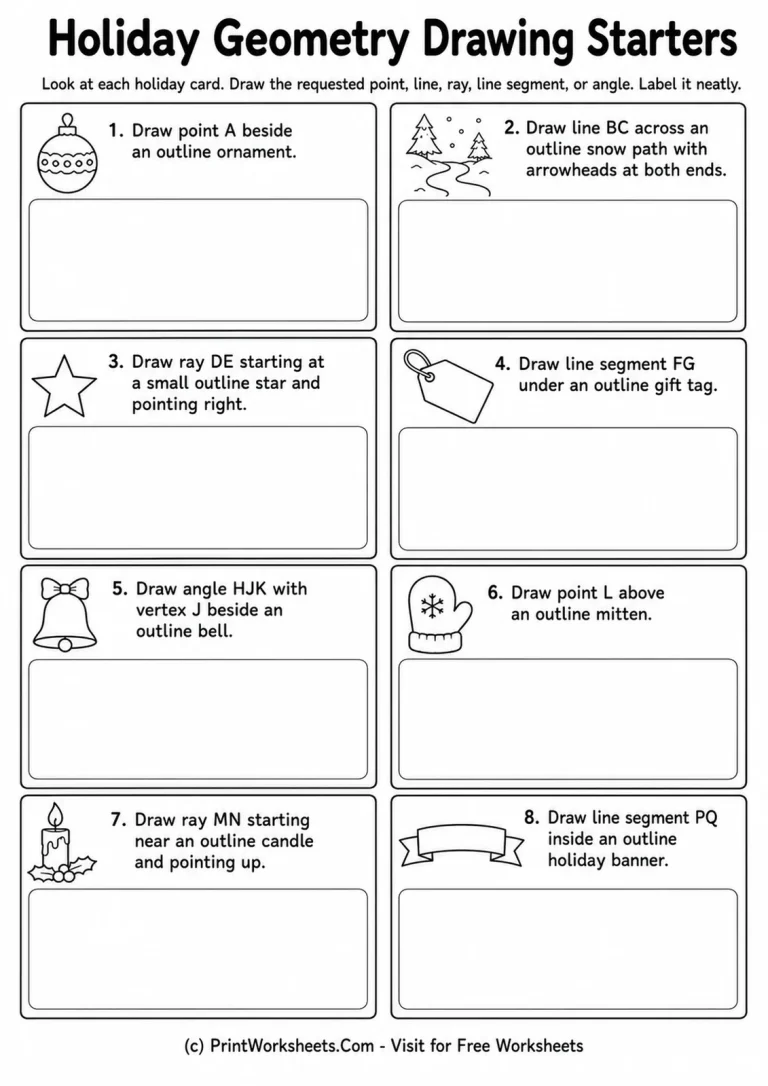
The first worksheet, Holiday Geometry Drawing Starters, asks students to construct eight different figures. Each prompt combines a simple seasonal picture with a precise geometry direction and a large blank box for the student’s work. Students draw point A beside an ornament, line BC across a snow path with arrowheads at both ends, ray DE starting at a star, and line segment FG under a gift tag. Later prompts include angle HJK with J as the vertex, point L above a mitten, ray MN pointing upward near a candle, and segment PQ inside a holiday banner.
This page is especially useful for checking whether students understand what the notation requires. A line must continue in both directions, a ray has one endpoint and one arrowhead, and a segment has two endpoints without arrows. The angle task also reinforces the important convention that the middle letter names the vertex. Because students create each representation themselves, teachers can see whether errors come from vocabulary confusion, endpoint placement, arrowheads, or labeling.
Match Geometry Words to Correct Representations
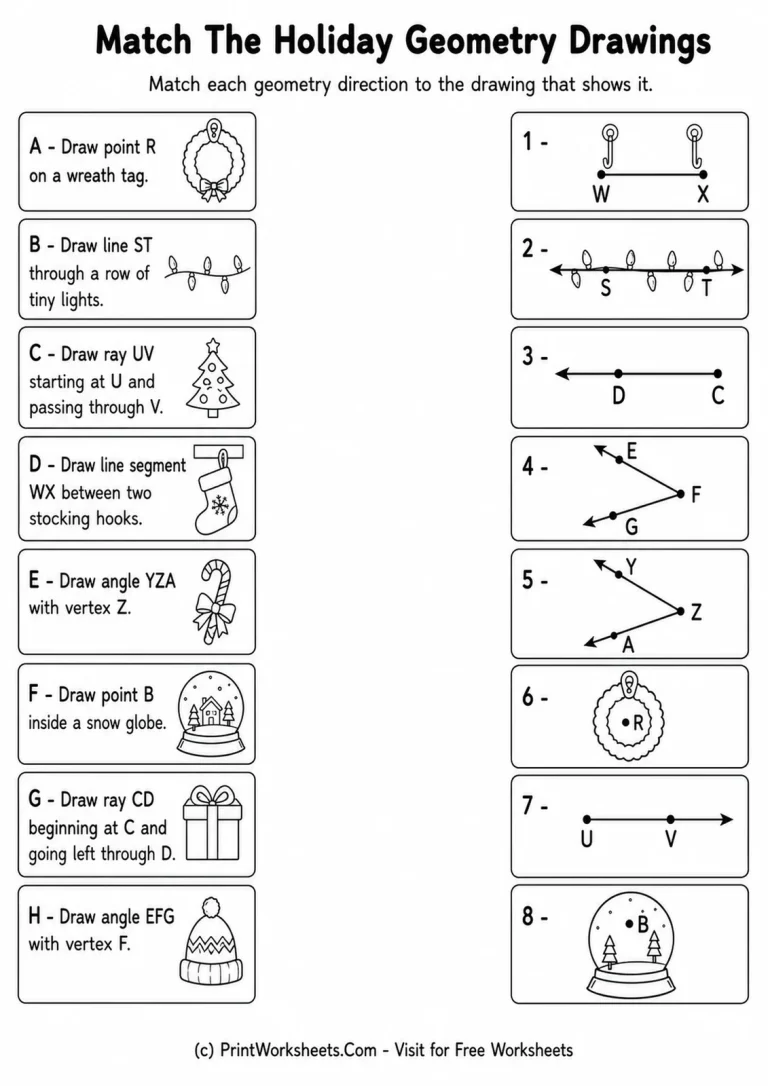
The second worksheet changes the task from construction to visual discrimination. Eight directions labeled A through H must be matched with eight numbered drawings. The examples include a point R on a wreath, line ST through a row of lights, ray UV beginning at U and passing through V, segment WX between two stocking hooks, angles YZA and EFG, point B inside a snow globe, and ray CD beginning at C and extending left through D.
The matching format makes students compare small but meaningful differences. For example, they must notice whether a figure has one arrowhead, two arrowheads, or two finite endpoints. They also have to read letter order carefully to distinguish the starting point of a ray and the vertex of an angle. This makes the page a useful follow-up after direct instruction or after practice with lines, rays, and line segments worksheets when a learner is ready to include points and angles in the same review.
Finish Missing Geometry Marks and Labels
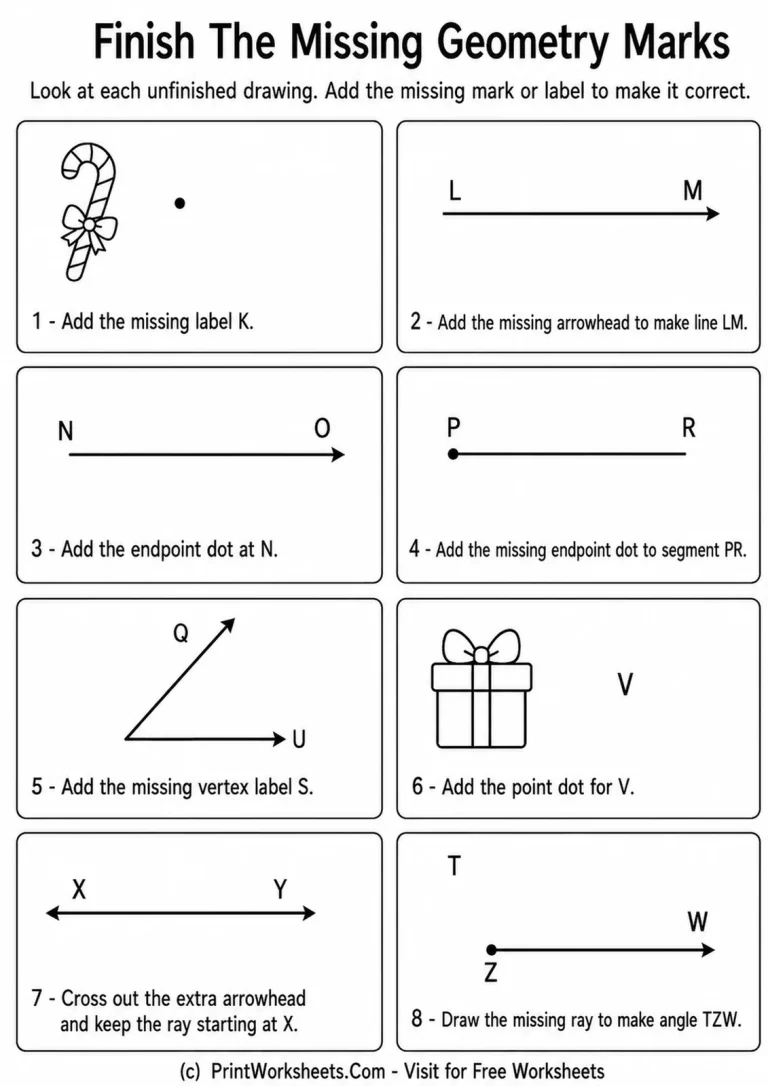
The third worksheet, Finish The Missing Geometry Marks, asks students to diagnose incomplete figures rather than draw everything from scratch. Students add a missing K label to a point, supply the second arrowhead needed to make line LM, add the endpoint dot at N, complete segment PR with its missing endpoint, label the vertex S on an angle, place point V beside a gift, remove an extra arrowhead so a figure remains a ray starting at X, and draw a missing ray from Z toward T to complete angle TZW.
This repair-style activity can reveal whether students understand why each mark matters. A student who can name a ray may still forget that its endpoint belongs at the starting letter. Likewise, a student may recognize an angle visually but need more practice with the middle-letter vertex convention. The final item extends that idea by requiring students to use an existing ZW ray and add the second side needed for angle TZW.
Ways to Use This Grade 4 Geometry Set
These pages work well as a short geometry station, independent practice, homework, or a quick skills check. One practical sequence is to begin with the drawing page, continue with the matching page, and finish with the missing-mark page. That order moves from producing representations to identifying them and then editing them for mathematical accuracy. Students who need a narrower review of lines and rays can revisit the linked Grade 3 resource, while students ready to move beyond basic angle notation can continue to find unknown angles worksheets for Grade 4.
The seasonal illustrations keep the pages visually approachable, but the mathematical work stays focused on Grade 4 geometry. Instead of relying on decoration alone, every page in this set asks students to make a geometry decision: where an endpoint belongs, which direction an arrow should point, whether a figure extends forever, which letter is the vertex, or which label completes the figure. Print the full set for a varied review, or choose one page to target construction, matching, or notation repair.