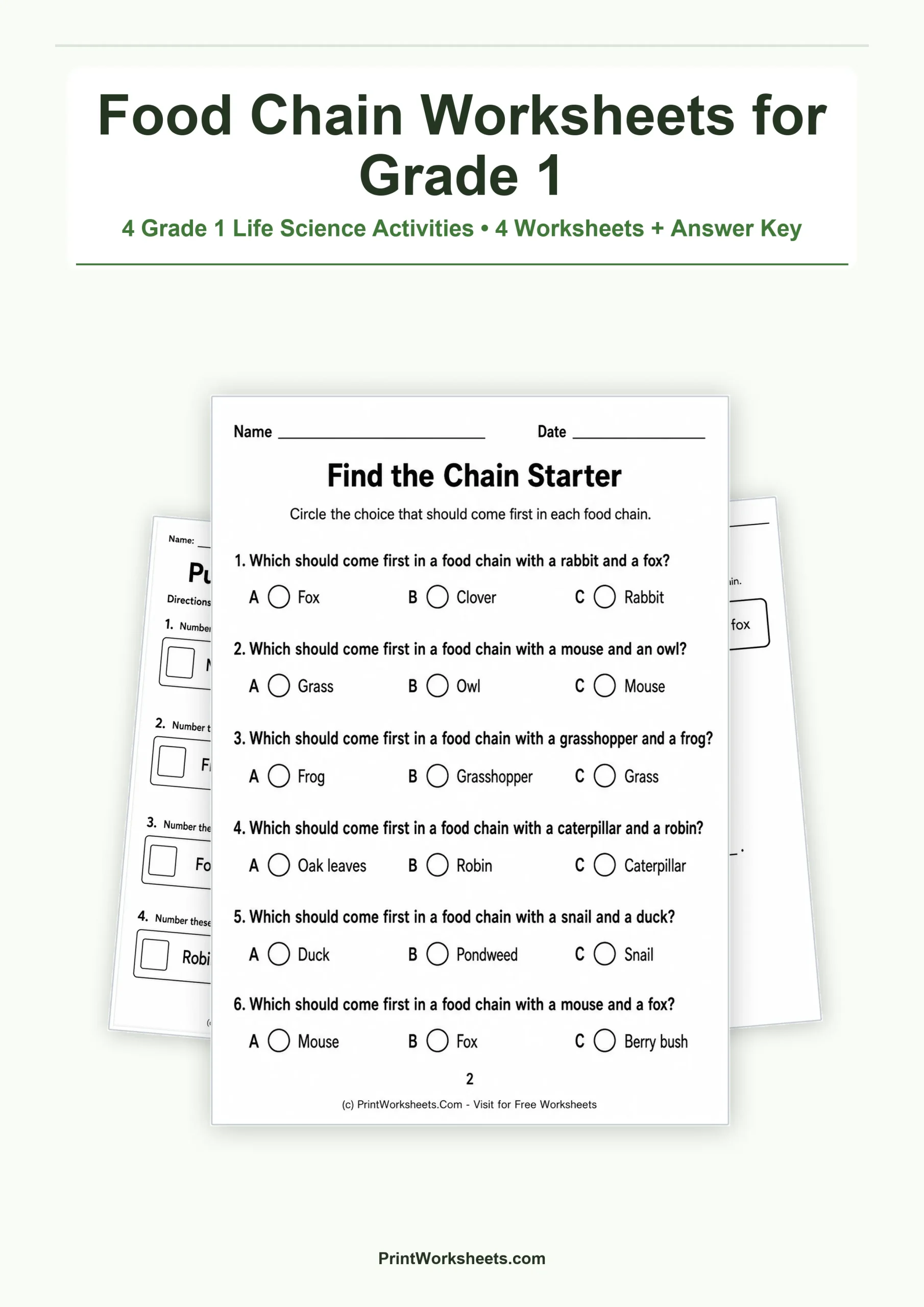
These food chain worksheets give first graders several ways to practice one important life science idea: plants begin simple food chains, animals eat plants or other animals, and the parts must appear in a logical order. Instead of asking children to repeat one format, this printable set moves through four different activities using familiar examples such as grass, mice, owls, rabbits, foxes, caterpillars, robins, pondweed, snails, and ducks.
How These Food Chain Worksheets Build Understanding
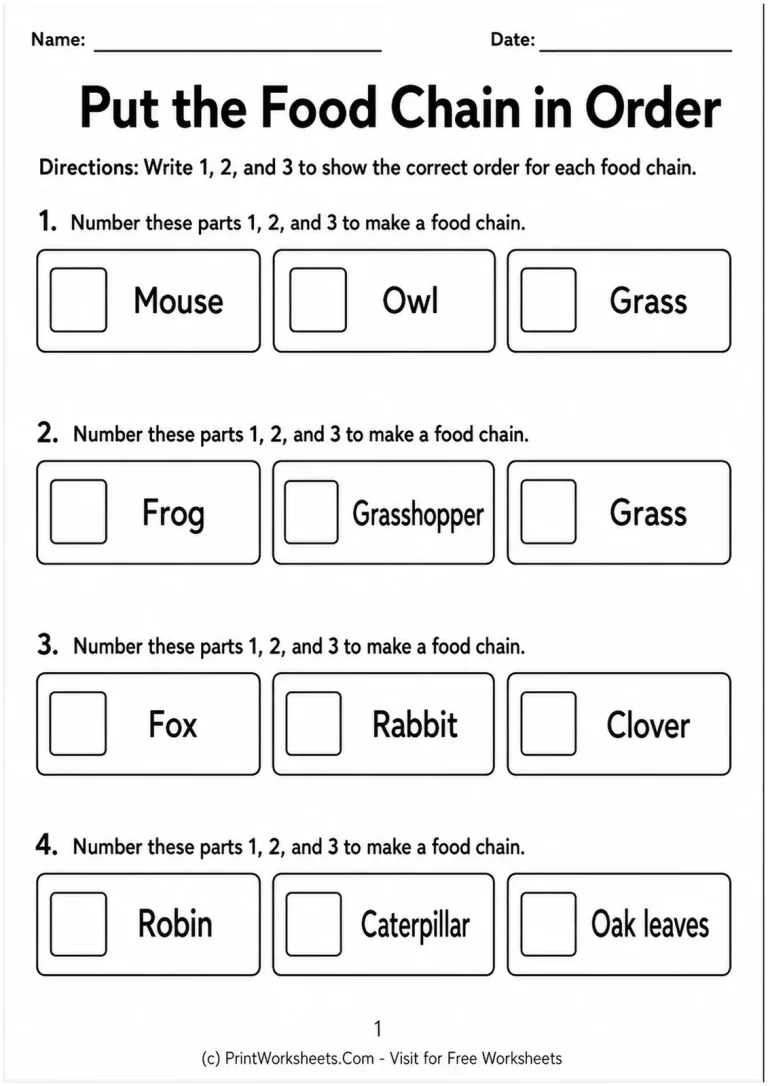
The first worksheet, Put the Food Chain in Order, asks students to number three parts of each chain as 1, 2, and 3. The four examples are Grass → Mouse → Owl, Grass → Grasshopper → Frog, Clover → Rabbit → Fox, and Oak leaves → Caterpillar → Robin. This activity is useful for introducing the idea that a food chain has a sequence rather than being a random group of living things.
Because the choices are already provided, students can concentrate on reasoning about who eats what. A child does not need to recall difficult vocabulary before showing understanding. Teachers can also ask students to read each finished chain aloud from left to right and explain why the plant belongs first.
Finding the Producer That Starts a Chain
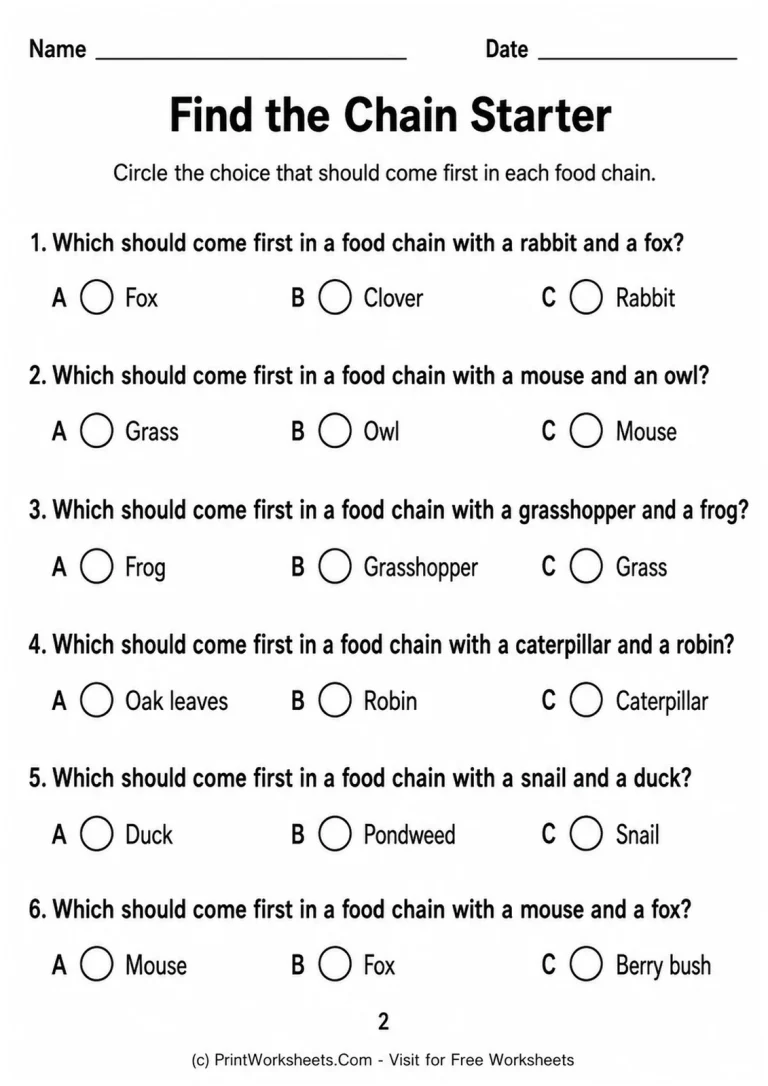
The second page, Find the Chain Starter, narrows the skill to the beginning of a food chain. Students circle the choice that should come first in six examples. They identify clover before rabbit and fox, grass before mouse and owl, grass before grasshopper and frog, oak leaves before caterpillar and robin, pondweed before snail and duck, and a berry bush before mouse and fox.
This page works well after a short lesson on producers because each question requires students to distinguish a plant from the animals that depend on it. The multiple-choice format also makes the page practical for independent practice, a science center, or a quick check for understanding.
Complete and Evaluate Simple Three-Part Food Chains
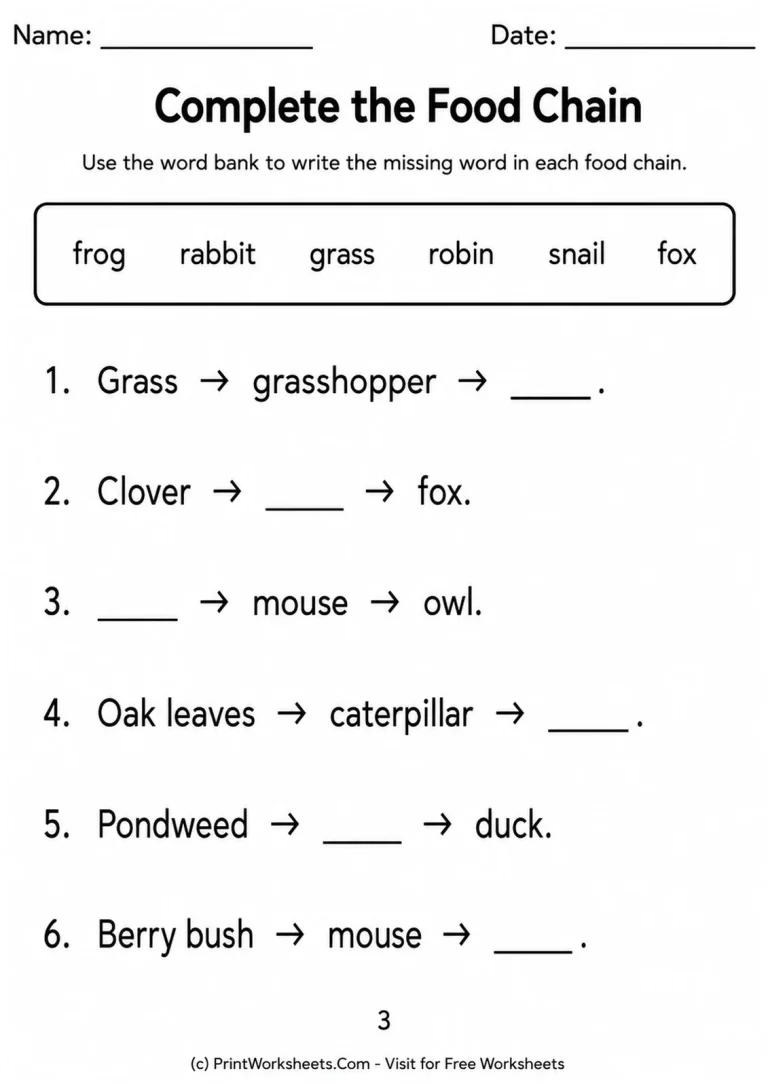
The third worksheet changes the task again. In Complete the Food Chain, children use a word bank containing frog, rabbit, grass, robin, snail, and fox. They fill one missing part in each three-step chain. Some blanks appear at the beginning, such as ___ → mouse → owl, while others appear in the middle or at the end. That variation helps students think about the relationship among all three positions instead of memorizing that the missing answer will always be the same type of organism.
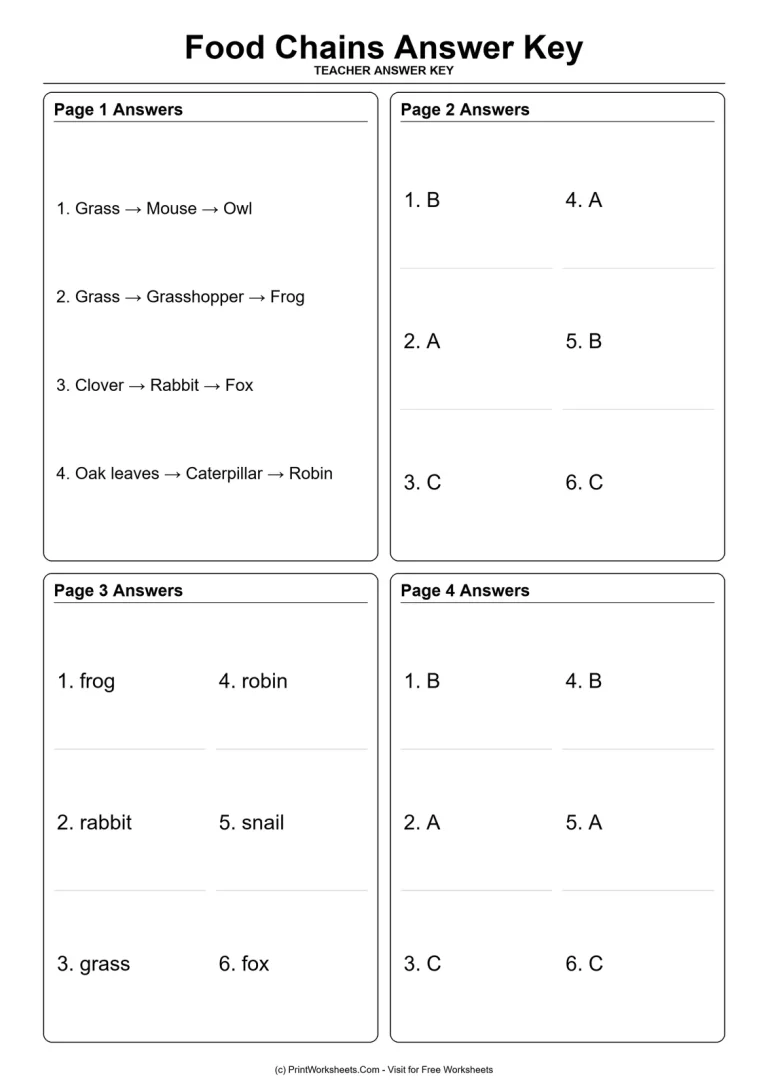
The six completed examples reinforce the same clear relationships used across the set: Grass → Grasshopper → Frog, Clover → Rabbit → Fox, Grass → Mouse → Owl, Oak leaves → Caterpillar → Robin, Pondweed → Snail → Duck, and Berry bush → Mouse → Fox. Reusing these examples across different tasks can help young learners recognize patterns while still requiring a new kind of response.
Choosing Which Food Chain Makes Sense
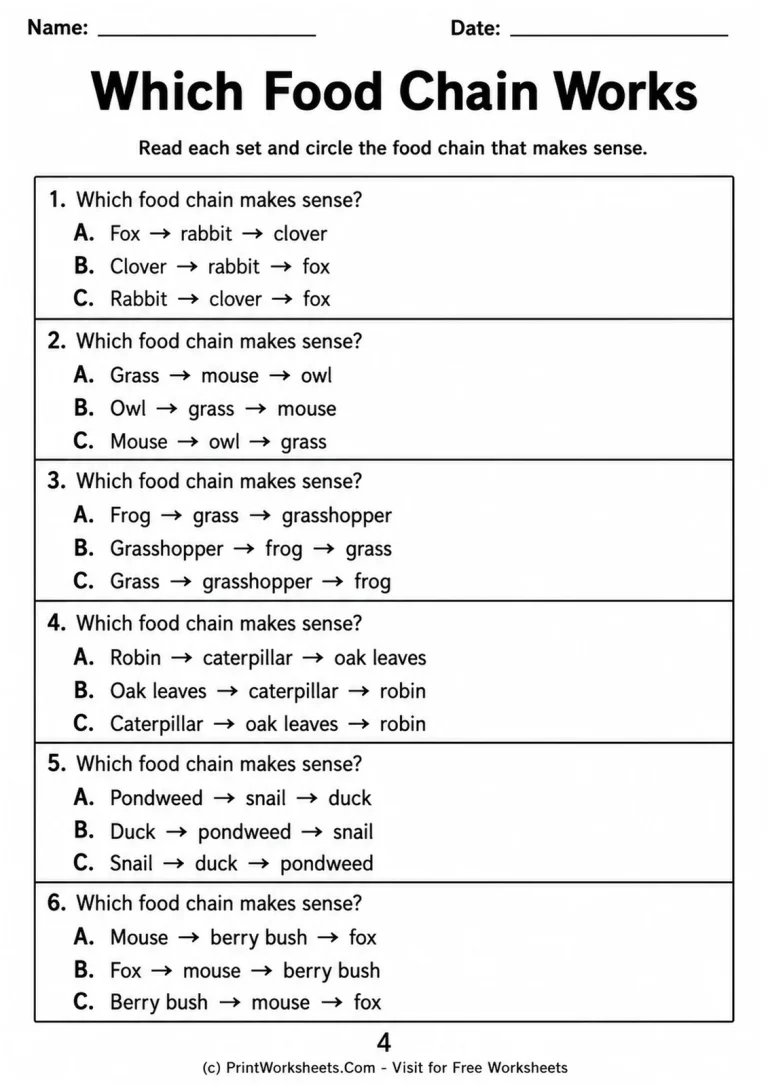
The fourth student page, Which Food Chain Works, asks learners to compare three possible orders and circle the one that makes sense. This is a stronger reasoning task because the incorrect choices contain the same organisms in illogical positions. Students must notice, for example, that Clover → Rabbit → Fox is sensible while Fox → Rabbit → Clover is not.
This format can reveal whether a student truly understands sequence. A learner who can select Grass → Mouse → Owl and Oak leaves → Caterpillar → Robin is showing more than simple word recognition; the student is applying the relationship among producer, plant-eater, and predator.
Ways to Use the Printable Set
For a first lesson, use the ordering page with teacher support and discuss each chain before students write the numbers. Follow with the chain-starter page to focus attention on plants as producers. The word-bank page can then provide guided independent practice, while the final multiple-choice page works well as a short review or informal assessment.
For differentiation, students who need extra support can draw arrows between the organisms or say a sentence such as “The rabbit eats clover” before answering. Students ready for an extension can draw their own three-part food chain and label which part comes first, second, and third. They can also compare two chains and identify what both have in common.
A complete teacher answer key is included for all four student pages, making the set convenient for classroom correction, homeschool instruction, small-group science work, or take-home practice. The progression from arranging given parts to evaluating complete chains gives Grade 1 learners repeated practice with a simple life science concept without making every worksheet feel the same.