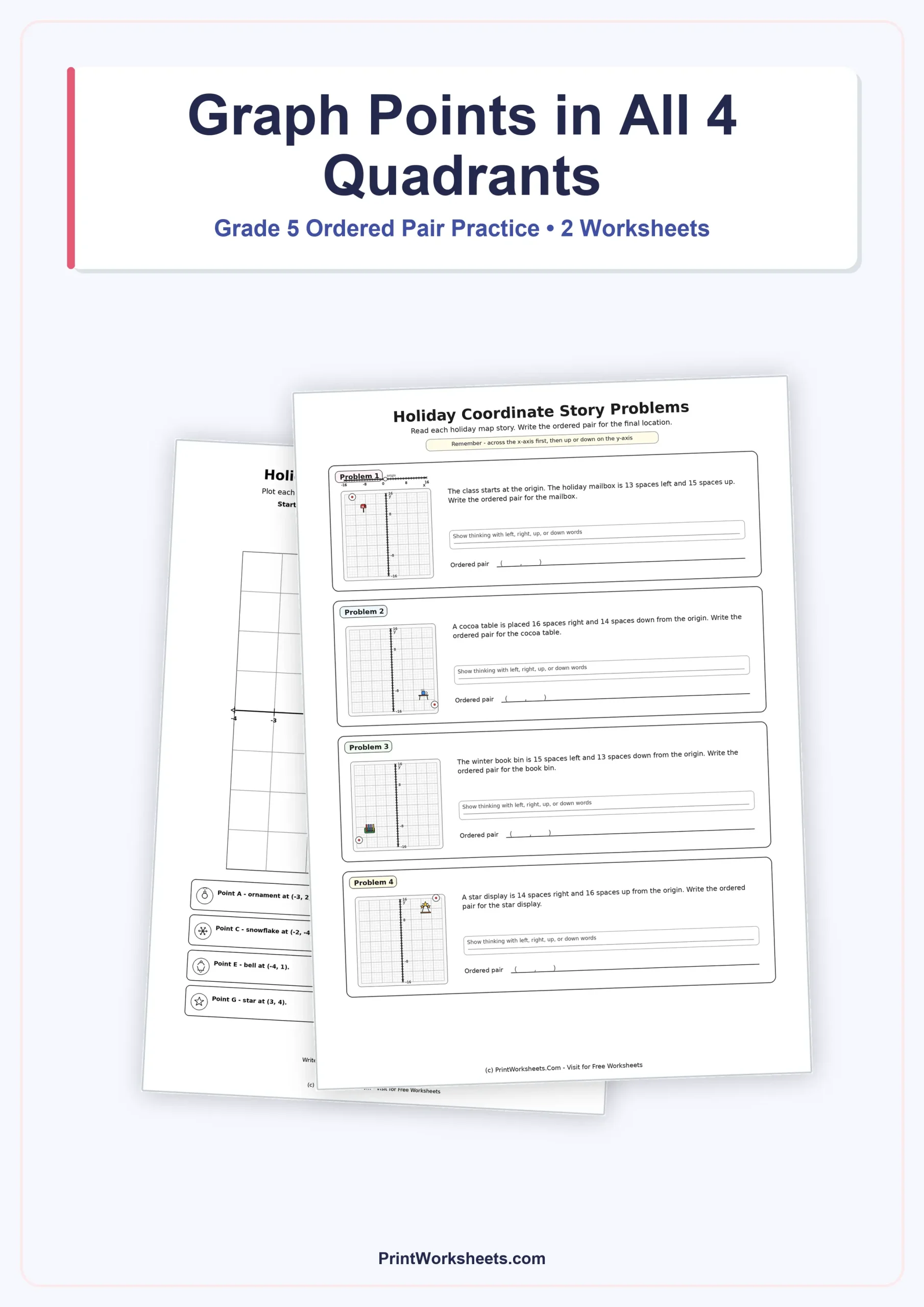
These four quadrant graphing worksheets give fifth graders two ways to work with ordered pairs beyond the first quadrant. Students first plot eight specified points on a coordinate plane that includes positive and negative x- and y-values. They then move into coordinate story problems that describe locations using left, right, up, and down movement from the origin. The pair of activities helps students connect the written form of an ordered pair with both a visible location and a verbal description of movement.
Four Quadrant Graphing Worksheets for Ordered Pairs
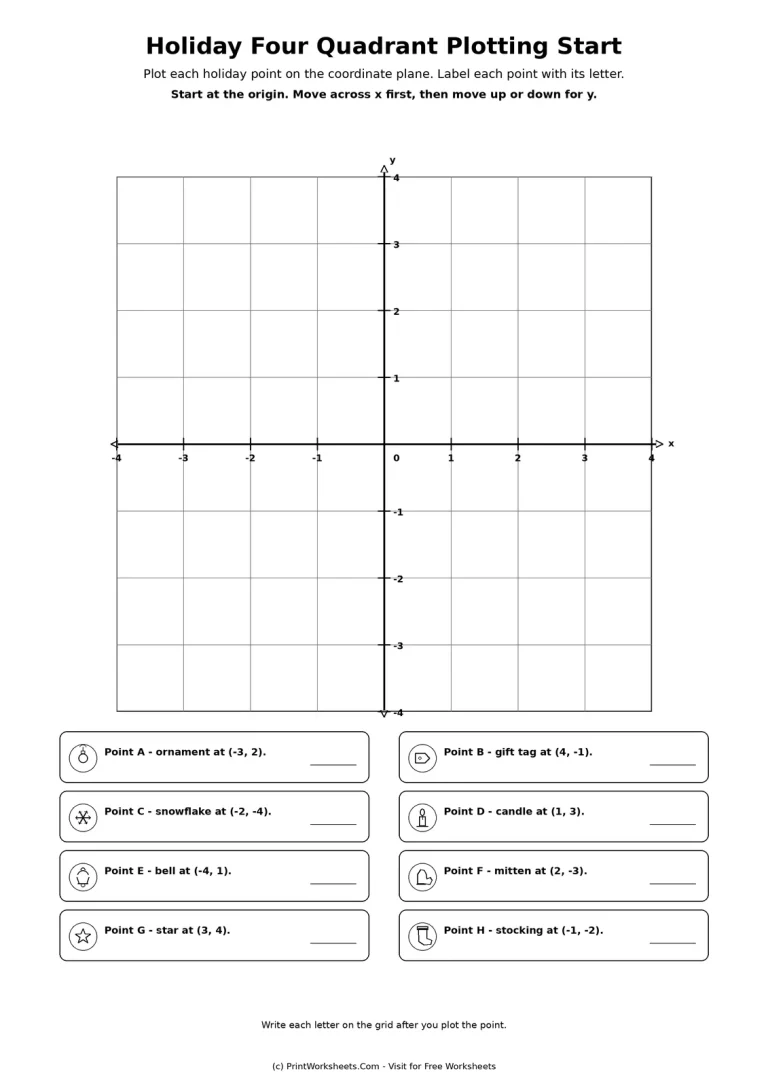
The plotting worksheet uses a coordinate grid from -4 to 4 on both axes. Eight holiday-themed points are identified by letters A through H, with coordinates such as (-3, 2), (4, -1), (-2, -4), and (1, 3). Students start at the origin, move across the x-axis first, and then move up or down according to the y-coordinate. That reminder is especially useful when students are beginning to work with negative values because it reinforces the order of the two numbers instead of relying on memorized quadrant labels alone.
The eight coordinates intentionally place points throughout the plane. Students encounter negative x with positive y, positive x with negative y, two negative coordinates, and two positive coordinates. Points also appear directly along the outer values of the grid, including x = -4, x = 4, y = -4, and y = 4. This makes the page useful for checking whether students can read the scale carefully and distinguish the horizontal and vertical axes before labeling each plotted point.
Move from Plotting to Coordinate Story Problems
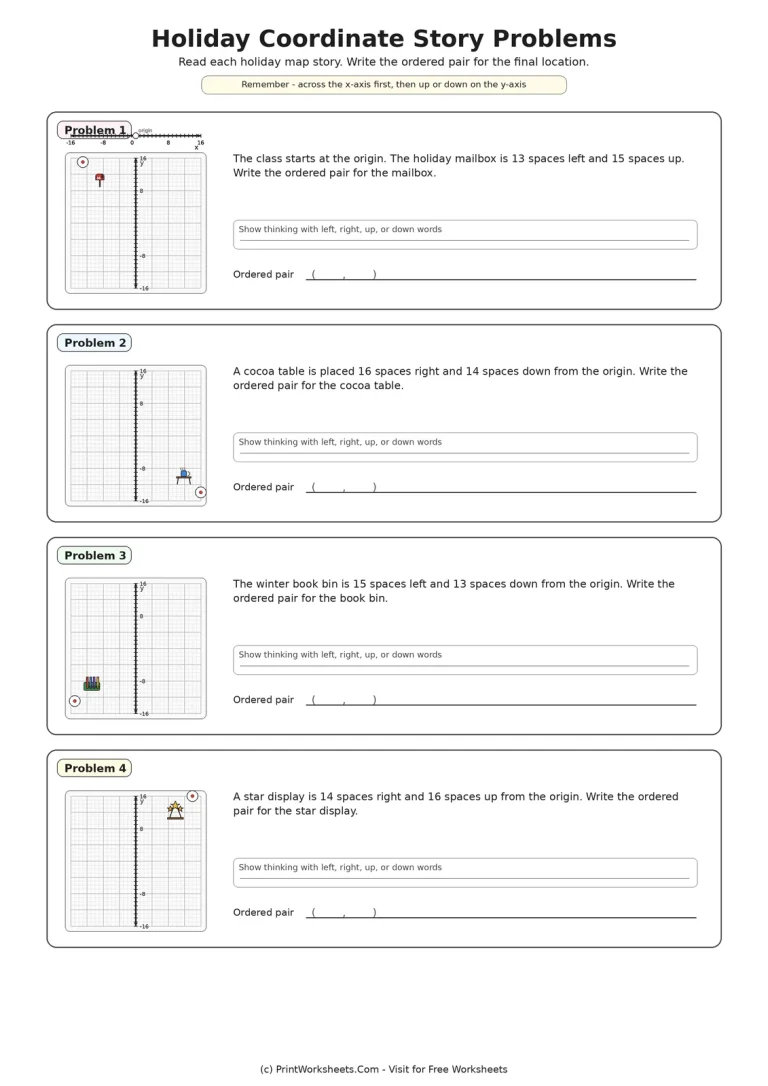
The second worksheet changes the format rather than simply repeating another list of coordinates. Four short holiday map stories describe a location relative to the origin. For example, students may be told that an object is a certain number of spaces left and up, right and down, or left and down. They must translate those directional clues into the signs and order of an ordered pair.
The values on this page extend as far as 16 units from the origin, so students apply the same coordinate rules on a larger scale. The four resulting locations include (-13, 15), (16, -14), (-15, -13), and (14, 16). Each problem provides a small coordinate plane, a line where students can record directional thinking, and a separate ordered-pair response area. That structure supports students who benefit from writing the movement in words before converting it into symbolic notation.
Skills Students Practice
Across the two printable pages, students practice reading x before y, recognizing positive and negative directions, plotting points in all four quadrants, and translating movement from the origin into coordinate notation. The activities also make it easier to notice common mistakes. A student who writes (15, -13) instead of (-13, 15), for example, may understand the numbers but still need practice with coordinate order and signs.
For related geometry review before or after coordinate work, students can revisit points, lines, rays and angles worksheets. Teachers looking for additional shape-classification practice can also use identify quadrilaterals worksheets as a separate geometry refresher.
Ways to Use These Grade 5 Coordinate Worksheets
The plotting page works well as guided practice after students learn how the signs of x and y determine direction from the origin. Teachers can model one coordinate, then have students complete the remaining points independently. The story-problem page is a stronger follow-up because students must determine the ordered pair instead of receiving it in advance.
For small-group instruction, ask students to say each movement aloud before writing the ordered pair: horizontal movement first, vertical movement second. During independent work, the reasoning lines on the story problems can show whether an incorrect answer came from reversing x and y or choosing the wrong sign. Parents can use the same approach at home by asking a child to explain why left produces a negative x-value or why downward movement produces a negative y-value.
Together, these Grade 5 worksheets provide a compact progression from plotting given coordinates to interpreting coordinate situations. They are useful for classroom practice, math centers, homework, review, or a quick check of whether students can confidently work in all four quadrants rather than only the positive first quadrant.