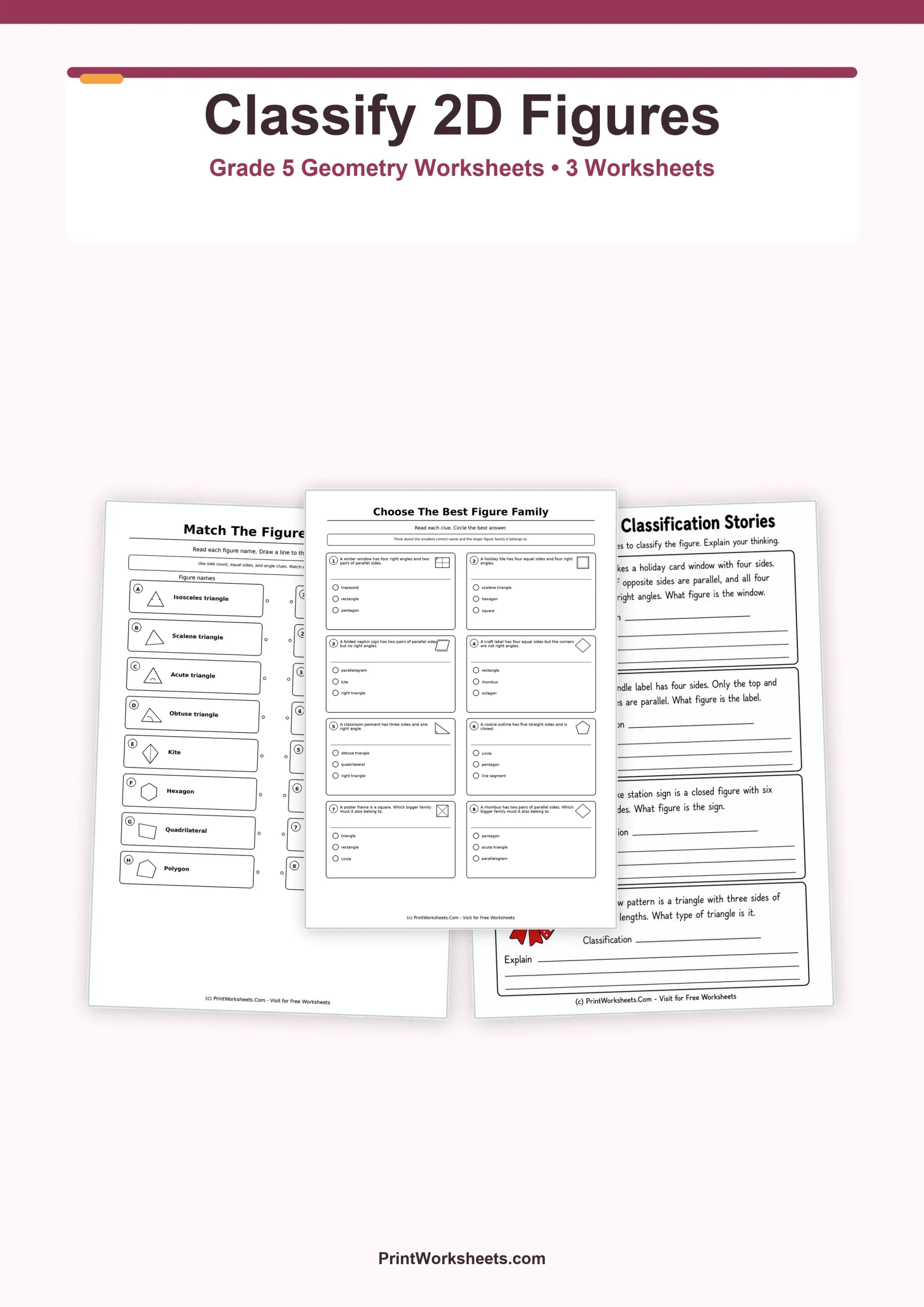
These classify two-dimensional figures worksheets give Grade 5 students three different ways to use geometric properties instead of relying on appearance alone. Students first connect figure names to defining clues, then choose the best figure family from multiple-choice descriptions, and finally explain classifications in short holiday-themed situations. Across the set, they work with side count, equal sides, angle types, parallel sides, and the way one figure can belong to a larger family.
Classify two-dimensional figures worksheets with property clues
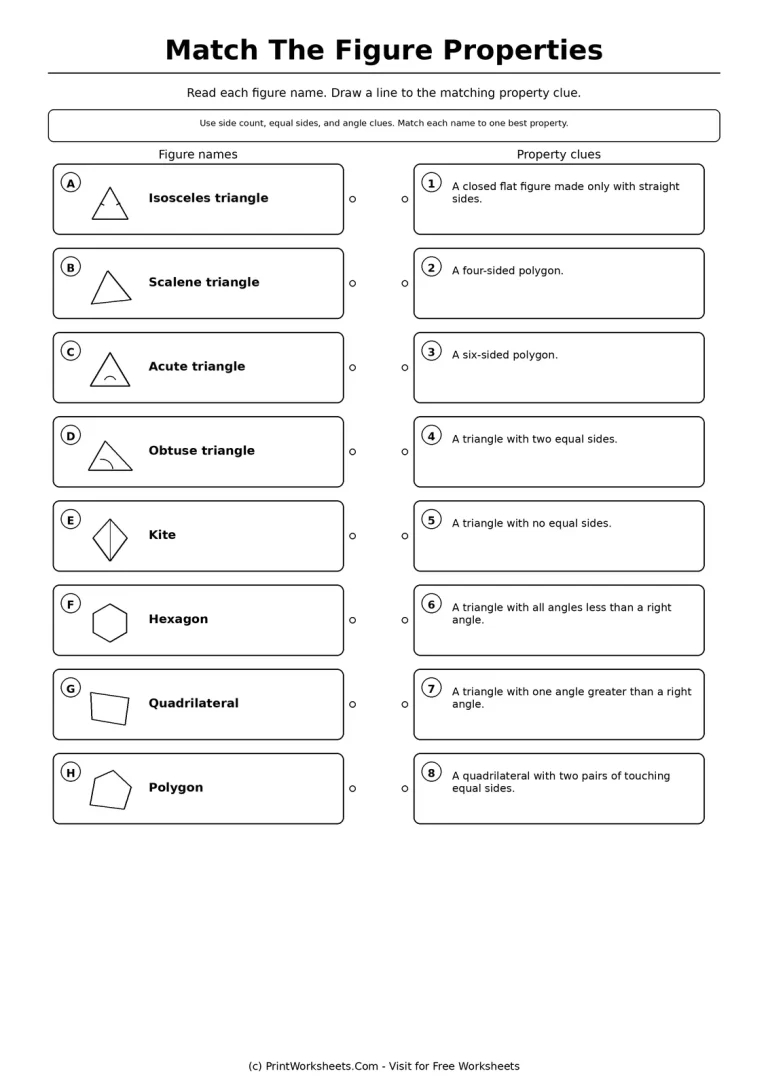
The matching page is a useful vocabulary-and-properties check because each figure name must be paired with one defining statement. Students distinguish an isosceles triangle from a scalene triangle by equal-side information, and they separate acute and obtuse triangles by angle size. The same page also includes kite, hexagon, quadrilateral, and polygon, so learners must move between specific figure names and broader categories. This is especially helpful when students know a shape visually but need practice explaining what makes that classification correct.
For a focused review of triangle categories before using this set, pair the page with classify triangles by angles and sides worksheets. That related practice narrows attention to triangle properties, while this Grade 5 set expands the work to several two-dimensional figure families.
Practice figure-family relationships and precise classification
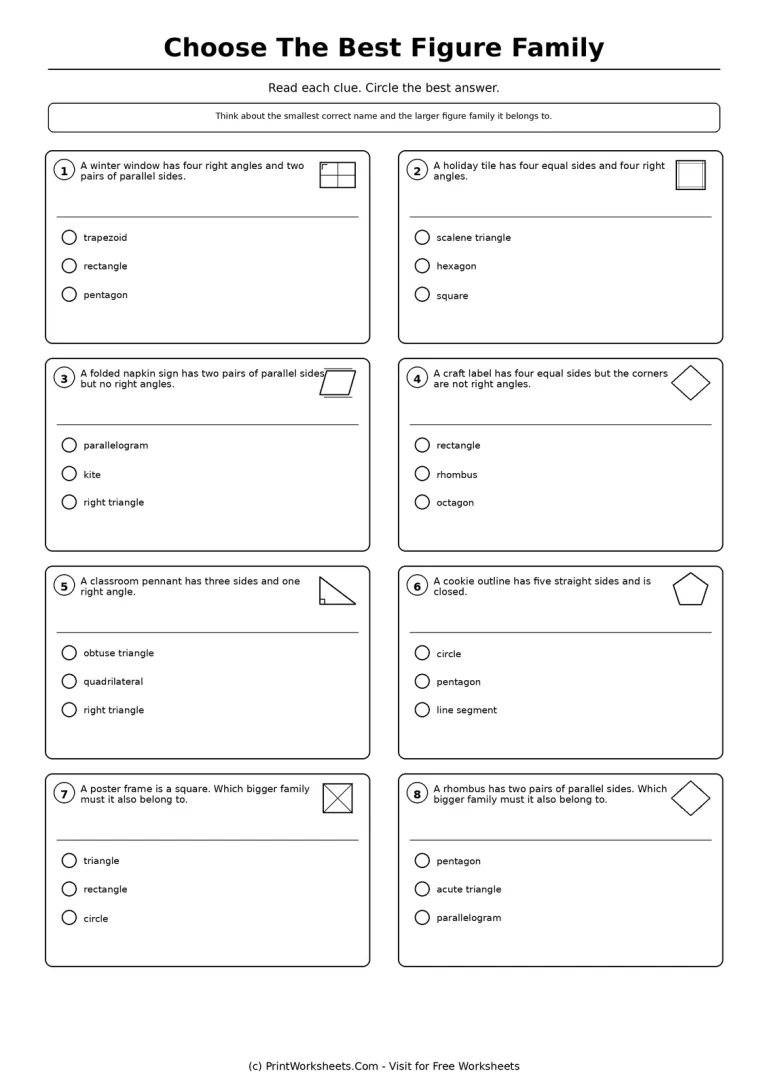
The multiple-choice page asks students to identify the smallest correct name and, in some questions, the larger family that must also contain the figure. A winter window with four right angles and two pairs of parallel sides is classified as a rectangle. A holiday tile with four equal sides and four right angles is a square. Students also identify a parallelogram from two pairs of parallel sides, a rhombus from four equal sides without right angles, a right triangle from three sides and one right angle, and a pentagon from five straight sides.
Two questions directly test hierarchy rather than simple recognition: a square must also belong to the rectangle family, and a rhombus with two pairs of parallel sides must also belong to the parallelogram family. That shift matters in Grade 5 because students need to understand that geometric categories can overlap. A square does not stop being a square when it is also described as a rectangle, and a rhombus can satisfy the definition of a parallelogram at the same time.
If students need extra work specifically on four-sided figures, use identify quadrilaterals worksheets as a supporting review. It can reinforce the vocabulary behind rectangle, rhombus, parallelogram, and other quadrilateral names before students tackle family relationships here.
Move from choosing an answer to explaining the reasoning
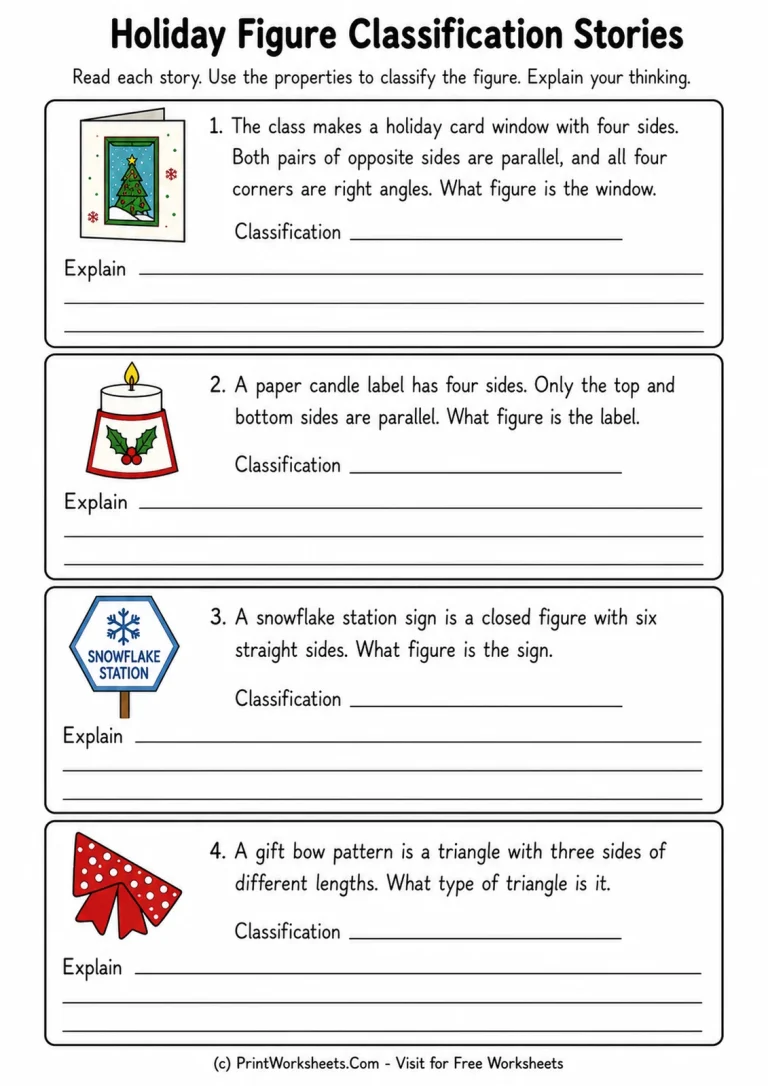
The story page raises the level of thinking by removing answer choices and asking students to write both a classification and an explanation. One holiday card window is described with two pairs of opposite parallel sides and four right angles, leading to rectangle. A candle label has four sides with only the top and bottom parallel, leading to trapezoid. A snowflake station sign is closed and has six straight sides, so it is a hexagon. The final story describes a triangle with three different side lengths, which students classify as a scalene triangle.
These prompts make the property language visible in students’ written reasoning. A complete explanation can mention the exact clue that determines the figure, such as “six straight sides,” “one pair of parallel sides,” or “three different side lengths.” Teachers can use those sentences to see whether a student truly understands the classification rule or is only recognizing the picture.
Ways to use the three-page set
Use the matching page as a warm-up or vocabulary check, the multiple-choice page for independent practice, and the story page as a more demanding follow-up. The sequence also works well across several days: review definitions first, practice selecting the best family next, and finish with written justification. Because the approved pages use different response formats, the set can support whole-group instruction, centers, homework, or a short assessment without repeating the same task structure.
Students who are also reviewing polygon measurement can continue with perimeter of polygons worksheets for a different application of polygon knowledge. In this set, however, the main goal stays on classification: noticing the properties that define a figure, choosing the most precise name, and understanding how that figure fits into a larger geometric family.