
These graphing patterns worksheets give fifth graders a focused way to connect number-pattern rules with ordered pairs and coordinate planes. Instead of plotting isolated coordinates, students generate x- and y-values from paired rules, organize the results, graph the points, and think about how the two patterns change. The two printable activities approach the same core idea from different directions, making the set useful for class practice, math centers, homework, or a short skills review.
Graphing Patterns Worksheets with Paired Number Rules
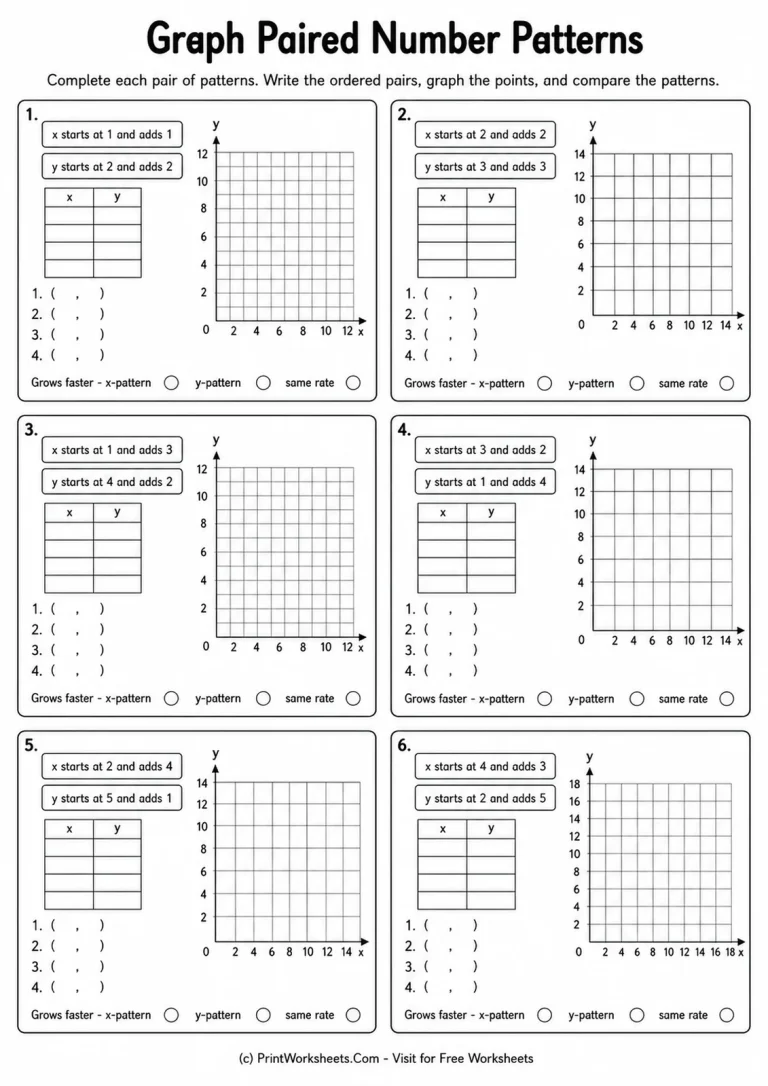
The first worksheet, Graph Paired Number Patterns, includes six separate problems. Each problem gives one rule for x and one rule for y. For example, a pattern may tell students that x starts at 1 and adds 1 while y starts at 2 and adds 2. Students extend both patterns for four terms, place the corresponding values in an x-y table, and write four ordered pairs.
After building the ordered pairs, students plot the points on the coordinate grid shown beside the table. The graph scales vary to fit the values in each problem, with axes extending to values such as 12, 14, or 18. This keeps students attentive to the scale instead of assuming that every graph is identical.
Each problem also asks students to compare the two patterns by deciding whether the x-pattern grows faster, the y-pattern grows faster, or both grow at the same rate. That final step adds reasoning beyond simple plotting. Students must look back at the repeated change in each sequence and connect the numerical rule to how the coordinates move across the graph.
What Students Practice on the First Worksheet
- Extending two numerical patterns from given starting values and addition rules.
- Pairing corresponding x- and y-values correctly.
- Writing ordered pairs in standard coordinate form.
- Plotting first-quadrant points on labeled coordinate planes.
- Reading different graph scales accurately.
- Comparing constant rates of change in two related patterns.
The six examples provide useful variety. Some pairs have y increasing faster than x, while others have x increasing faster. Students therefore cannot rely on one repeated answer pattern; they must inspect the rules in each problem.
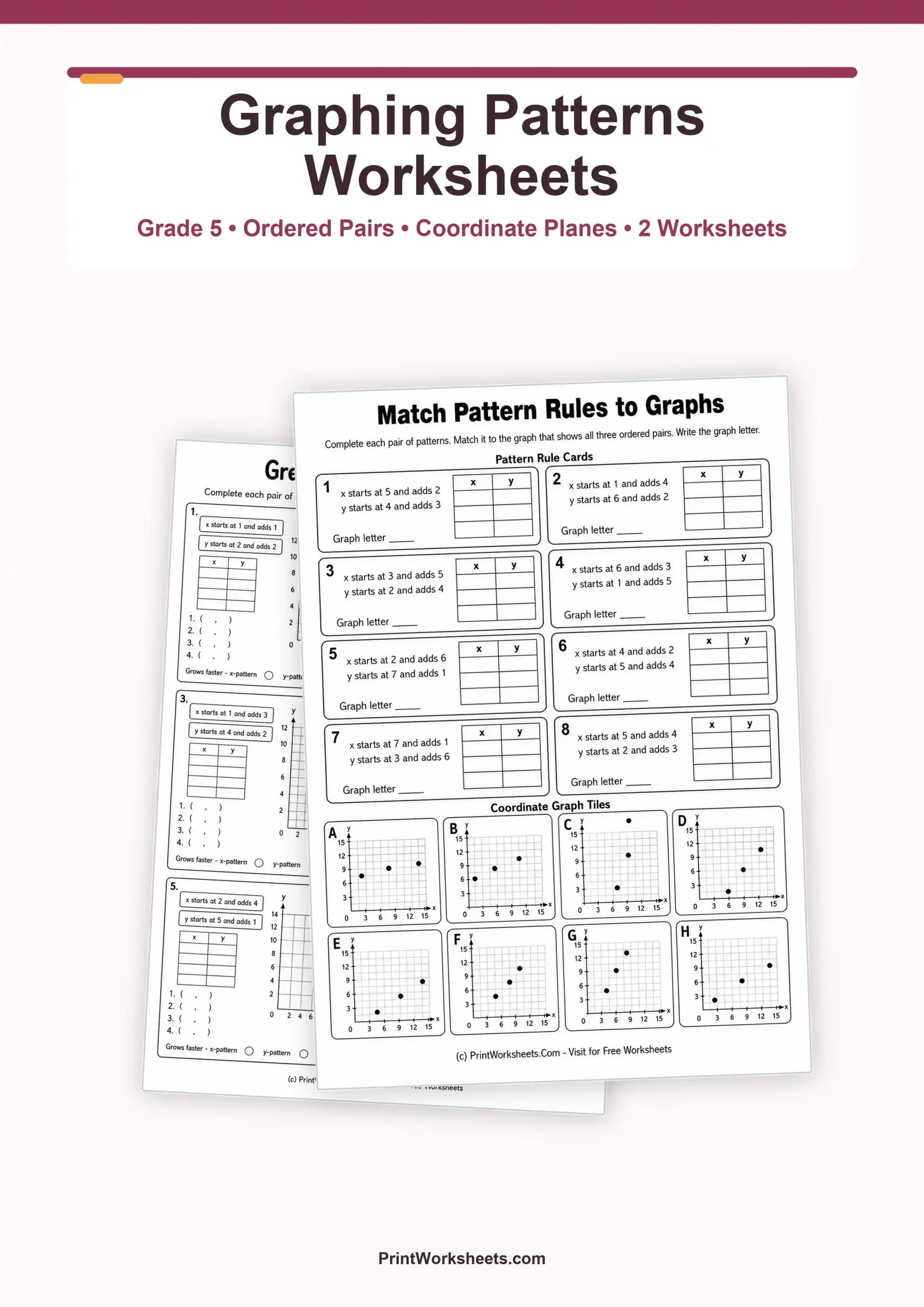
Matching Pattern Rules to Coordinate Graphs
The second worksheet changes the direction of the task. It presents eight Pattern Rule Cards, and each card again gives separate starting values and addition rules for x and y. Students first complete a small table with three corresponding x-y values. They then study eight coordinate graph tiles labeled A through H and determine which graph represents all three ordered pairs from each rule card.
This format strengthens the connection between symbolic rules, numerical tables, and visual graphs. A student may correctly generate values such as x increasing by 2 while y increases by 4, but the matching step requires another level of understanding: the student must recognize where those pairs appear in the coordinate plane and distinguish that graph from seven plausible alternatives.
The graph tiles include different locations and different rates of increase. Some sets rise gradually, while others show a steeper vertical change as x increases. Because every rule card must be matched to one graph letter, the activity works well as a complete independent assignment or as a partner task in which students explain why a particular graph fits a rule.
A Useful Progression for Grade 5 Coordinate Skills
Together, the worksheets form a compact progression. Students begin by creating values and plotting their own points. They then move to recognizing which completed graph corresponds to a pair of numerical rules. This shift from production to identification helps reveal whether students understand the relationship among the rule, the table, the ordered pairs, and the graph rather than simply following plotting steps.
Teachers can use the first page during instruction on paired numerical patterns and coordinate graphing, then use the second page as follow-up practice or a quick check for understanding. For students who need support, completing the x-column and y-column separately before pairing the values can reduce errors. Students ready for an extension can describe how the difference between the x-rule and y-rule affects the visual direction of the plotted points.
Printable Practice for Patterns, Ordered Pairs, and Graphs
This Grade 5 set is especially useful when lessons connect numerical patterns to coordinate relationships. Students are not only locating points; they are generating the coordinates from rules and interpreting how repeated changes shape a graph. That makes the worksheets suitable for reinforcing ordered pairs, first-quadrant graphing, input-output thinking, and comparisons between two changing quantities in one focused printable activity set.