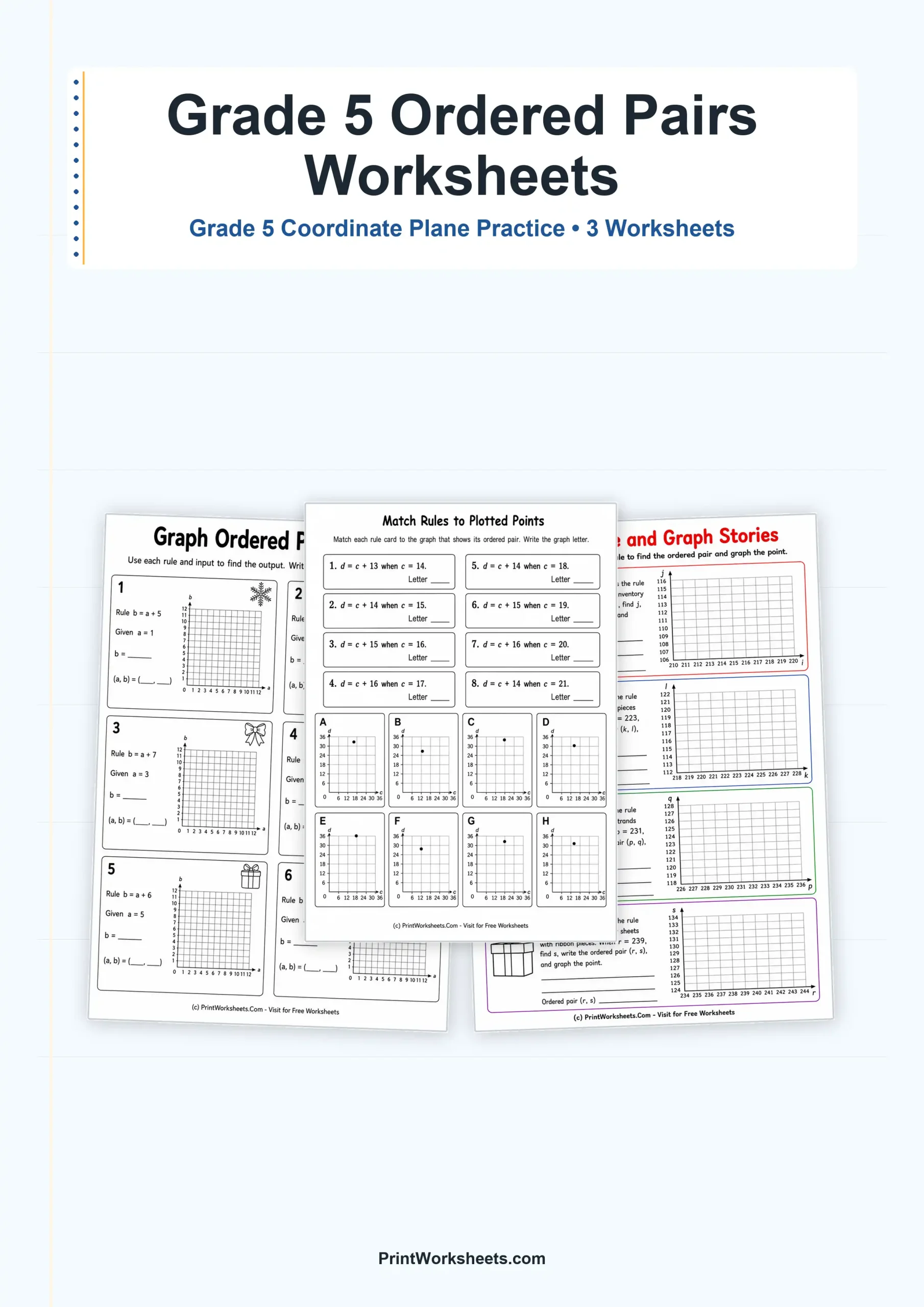
These Grade 5 ordered pairs worksheets connect numerical rules with coordinate graphing in a practical way. Instead of receiving a list of coordinates to copy onto a grid, students first have to determine what each point should be. They substitute a given input into a rule, calculate the output, write the ordered pair, and then use the coordinate plane to represent the result. Across the set, students also match rules to already plotted points and solve holiday-themed situations with much larger coordinate values.
Ordered Pairs Worksheets Built Around Numerical Rules
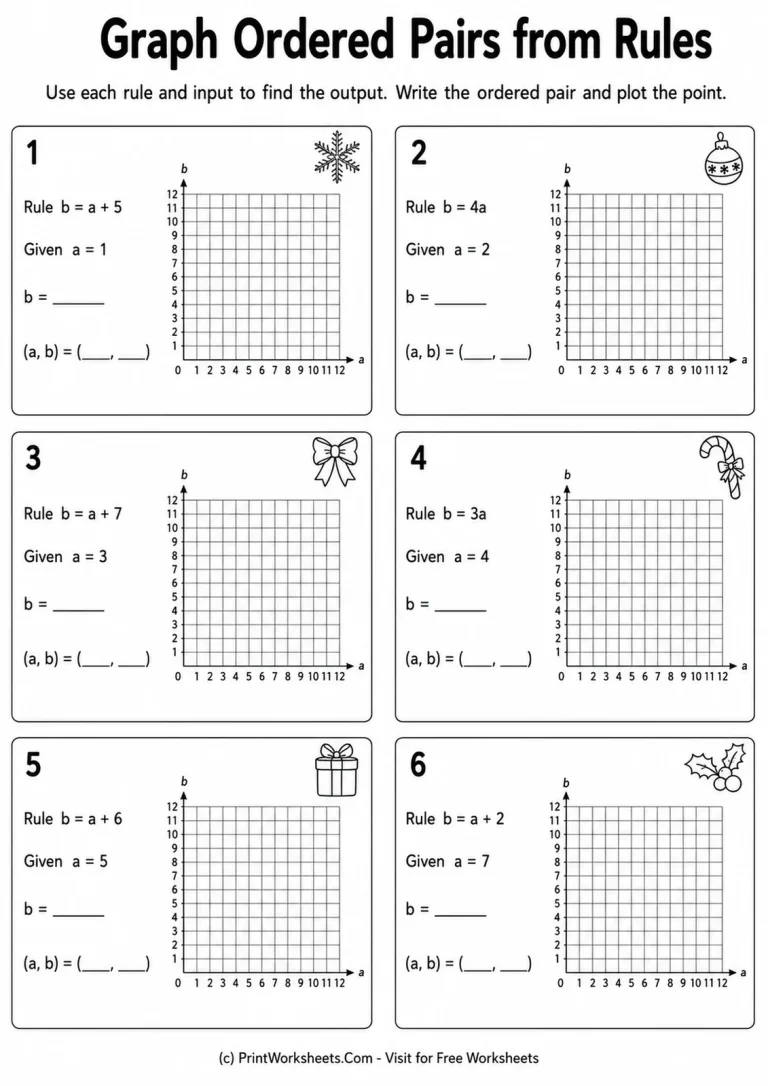
The first worksheet makes the relationship between a rule and a plotted point especially clear. Six problems provide a value for a and a rule for finding b. Students calculate the missing output, complete the ordered pair (a, b), and plot that point on a grid marked from 0 through 12. The rules include addition relationships such as b = a + 5, b = a + 7, b = a + 6, and b = a + 2, along with multiplication rules such as b = 4a and b = 3a.
This format helps students see that the first coordinate comes from the given input while the second coordinate is produced by applying the rule. Because students must complete both the calculation and the graph, the page checks more than arithmetic alone. A correct numerical answer still has to be placed in the correct horizontal and vertical position.
Matching Rules to Plotted Ordered Pairs
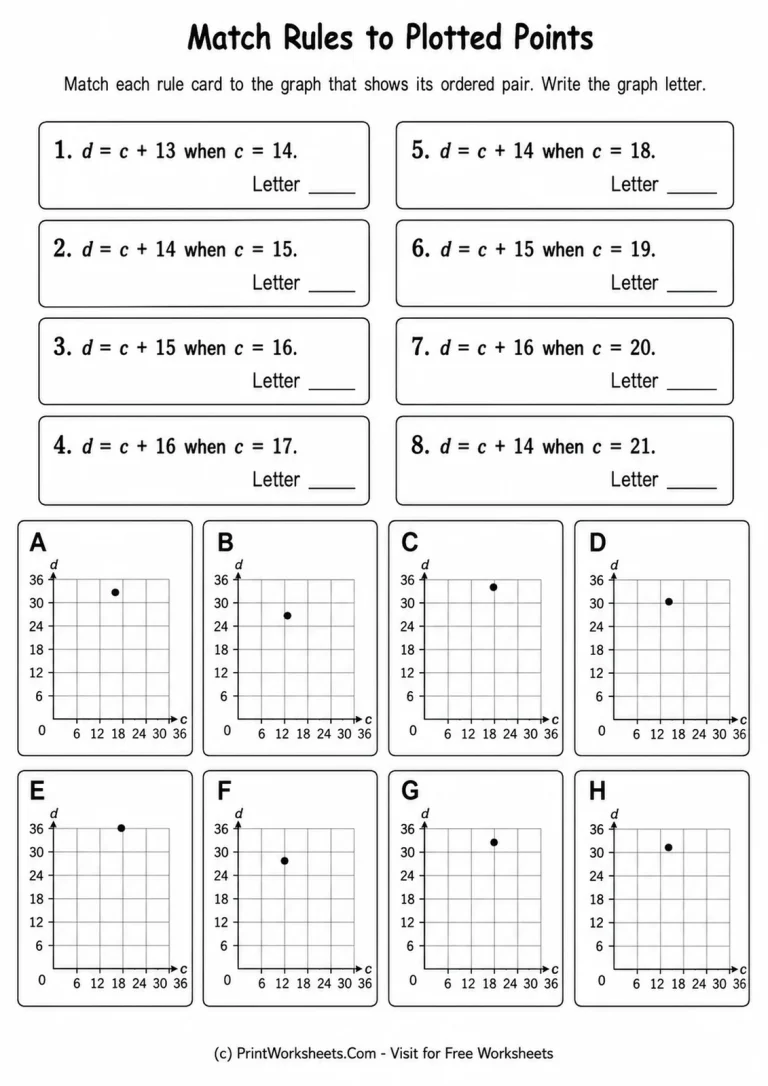
The next approved activity reverses the process. Students are given eight rule cards and eight coordinate graphs labeled A through H. Each rule uses a specified value of c to determine d. After finding the ordered pair, students identify which graph displays that point and record the graph letter.
The inputs run from 14 through 21, while the resulting outputs reach into the upper 20s and 30s. This creates useful practice with coordinates beyond the small single-digit grids students often encounter when first learning the coordinate plane. It also requires careful comparison: students must evaluate the rule correctly and then distinguish among several nearby plotted points rather than simply drawing one point on an empty grid.
From Calculation to Coordinate Interpretation
Together, the first two activities support two complementary skills. One asks students to generate and graph an ordered pair themselves; the other asks them to calculate an ordered pair and recognize its plotted representation. This difference makes the set useful for checking whether a student understands what the coordinates mean, rather than relying on one repeated worksheet routine.
Rule-Based Graphing in Holiday Word Problems
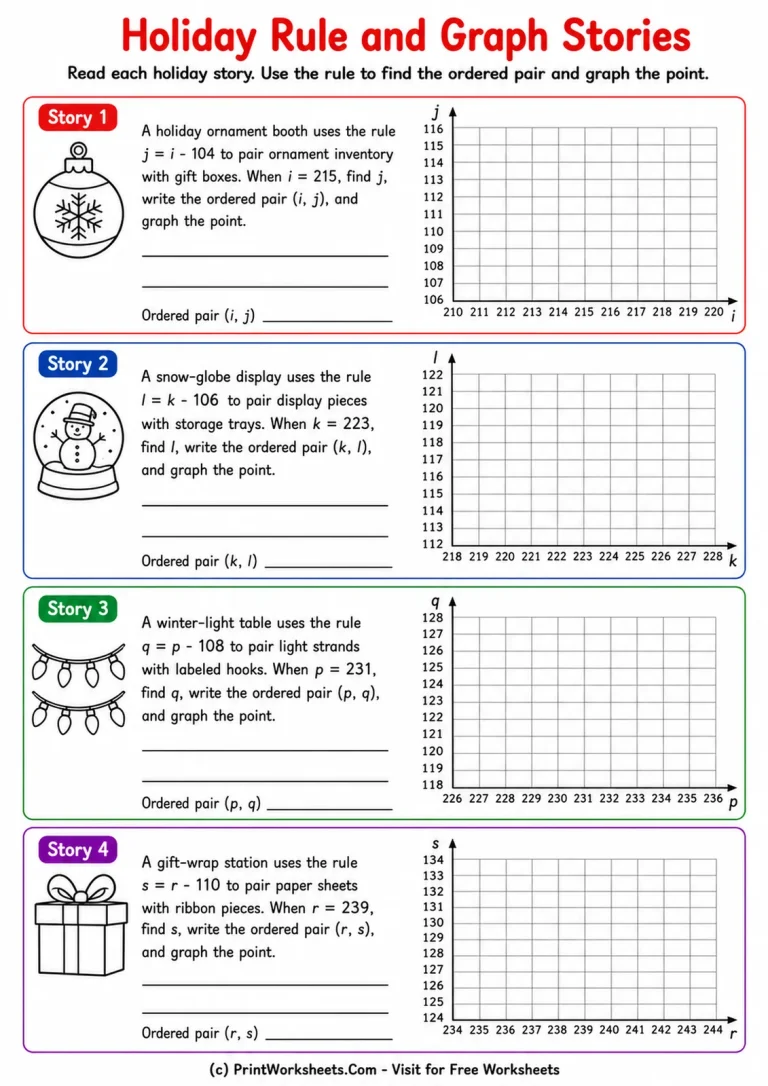
A third worksheet places the same mathematics inside four short holiday stories. The situations feature an ornament booth, a snow-globe display, winter lights, and a gift-wrap station. Each story provides a subtraction rule and a large input value. Students calculate the corresponding output, write the ordered pair, and plot it on a coordinate grid designed for that numerical range.
For example, the activities use rules based on subtracting 104, 106, 108, or 110 from inputs above 200. The resulting points include values such as (215, 111), (223, 117), (231, 123), and (239, 129). Working with these larger numbers encourages students to pay attention to axis labels and scale rather than assuming every graph begins at zero or increases through only small values.
How to Use These Grade 5 Coordinate Worksheets
The pages can be used as a short lesson sequence or as separate practice. A student who is new to rule-based graphing can begin with the direct calculation-and-plotting page, where every problem follows the same visible structure. The matching activity works well afterward because it removes the blank-grid routine and asks students to identify the correct representation among several choices. The holiday story page can then serve as an application task in which the rule is embedded in text and the coordinate values are considerably larger.
Teachers can also use the worksheets to identify different kinds of errors. If a student calculates the output incorrectly, the problem may be with substitution or arithmetic. If the ordered pair is written correctly but the point is misplaced, the issue may involve coordinate order, axis direction, or reading the scale. Parents using the pages at home can follow the same sequence: calculate the output first, say the ordered pair aloud, then locate the horizontal coordinate before moving vertically to the second coordinate.
A Focused Practice Set for Rules and Coordinates
This collection is especially useful when Grade 5 students are ready to connect numerical relationships with coordinate representations. The activities move beyond isolated point plotting by making each coordinate the result of a rule. With direct graphing, point matching, and contextual problems in one set, students get several ways to practice the same underlying idea: an input and its calculated output can be represented together as an ordered pair on a coordinate plane.